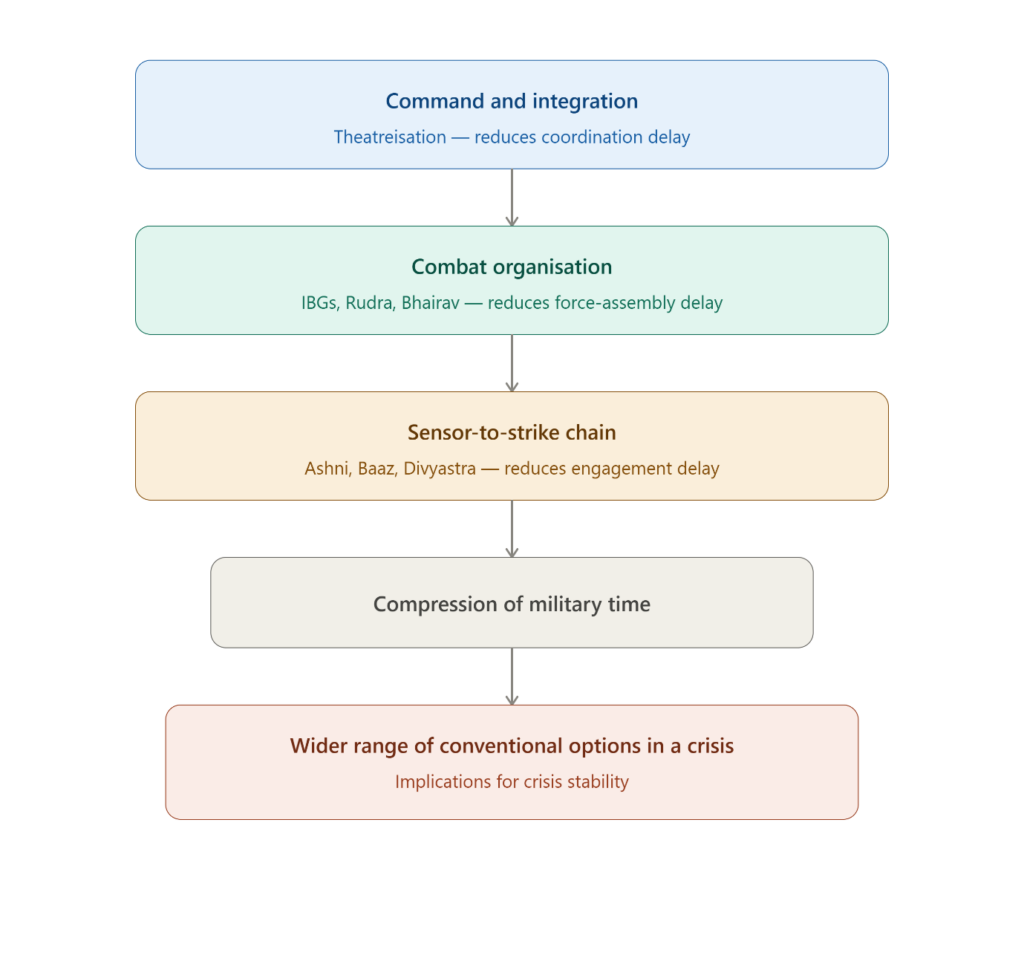
The shift of India’s military transformation from concept to structure is underway. The first Integrated Battle Groups (IBGs) are now operational, theatreisation proposals are in final government discussions, and 2026 is being pushed as the Year of Networking and Data Centricity, so what seemed like a series of separate enhancements looks now like a unified redesign. Theatreisation, IBGs, Rudra Brigades, Bhairav and Baaz Battalions and longer-range precision systems are all significant changes to the way the force commands, packages combat power, and turns information into effect. This shrinks the time gap between political decisions and military action across three interconnected layers – command integration (coordination delay); combat restructuring (force-assembly delay); sensor-to-strike integration (engagement delay). The primary concern for Pakistan is whether the reforms increase New Delhi’s capacity and capability to produce prompt and calibrated conventional effects in a crisis.
Command: Moving towards Integration
The theatreisation is the first layer, which seeks to move away from inter-service coordination to integrated operational command. The model distinguishes Raise-Train-Sustain from force-employment. Theatre commanders will have operational autonomy over their under command land, air, maritime and assets in assigned theatres.
It’s common practice around the world. Services coordinate, train and equip, and theater commanders exercise operational control. A similar approach is being followed by the United States, and China has also introduced theatre commands replacing military regions to enhance effectiveness of joint operations. India is seeking a comparable approach with plans centered on three theatres – one relating to China, one to Pakistan and one maritime. The proposal was developed following wide consultations by service chiefs and the CDS and is currently being considered by the Government.
Yet, it is not enough to simply redraw the command boundaries for jointness to be achieved. It demands joint planning, an integrated operating picture, joint logistics, coordinated air and long-range fires, and access to cyber, space, and electromagnetic capabilities. As demonstrated in Russia, new command posts are not enough to produce jointness. Advantage is only gained if the commands have real authority, information is reliable, scarce resources can move along axes. India is making command itself a source of speed, which embeds joint integration earlier in the operational timeline, reducing the Observe-Orient-Decide-Act (OODA) loop at the operational level.
Combat: Creating a Graduated Spectrum of Force
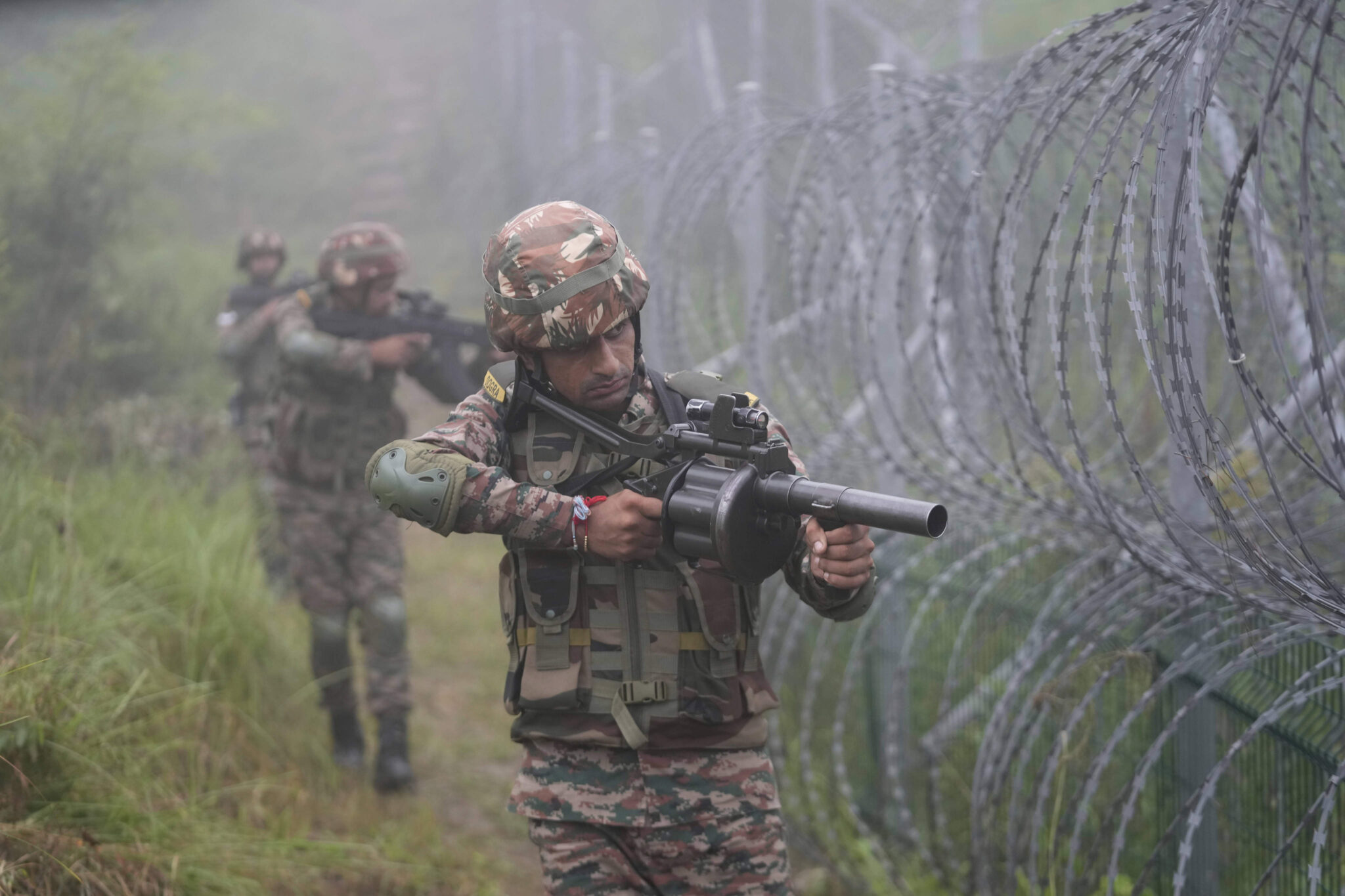
The second layer alters the formations in which the commanders can fight. IBGs, Rudra Battalions, and Bhairav Battalions sit at various ends of a spectrum of size, autonomy and mission. For rapid commitment and combined arms operations, IBGs deployed under formations like the XVII Mountain Strike Corps contain more than 5,000 personnel including infantry, armour, artillery, air defence, engineers, signals and their organic logistics.
Rudra Brigades operate at tactical level, as all-arms formations, with supporting arms and unmanned systems for multi-domain operations. Although they are dependent on higher echelons for sustained firepower and reinforcement, but still they can still deliver the initial punch on their own. The Indian army by mid-2025 had already converted two brigades and more were planned.
Bhairav Battalions are a unique category, each with a strength of about 200-250, to link Ghatak platoons and Special Forces units. By late 2025 the Army had already created the first five of the 25 planned battalions, providing brigade and divisional commanders with a force that they could use for raids, reconnaissance and limited offensive operations on short notice, without involving full conventional units or deploying scarce strategic Special Forces. There is a flexible range of force with this graduation. Now the operational commander has no longer to choose either between limited infantry probes but smaller special forces packages may be used during the initial stages, and backed up with heavier groups if needed.
Sensor-to-Strike: Distributing and Connecting the Kill Chain
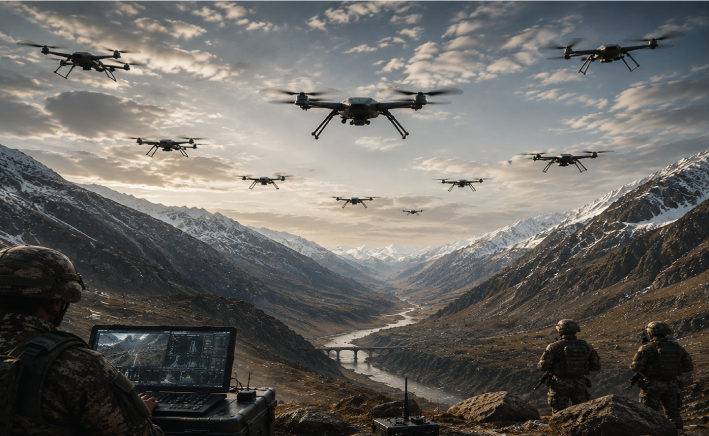
The third layer is to make it easier to get from detection to engagement. By October 2025, 380 infantry battalions had been equipped with Ashni drone platoons comprising 20-25 soldiers, armed with surveillance drones and loitering munitions, bringing organic sensing and strike capabilities to the tactical forefront. In parallel, echelons of artillery and aviation are being restructured. Divyastra batteries are to reinforce the traditional artillery with loitering munitions ISR and strike operations, Shaktibaan regiments are to focus on loitering munitions with greater range and Shaurya squadrons will provide early warning to armoured formations. The newly announced Baaz Battalions under the Army Aviation aim to provide persistent deep ISR, outside the tactical drone range. Horizontal integration is taking place as well as vertical distribution.
On command and Control (C2) side the tri-services has its own have integrated their respective systems including the Indian Army’s Akashteer air-defence system, , the Indian Air force Integrated Air Command and Command System (IACCS) and the Navy’s TRIGUN network, providing a real-time picture to the decision makers. .
Moreover, India’s designation of 2026 as the Year of Networking and Data Centricity reinforces this, focusing on fusing and sharing data across services and echelons. A networked system is designed to ensure that relevant data is instantly available to commanders who can then order the most suitable effect – artillery, loitering munitions, air power or electronic attack – without the delays of having to go through multiple layers of approval.
Implications for Pakistan
The main concern for Pakistan is whether India’s reforms expand New Delhi’s ability to generate calibrated conventional effects more quickly and precisely in a crisis, shrinking decision time and blurring the line between limited action and a wider conflict.
At the strategic level, rapid, graduated conventional action risks reducing crisis stability by lowering the perceived cost of limited actions and eroding the firebreak with the nuclear threshold. Pakistan’s full-spectrum deterrence (FSD), crisis-management channels, and strategic signalling require continuous refinement to ensure thresholds remain clear and decision-makers retain time under compressed timelines.
At the operational level, shorter Indian force-generation times and higher early precision effects pose the primary challenge. Pakistan must further enhance its resilient, dispersed command and control under disruption, strengthen the integration of air defence with ground and electronic warfare assets, and maintain the capability to shift reserves without depending on single nodes.
At the tactical level, units will face denser unmanned surveillance, loitering threats, and faster engagement cycles. Deepening decentralised execution, small-unit electronic camouflage, and organic counter-UAS training will ensure frontline forces can operate with less continuous higher direction while placing constant friction on opponent sensor-to-strike links. Across all levels, Pakistan’s approach must prioritise denying confidence in quick, controllable gains, ensuring any initial advantage in speed or precision is offset by higher costs, operational uncertainty, and credible counter-options.

This article was published by the Global Defense Insight in another form at https://defensetalks.com/three-layers-of-transformation-in-indian-army/


Syed Ali Abbas is Research Officer & Comm Officer at the Center for International Strategic Studies (CISS) Islamabad. He is also an MPhil scholar in the Department of Strategic Studies at the National Defense University (NDU) Islamabad.