Press Release
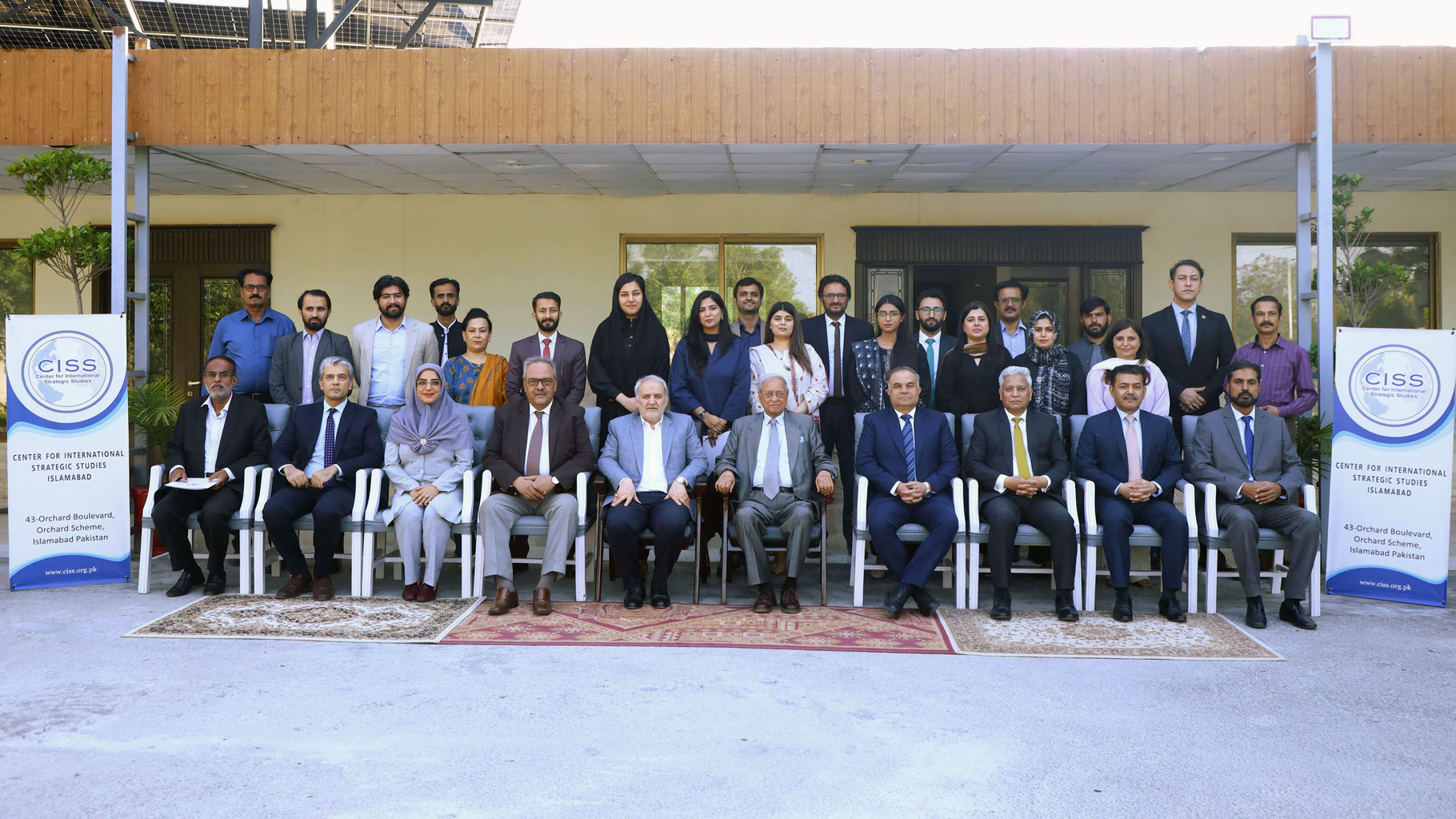
The Center for International Strategic Studies (CISS), Islamabad hosted a roundtable discussion with the Ambassador of the Islamic Republic of Iran, H.E. Dr. Reza Amiri Moghadam on the 6th of May 2026. The talk brought together diplomats, academics and practitioners to discuss the future trajectory of Pakistan-Iran relations and the broader geopolitical environment as the US-Israel war on Iran continues.
Beginning with his thoughts on Pakistan-Iran relations, the Iranian Ambassador Dr Moghadam extended sincere gratitude to Pakistan for its steadfast support during difficult times and mediating the talks between Washington and Tehran, highlighting the strong brotherly ties between the two nations. He reaffirmed that Iran will never allow its soil to be used against Pakistan, adding that despite maintaining relations with other countries, including India, Iran’s relationship with Pakistan remains a priority and continues to grow stronger.
He further said that Iran has consistently pursued friendly relations with all neighbouring countries. While suggesting that the recent war could significantly reshape the regional order, leading to a decline in US influence, the growing isolation of Israel, and the potential emergence of a new geopolitical alignment involving Israel, India, the United Arab Emirates (UAE), and Somaliland, at the same time, he noted that Pakistan-Iran relations have strengthened considerably, raising prospects for a new regional alliance comprising Iran, Turkiye, Saudi Arabia, Egypt, and Pakistan once the war ends.
Ambassador Asif Ali Khan Durrani, Pakistan’s former ambassador to Iran and the UAE, and former Special Representative on Afghanistan said that Chabahar and Gwadar ports should be viewed as complementary rather than competing assets, with Gwadar potentially serving as a mother port to support regional connectivity and trade integration. He underscored that Pakistan’s diplomatic approach indicates a simultaneous engagement with the United States while maintaining its brotherly ties with Iran. The approach, he emphasized, should not be interpreted as neutrality but a well-calibrated and deliberate diplomatic approach focusing on de-escalation, extending the ceasefire, and working toward a durable and permanent resolution to the conflict, while preserving regional stability and economic security.
Professor Dr Nazir Hussain, former Dean, Faculty of Social Sciences at Quaid-i-Azam University, said that Pakistan and Iran share deep historical and cultural ties, and both countries have made efforts to improve coordination, expand border trade, and strengthen institutional engagement in recent years. He further said that there is significant untapped potential for economic cooperation in areas such as energy, trade, and connectivity, with both countries increasingly viewing each other as important partners for regional stability and development.
Earlier in his welcome remarks, Ambassador Ali Sarwar Naqvi, Executive Director CISS, said that Pakistan played a constructive role in facilitating a ceasefire between the United States and Iran on 7 April 2026, followed by direct bilateral talks on 11–12 April after decades of estrangement. He maintained that Pakistan’s mediation efforts are ongoing following the extension of the ceasefire, and that Islamabad remains committed to supporting initiatives that promote regional peace and stability. In his concluding remarks, Dr Bilal Zubair, Director Research CISS stated that diplomacy, negotiations, and peaceful resolution remain the only viable path forward, and expressed hope that constructive engagement will lead to de-escalation and lasting peace and stability in the region.