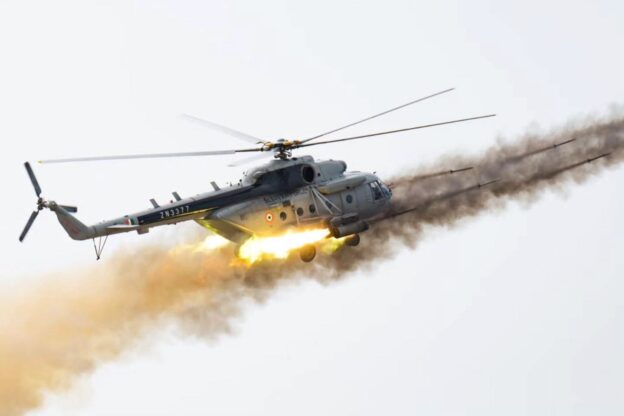
The Indian Air Force (IAF) concluded a week-long drill, Exercise ROTOR CLAP III, on 2 August at the Pokhran firing range in Rajasthan. The exercise was conducted to validate a key operational concept of shooting down unwarranted low-flying loitering munitions and drones. The article argues that the exercise is part of an attempt by the IAF to plug the loopholes exposed during Operation Sindoor, especially pertaining to the incursion of Pakistani drones deep into Indian Territory. This activity carries serious consequences for Pakistan, as it is linked to India’s attempt to establish a defensive shield against airborne objects, as evidenced by New Delhi’s pledge to operationalize Mission Sudarshan Chakra.
As its name suggests, it is not the first edition but the third, conducted by the IAF using its rotary assets to take out drones since India launched Operation Sindoor last year. This was not a usual activity for the IAF but rather a novel attempt to test and validate new warfighting tactics, techniques, and procedures, with a central focus on shooting down slow-moving airborne targets. The exercise involved rotary-wing platforms from the IAF fleet, including Apache, Prachand, Mi-25/35P, Rudra, and Mi-17V-5.
It was held under the aegis of the IAF South Western Air Command, which saw the activation of its units at forward operational bases in Rajasthan, bordering Pakistan. The air rotary maneuvers were conducted there because both Prachand and Apache helicopters are deployed in different air stations and aviation bases in Rajasthan. Apaches of the IAF have been deployed at the IAF Jodhpur air station since 2022, while Apaches are with the 451 Army Aviation Squadron based in Jodhpur.
The field activity suggests it could be a broader part of the Sudharshan Chakra Mission and serve as its airborne leg to intercept and neutralize aerial objects. This could be the case because rotary platforms have demonstrated in recent conflicts that they are as effective as other defence systems at shooting down intruding aerial objects. For instance, the Israeli Air Force Apache helicopter shot down six drones in a couple of minutes during the 2025 12-day Iran-Israel war. As India has close and strategic cooperation with Israel, it is a strong possibility that the IAF may have approached the Israeli Air Force for assistance as well.
A key question arises as to whether India has sufficient numbers of helicopters to carry out the task of tracking and shooting down airborne drones and loitering munitions. The backbone of the Indian helicopter fleet would be the indigenously developed Prachand. The IAF and Indian Army Aviation Corps have 10 and 5 Prachand helicopters in service, respectively. In the future, 156 additional units will be inducted into the fleets of both services. Out of 156, 66 will be supplied to the IAF and 90 to the Indian Army. These 156 helicopters will be delivered by 2032. The order could be completed earlier as well, as Hindustan Aeronautics Limited (HAL), the original manufacturer of Prachand, has partnered with Adani Defense Systems and Technologies Limited and Bharat Earth Movers Limited (BEML) to boost its annual production.
Likewise, Rudra will also be used for drone interdiction missions, as it has already been inducted in large numbers by both the IAF and the Indian Army. The IAF has one operational squadron and is expected to induct three more, whereas the army has around 75 of them across five operational aviation wings. In addition, both services have 28 advanced Apache helicopters in service: 22 with the IAF and 06 with the Indian Army. The number will likely increase in the future, as India has already retained the capability to produce parts of the Apache, including its key component, the fuselage.
ROTOR CLAP III specifies that the Sudharshan Chakra Mission’s scope has expanded beyond a ground-based air defense shield. It now also entails using helicopters to interdict drones and loitering munitions. The exercise also envisages that rotary platforms capable of flying low to evade even low-level radars can perform these missions in proximity to the border with Pakistan. It is not as cost-effective a means to interdict low-cost drones as using ground-based air defense guns or jammers; however, it is far less expensive than firing costly missile interceptors. All this points to New Delhi seeking to increase its options and expand its horizons to intercept a wide range of airborne threats as part of a wider air defense doctrinal recalibration in response to limitations encountered during Operation Sindoor.
Amid rapidly changing regional and global dynamics, India’s Pakistan-specific military maneuvers, to the extent of using new tactics earlier employed by Israel against Iran, are a sign of concern. India has a strategic partnership with Israel, so the possibility cannot be ruled out that the IAF may have received assistance from the Israeli air force in the preparation and execution phase of ROTOR CLAP III. This could be the case, as Israel has a history of supporting the IAF to enhance its warfighting tactics, as evident from its timely support during the Kargil War. Likewise, the possibility seems more probable because India has also been aiding Israel’s war effort, as evidenced by a newly released report by Amnesty International. To counter the IAF’s growing novelty, Pakistan needs to adopt new strategies and tactics to counter the IAF’s evolving tactics. First, Pakistan should induct high-speed loitering munitions, with speed exceeding Mach 0.5, as at this velocity it will be difficult for helicopter-based interdiction by the IAF. Second, to engage Indian rotary platforms that might come close to the border, Pakistan can close the low-level radar detection gap that the former seeks to exploit by deploying advanced long-range electro-optical sensors that do not rely solely on line-of-sight radar horizons, along with additional low-level radar deployment. Last but not least, the Pakistan Army and Air Force should conduct joint exercises to develop a joint strategy to counter the IAF’s evolving tactics, thereby enabling them to uphold conventional deterrence at the tactical level.
This article was published by The Diplomat in another form at https://thediplomat.com/2026/08/exercise-rotor-clap-iii-and-mission-sudarshan-chakra-options-for-pakistan/


Abdul Moiz Khan is Research Officer at the Center for International Strategic Studies (CISS), Islamabad.