The international nuclear order has been transforming, witnessing both vertical and horizontal proliferation. Arms control arrangements have already been dismantled with the breakdown of New START between Russia and the United States (US) on 5 February 2026, and after the Iran-US war in the Middle East, the trust deficit has widened among NATO member allies regarding US security commitments. Moreover, the predatory approach of the Trump administration regarding the threat of annexation of Greenland from its NATO member ally, Denmark, engenders doubts among European NATO allies regarding the reliance on the US security guarantee. For eighty years, the security of European NATO allies has rested on a commitment made by the US, which entails that an attack on one ally would be regarded as an attack on all. The commitment was backed by the full force of the American nuclear arsenal. However, this commitment has begun to fray at the edges given the uncertainties in the global nuclear order. Against this backdrop, President Emmanuel Macron, on 2 March 2026, announced that France will not only increase its nuclear arsenal but will also permit its European allies to host French aircraft as part of a renewed nuclear deterrence strategy. Paris has also decided to stop publicly disclosing the size of its arsenal. With this shift in nuclear doctrine of Paris, France has signalled an openness to a European dimension.
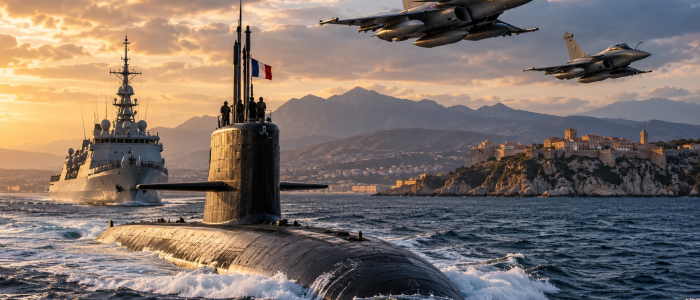
According to the French President, this shift in French doctrine aspires to reinforce Europe’s security amid uncertainty in transatlantic relations, given the Trump administration’s softer approach towards Russia and tougher stance on allies. To enhance Europe’s role in strategic deterrence, President Macron invited European states like Poland, Greece, the Netherlands, Belgium, Germany, Sweden, and Denmark to participate in nuclear wargames and exercises. Under the “forward deterrence doctrine,” President Macron announced plans to station nuclear-capable Rafales on the territory of willing European allies. However, the launch decision remains intact under the authority of the President of France. At the Munich Security Conference in February 2026, the German Chancellor Friedrich Merz vowed to strengthen deeper nuclear cooperation with France, announcing that we simply must become stronger together in nuclear deterrence in Europe. He further confirmed coordination between the France-Germany nuclear steering group, which can be observed from the participation of conventional German forces in French nuclear exercises. In a similar manner, the Prime Minister of Poland has further added that Poland is actively engaged in consultations with France and other European allies on advanced nuclear deterrence.
However, without binding security commitments and a shared decision-making mechanism, French nuclear cooperation may complement but cannot fully replace the US nuclear umbrella.
Though Paris maintained a doctrine of strict sufficiency, President Macron announced an increased number of warheads from the existing stockpile of 290 submarine-and air-launched weapons. France already spends $6.04billion yearly on maintenance of its nuclear stockpile, making it the fourth-largest nuclear power after the US, Russia, and the UK. While maintaining nuclear decision-making under the authority of the French President, Macron announced that Paris will ensure transparency with Washington and coordination with NATO’s nuclear mission to remain intact. Such a transition in French nuclear doctrine highlights Europe’s intent to augment collective defence amid changing geopolitical realities and intensifying uncertainty over transatlantic US security guarantees.
European security thinking has been unsettled during President Trump’s second presidency. The US 2026 National Security Strategy explicitly puts responsibility on European NATO allies for their defence, with limited but critical assistance from the US. With this shift in the US strategy, the conventional burden from the US has been shifted towards Europe; however, the collective defence obligations remain intact as enshrined under Article 5 of NATO treaty obligations.
Germany, too, has announced that it will continue to abide by the obligations of the Nuclear Non-Proliferation Treaty. Berlin pursues a calibrated approach, as Merz maintained they do not intend to create zones of differentiated security. Although Berlin wants to cooperate with France, it is not ready to depend entirely on Paris for its security. Like Germany, France has also signed the Northwood Declaration with Britain in 2025. Under this declaration, both states aspire to foster nuclear cooperation with joint submarine patrols and shared strategic planning. This cooperation links two independent nuclear-powered states in Europe for the first time. Poland has also expressed its interest in preparing Warsaw for autonomous actions in the nuclear domain. Other NATO member states like the Netherlands and Belgium, which already host American B61 bombs, have expressed a desire to join the French framework to supplement its deterrence. Moreover, such a shift in France’s nuclear doctrine erodes the efficacy of the Global Nuclear Non-Proliferation architecture that rests mainly on US security commitments and European extended deterrence to non-nuclear states in exchange for commitment to shun nuclear aspirations. However, the operationalisation of forward deterrence remains vague, rendering the French President’s speech symbolic. Paris has not offered any guarantee under a formal treaty, and it does not have any intention to dilute its sole authority over the launch decision. Paris aspires to shun a shared-decision arrangement, avoiding transformation of France’s deterrent into a collective one. Conclusively, France’s forward deterrence strategy reflects Europe’s growing determination to reduce its dependence on American security guarantees amid an increasingly uncertain transatlantic relationship. However, without binding security commitments and a shared decision-making mechanism, French nuclear cooperation may complement but cannot fully replace the US nuclear umbrella. The real test of this emerging framework will be whether it can strengthen European strategic autonomy without accelerating nuclear proliferation and further eroding the global non-proliferation regime.
This article was published by the Centre for Strategic and Contemporary Research (CSCR) in another form at https://cscr.pk/explore/themes/defense-security/french-forward-deterrence-in-european-nuclear-security/


Ms Nawal Nawaz is Research Assistant at the Center for International Strategic Studies (CISS), Islamabad.