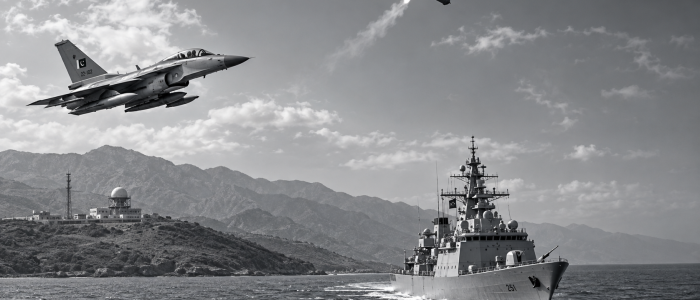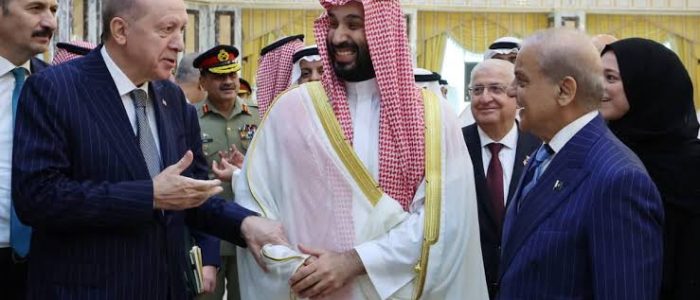
On Aug 7, Pakistan, Turkiye, and the Kingdom of Saudi Arabia (KSA) signed a mutual defense agreement, committing the three nations to treat “an armed attack against one as an attack against all”. The significance of the Mecca defense pact can be gauged from the fact that this trilateral defense pact brings together a leading oil-exporting nation- KSA- NATO’s second-largest army-Ankara, and the only Muslim nuclear-armed state- Pakistan, spanning the three countries across the Middle East, South Asia, and Europe. Together, these three armies form a sizeable military bloc, combining nearly 1.4 million active military personnel, 3400 aircraft, 6000 tanks, and more than 340 naval assets, consolidating the defense pact as the most significant geopolitical development influencing the strategic landscape of the Middle East and beyond. All the parties to this trilateral arrangement commit that the pact is not against any country and that the nature of the agreement is purely defensive, serving solely as a deterrent against external aggression and open to other brotherly states seeking regional peace and security.
Islamabad and Riyadh had already signed a Strategic Mutual Defence Agreement last year, and with the inclusion of Turkey, the bandwidth of the alliance has been widened, augmenting the collective strength of these three states into a formidable force in the region. At the heart of this tri-lateral defense agreement lies the complementary strength of Saudi’s capital, Turkiye’s technological advancement and Pakistan’s outstanding military power, placing collective defence at the centre of this tri-lateral arrangement. Though the Turkish Foreign Minister described the mechanism of the mutual defense agreement as technically comparable to Article 5 of NATO; however, there is no provision in this framework that automatically translates military commitment of the sort people often imagine when they think of “NATO”.
Though it remains silent on the question of where the common threat lies. The provision that “an attack against any member state amounts to an attack against all” reflects the perception that the alliance has taken the form of Islamic NATO. This proposition lacks any solid ground for its justification; in case of a war between Pakistan and India, there is no arrangement that compels other members of this tri-lateral pact to come in defense of Pakistan. The Mecca Defense Pact is celebrated as strategic hedging rather than a meaningful military pact. To mitigate the risk of entrapment, the three states kept operational execution vague while omitting a mechanism for an automatic military response; By doing so, these states aspire to minimise abandonment while retaining the autonomy to decide their level of involvement.
It is not justified to call the Mecca agreement a military bloc like NATO, as blocs derive their significance through an identifiable strategic competition: they consolidate one group of states at the expense of other states in relation to one another. All the member states of the Mecca agreement intentionally avoided giving this strategic character to the defense arrangement. Even Islamic NATO does not appropriately describe this sort of arrangement. NATO is not merely about the mutual-defense clause; it stands as a deeply institutionalized military architecture which has been built around the pillars of planning, command structures, interoperability, and an historical strategic adversary. Mecca agreement should be taken as aiming to establish collective deterrence, without wedging a new geopolitical division line. More than the arithmetic of tanks and aircraft, the trilateral defense pact reinforces strategic reassurance within the three partners while accentuating the costs and uncertainty associated with aggression against any one of them.
Mecca agreement reiterates the fact that in a multipolar order, great powers are not losing their significance; however, the middle powers are becoming reluctant to outsource their security to these influential powers. Through the Mecca agreement, three states aspire to establish deterrence without requiring an enemy to define it.
The question of what compelled these three states to sign this agreement grabs the attention of the international community. After the erosion of the US security assurances in West Asia, Gulf States had realized the need to transform their security and development model away from the US, grounding it in taking greater responsibility for their own security frameworks. On Sep 9, 2025, Israel, the closest ally of the US, attacked Qatar, which hosts the largest US military base in the region with ballistic missiles, questions credibility of the US security commitment to its Gulf allies. Likewise, the five-month Iran-US war has eroded the security architecture in the region, forcing Gulf allies to reconsider decades of conventional wisdom grounded in the US military supremacy.
The defense pact has been welcomed by most of the Arab countries, including Bahrain, Kuwait, and Somalia. In addition to Gulf states, the Organization of Islamic Conference (OIC), a 57-member states group, has also hailed this initiative. Iran welcomed the initiative and the expansion of this alliance, and Turkiye expects Egypt to be the next state joining this initiative. However, tensions between Riyadh and the UAE escalate, with prominent Emirati and Saudi voices publicly clashing over the kingdom’s decision to pursue a new regional security partnership beyond the Gulf Cooperation Council (GCC), which includes energy-rich monarchies of Bahrain, Kuwait, Oman, Qatar, Saudi Arabia and the United Arab Emirates. Kingdom of the Emirate aptly pointed out the rationale behind signing this accord, pointing out that the success of any agreement hinges on the common enemy, and in the case of the Mecca agreement, there is no common enemy. Nevertheless, Turkish Foreign Minister Hakan Fidan clarified that the new strategic triangle is not signed against a common enemy and targets no specific state, stating the agreement is more of a signal that three states would stand shoulder to shoulder in the face of common security threats to restore balance in the region. After the failure of the GCC in implementing a joint security strategy after the Israeli attack on Qatar in 2025, this trilateral strategic pact became a necessity for deterring Israel in the region. Therefore, in the absence of security guarantees from the US in the region, there is a need for an alternative security framework; though the Mecca agreement cannot work as a substitute for the GCC or American security partnerships, the agreement could help synchronise strategically compatible smaller states. Both in terms of operation and legality, the agreement needs to work on its institutional depth, unified command structures, joint military planning and integrated logistics that form the core of a functional collective defence alliance. With the joining of more states, this trilateral strategic arrangement could grow into a wider, regionally owned security platform assuring sustainable and holistic regional security architecture for West Asia.
This article was published by the Centre for Strategic and Contemporary Research in another form at https://cscr.pk/explore/themes/defense-security/mecca-defence-pact-and-the-question-of-an-islamic-nato/


Ms Nawal Nawaz is Research Assistant at the Center for International Strategic Studies (CISS), Islamabad.