Abstract

The establishment of integrated military theatre commands in India is a significant restructuring of the country’s defence forces, with tangible consequences for Pakistan’s security. The reform will bring the integration of the Army, Navy and Air Force into Joint Command Forces that can operate fast and on multiple domains, on the basis of previous ideas like the Cold Start doctrine and the Integrated Battle Groups (IBGs). The developments are potentially destabilising because they compress the traditional response time, reduce the time limit for crisis decision-making and enhance the risk of limited military response under the nuclear overhang scenario for India. By enabling faster and more coordinated offensive options, India’s Theaterisation deepens Pakistan’s security dilemma and raises concerns about rapid, limited strikes that could exploit reduced warning time. The paper discusses the implications of Indian theatre commands for deterrence stability in South Asia. It argues that Pakistan will likely respond with enhanced inter-service integration, better intelligence, surveillance and reconnaissance (ISR) and continued evolution of its Full Spectrum Deterrence posture, to deny India the space for limited war. The methodological approach used in the study is qualitative analysis, which is based on official statements, institutional reforms, public statements, and open-source strategic assessments. The analysis finds that while India is moving toward greater operational efficacy and jointness, Theaterisation may also raise crisis instability, quicken escalation risk, and further complicate the strategic stability in South Asia.

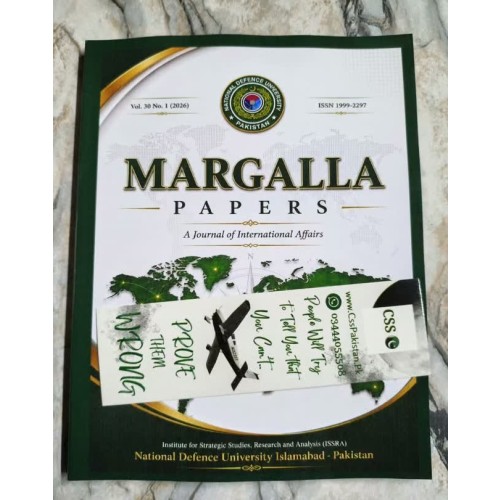
This resarcher paper was published by the Institue for Strategic Studies Research & Analysis (ISSRA) in Margalla Papers 2026 Vol.30 No.1 and can be read at https://margallapapers.ndu.edu.pk/index.php/site/article/view/376

Syed Ali Abbas is Research Officer & Comm Officer at the Center for International Strategic Studies (CISS) Islamabad. He is also an MPhil scholar in the Department of Strategic Studies at the National Defense University (NDU) Islamabad.

Share.

Comments are closed.

Mr Syed Ali Abbas

Research Officer/ Comm Officer/ Managing Editor CISS Insight

Syed Ali Abbas is a Research Officer/Communication Officer at the Center for International Strategic Studies (CISS), Islamabad. Previously, he served as an associate editor at Indus News Network. His areas of interest include Middle East politics, military modernization, foreign policy, and nuclear politics. He has contributed to various platforms, including The National Interest, South Asian Voices, and others.

Dr Anum Riaz

Associate Director Research

Dr. Anum Riaz is the Associate Director Research at the Center for International Strategic Studies, Islamabad. She holds a Ph.D. in Political Science from the Department of Political Science at Bahauddin Zakariya University, Multan. She also possesses M.Phil. and M.Sc. degrees from the Department of Defence and Strategic Studies at Quaid-i-Azam University, Islamabad. Additionally, she has taught BS and Master’s students at the Department of Political Science at Bahauddin Zakariya University, Multan. Her areas of interest include strategic studies, international relations, international nuclear politics, the nuclear non-proliferation regime, arms control and disarmament, as well as traditional and non-traditional security issues.

Dr Bilal Zubair

Director Research

Dr. Bilal Zubair has worked as an Assistant Professor at the National Defence University Islamabad and Lecturer at the National University of Science and Technology. He holds a Ph.D. and M. Phil. in International Relations from Quaid-e-Azam University, Islamabad. Dr. Zubair is author of the book Chinese Soft Power and Public Diplomacy in the United States (Palgrave Macmillan, 2024) and contributed to several journal articles and book chapters focusing on soft power, diplomacy, and China’s role in international relations.

His research has been published in various academic journals, and he has presented at international conferences Dr. Zubair has also been an active reviewer and editorial board member. His professional interests include great power politics, and the role of communication in global diplomacy.

Mr Mobeen Jafar Mir

Research Officer

Mobeen Jafar Mir is a Research Officer at the Center for International Strategic Studies (CISS), Islamabad. His research focuses on U.S. foreign policy, particularly in the areas of strategy, technology, and arms control. He is currently pursuing an M.Phil. in International Relations at the School of Politics and International Relations, Quaid-i-Azam University, Islamabad. He can be found on Twitter @jafar_mobeen.

Exit mobile version