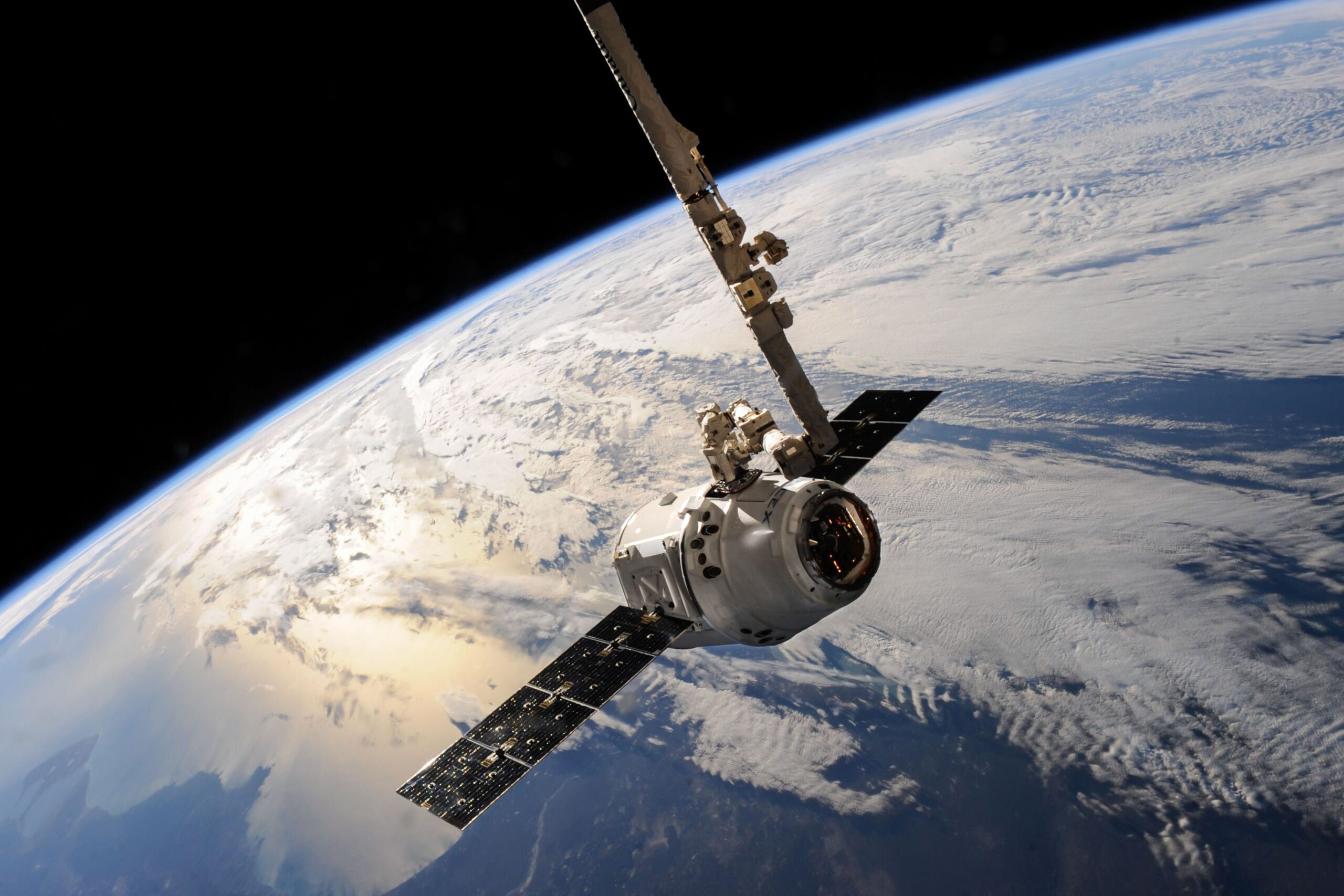
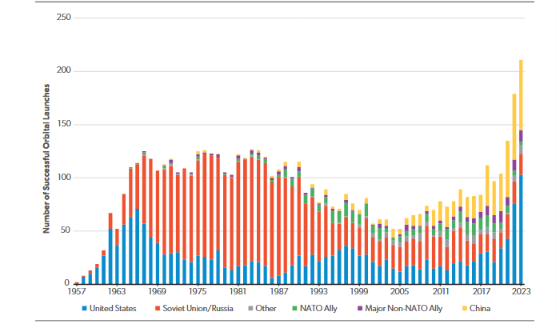
For most of the Space Age, orbit was the exclusive province of superpowers, the US and USSR, during the Cold War era. Now, it has become a marketplace with many commercial actors. “Third Space Age” is characterized by the commercialization of space after the invention of reusable rockets and mega-constellations. In 2025 alone, the countries attempted 329 orbital launches and deployed 4,522 satellites, an eightfold increase from the 580 satellites launched in 2019. Commercial companies carried out roughly two-thirds of that total, with governments launching directly only 99 times. This is not simple stats; instead, it is a structural revolution that is reshaping the security architecture of space faster than international law can follow. A single company is dominating the launch industry because of its reusable rockets. According to Jonathan’s Space Activities Report 2025, (a credible source tracking space objects and releasing an annual report since 2014), 182 launches of the US in 2025, 165 were SpaceX Falcon 9 missions. The number comprises more than that of China (92), Russia (17), and Europe (8) combined. The US deployed 3,725 satellites that year, China deployed 371 and Russia, 87. SpaceX is the engine of that dominance.By December 2025, SpaceX had launched 10,801 Starlink satellites, with 9,399 operational, making up 58% of all working satellites in orbit and 66% of the 14,132 active satellites tracked worldwide. The global space economy, now valued at nearly $626 billion with a 78% commercial share, is projected by the World Economic Forum to reach $1.8 trillion by 2035. Cheaper and more frequent access to space has drawn in new commercial actors into space for services such as Earth observation, in-orbit servicing, and eventually mining and manufacturing. It has completely overturned the old assumption that states hold a monopoly on reaching orbit.

Commercialization of space has many security implications at the international level. Firstly, it has challenged states monopoly in outer space. Now, commercial actors play a consequential role in outer space politics. Secondly, there is a clear fusion of commercial and military space infrastructure. The most notable incident happened during Russia’s February 2022 invasion of Ukraine. SpaceX deployed Starlink terminals within days, and the network quickly became a warfighting tool rather than a support service. Starlink provided imagery to Ukrainians that enabled battlefield communications, drone navigation, and artillery-targeting coordination. A Russian foreign ministry official threatened to attack commercial space systems like SpaceX and said that commercial satellite systems “may become a legitimate target for retaliation.” SpaceX participation in war and Russian response highlighted private space systems as legitimate military targets under certain conditions and blurred a line that international law never anticipated.
The US formalized this blurred distinction of private and state actors. The Pentagon’s 2024 Commercial Space Integration Strategy showed its commitment to integrate private space capacity directly into national security architecture. This strategy declares that there is the possibility of using military force to protect commercial operators in conflict. Within two years, 2024-2026, 13 batches of Starshield satellites were launched under the National Reconnaissance Office (NRO), built on the Starlink design. In 2025, the US launched 150 defense-classified satellites, 43 for China and 18 for Russia. Commercial space has become a principal delivery mechanism for national security purposes, without any accompanying international framework establishing how such assets should be treated, protected, or attacked.
States are also mindful of protecting their spatial data and sovereignty amid intensifying commercialization of space. States are not perceiving commercial space actors as benign and peaceful; rather, they are cautious about surveillance and data sharing through commercial actors. One such notable incident occurred when Iran filed a complaint against SpaceX Starlink in the International Telecommunication Union (ITU) for unauthorized operation in Iran. In 2023 and 2024, ITU gave rulings in Iran’s favor. Iran has also blocked unauthorized Starlink signals in early 2026 during a protest. Another notable incident was when India withheld the final security clearance and approval for Starlink to operate in India. It is a reaction to the use of unauthorized Starlink satellites during the ongoing US-Israel war on Iran. These events highlight increasing consciousness of states regarding the military role of commercial actors in space.
Commercialization has a direct physical hazard impact as well. Outer space is becoming congested with an increasing number of satellites and actors. Reusable rockets have reduced the cost of launch, which has accelerated the rate of satellite deployments, increasing congestion. More satellites are orbiting Low Earth Orbit (LEO), which increases the chances of collisions. According to the European Space Agency’s (ESA) Space Environment Report, LEO debris density has reached a critical threshold after a 20% increase in collision risk. Thus, private space actors in outer space have augmented the probability of Kessler’s syndrome, a hypothetical scenario where the density of objects in low Earth orbit (LEO) becomes so high that a single collision triggers a runaway chain reaction.
The legal architecture governing all of this dates to 1967. The Outer Space Treaty (OST) declares space the “province of all mankind” and bars weapons of mass destruction from orbit. Still, it was written for a world of two spacefaring governments and not thousands of private satellites, a single company’s mega-constellation, and a defense establishment that now depends on that company to fight wars. None of these argue for a retreat from commercialization; they argue for governance catching up to the needs of the third-space age.
States need to address the modern-day challenges of outer space with a multipronged approach. First, states shall modify the OST with an instrument addressing private operators directly (limitations, rights, and disposal standards). Second, states need to build binding orbital traffic-management rules among major spacefaring states, rather than waiting for full UN consensus. Third, states shall establish a clear, agreed process for classifying commercial satellites drawn into military use, so it is easy to improvise rules of engagement in real time. In a nutshell, space is no longer an arena for states only. Non-state actors are also playing a significant role by providing services to states. Innovation and reduced costs are at the core of the functioning of the non-state actors. Some states relegate security tasks to these companies; others feel a security dilemma and consider private actors as offensive. The situation has outgrown the existing space governance framework. There is a need to evolve space laws according to the increasing diversity of space actors and their complicated role.
This article was published by the Strafasia in another form at https://strafasia.com/third-space-age-profit-power-and-the-perils-of-commercializationareesha-manzoor-1786965743695


Areesha Manzoor is Research Assistant at the Center for International Strategic Studies (CISS), Islamabad.