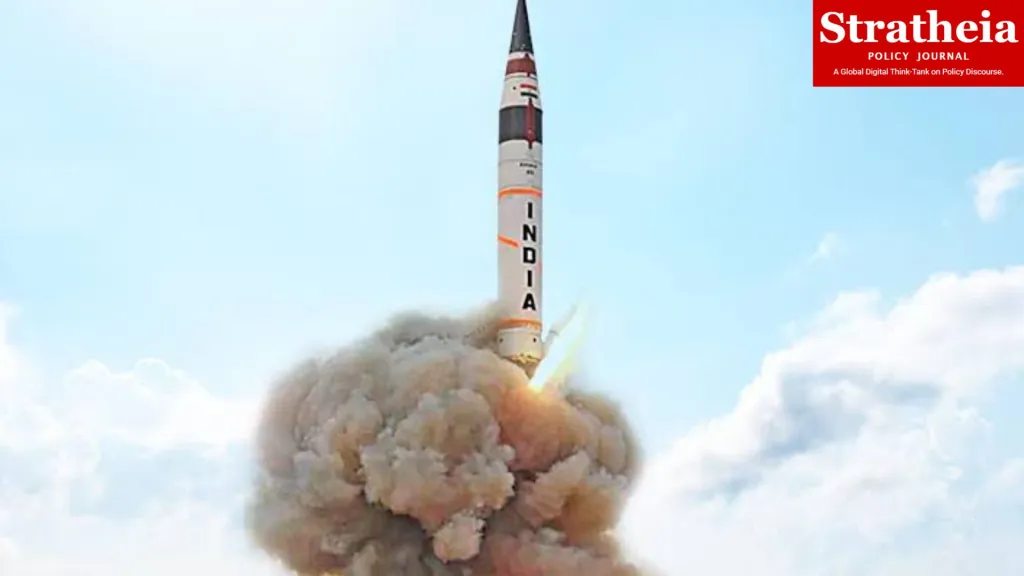
India’s missile program is one of the main elements that determines its strategic ambition. Its missile’s inventory is developing rapidly over the past decades. Agni-VI marks as the latest initiative that has sparked debate among strategists and scholars across the global about India’s strategic design.
Nonetheless, the Agni-VI has yet to be officially tested, it is assumed as an Intercontinental Ballistic Missile (ICBM) with range between 10000 to 12000 kms. The question is, whether India has developed this capability? Why does India develop a missile system that does not align with its strategic necessity? What are India’s intentions in developing such capabilities?
Recently, Indian Defense Minister Rajnath Singh was asked by a reporter about an Agni-VI missile test. The minister responded with a cryptic smile, stating, “Be patient. Everything will turn out well.” Importantly, he neither confirmed nor denied the reports. His response was significant because he chose not to dismiss the speculation outright.
This ambiguous reply has fueled assumptions that the Agni-VI project remains active and may be progressing discreetly. It created the impression that the Agni-VI program does indeed exist, although questions remain regarding its current stage of development and whether it is ready for testing.
There are several reasons to suggest that the Agni-VI program is not merely speculation but a reality under development. First is the testing of advanced propulsion systems related to India’s next generation submarine launched ballistic missile programs, especially the K-series missiles. The development of K-series missiles faces many technical complexities as compared to the land-based systems in the context of environmental factors, launching constraints, and space limitations.
However, India had successfully manufactured the K-series missile by showing significant progress in overcoming a number of technological barriers such as advanced propulsion, guidance systems, and MIRV integration. All of these technologies could be adapted for a land-based missile such as the Agni-VI system.
Second, there is another indicator that indicates the notion that India might have acquired or is about to acquire the Agni-VI system. The recent Agni-V tests showcased erratic flight trajectory, maneuvering behavior, and enhanced precision. Some analysts perceive these features as conceivable indicators of post-boost vehicle testing; the technology which is responsible for deploying Multiple Independently Targetable Re-entry Vehicles (MIRVs). These technological developments are believed to be a harbinger of more advanced strategic missile systems such as Agni-VI.
Third, India’s rail-mobile Agni-V test, which could be considered as a potential reason that India is preparing the necessary infrastructure and operational mechanisms could be related to Agni-VI in the future. Rail mobility is particularly effective for a large number of ICBMs as it increased survivability and concealment.
Large missiles like Agni-V and Agni-VI could encounter operational constraints while launching from a land-based platform. Whereas railway infrastructure is capable of supporting significantly larger payloads. Therefore, the accumulation of technological, operational, and political capabilities signifies that India continues to invest heavily in advanced strategic programs such as Agni-VI.
The Agni-VI will be the most advanced and sophisticated production of India’s defense industry to date. It would be more survivable, and capable of penetrating into the enemy’s heavily defended airspaces.
The most advanced the world include the US’s THAAD, Russia’s S-500, and China’s HQ-19. These systems are capable of intercepting missiles at multiple stages of flight, and making the ballistic missile trajectory vulnerable.
Agni-VI is said to have advanced penetrating capability, enabling the interceptors to bypass, dodge, and overrun the incoming missile grid. This embodies a significant development from the past generation of missiles that hinged primarily on speed and altitude.
India’s missile program was designed to counter threats from China and Pakistan. Although India’s existing missile capabilities possess sufficient range to strike any part of Pakistan as well as China, it is still moving toward acquiring an ICBM with a range of around 12,000 km.
This development demonstrates India’s broader strategic ambitions to establish deterrence at the global level. The concept of Agni-VI reflects India’s aspiration to compete with great powers such as the United States, China, and Russia.
Economically, India has risen to become the world’s fourth-largest economy, while in terms of population and geographical size, it ranks as the second- and seventh-largest country, respectively.
The perception within the Indian government has increasingly evolved toward viewing India as a major military power on the global stage. Similarly, India’s advances in missile technology underpin its ambition to attain a global strategic reach.
The Agni-VI is not a security concern for Pakistan and China, however, its potential capabilities to extend India’s strategic reach to any region of the world must be shocking for the international community. The missile can carry multiple independently targetable warheads.
MIRVs capability further enhances the missile’s precision, flexibility, maneuverability and survivability. With the rapidly evolving global geopolitical landscape, the Agni-VI would be a stepping stone for India to introduce New Delhi into a global strategic calculus along with the United States, Russia, and China.
Agni-VI is not just a missile, but it also marks India’s strategic shift from regional to global. The US has always supported India against China by favoring India with defense equipment, waiving off the Nuclear Suppliers Group requirements, and listing it in the Missile Technology Control Regime (MTCR); but all have backfired in the form of a capability that can hit Washington, London, and Paris. Nonetheless, no Western power has issued any statement against the Indian ICBM program, which is highly surprising.
Agni-VI has distorted India’s credible minimum deterrence policy and reflects India’s deterrence viability at the global level. It threatens the global strategic framework in India’s pursuit of international prestige, and recognition. The International community particularly the United States is continuously ignoring and turning a deaf ear to India’s development of land-based as well as sea-based ICBMs.
Agni-VI, as well as the K-5 and K-6 SLBMs, have symbolized India as an emerging global strategic power. Considering the irresponsible and reckless attitude of India as a nuclear power state, and the Brahmos episode in particular, these developments should not be ignored by the US and western powers, because the costs of such developments would ultimately be paid by those countries.
This article was published by the Stratheia at: https://stratheia.com/indias-agni-vi-an-unnecessary-escalation/


Mr Murad Ali is a Research Officer at Center for International Strategic Studies (CISS), Islamabad