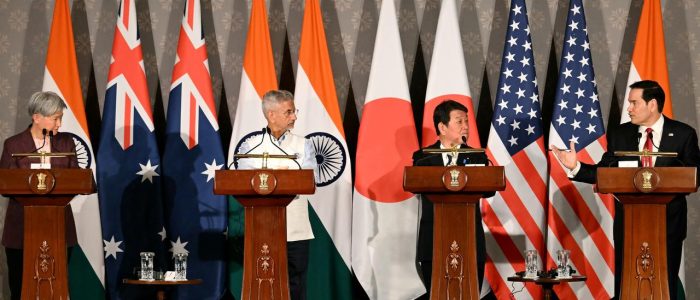
The 11th ministerial-level meeting of the Quadrilateral Security Dialogue (Quad) took place in New Delhi on 26 May 2026. It was the third Quad meeting after Trump assumed office for the first time. The meeting incorporated new agenda items along with the existing ones. The most concerning development in the Quad meeting was the adoption of Indo-Pacific Maritime Surveillance (IPMSC) cooperation under the umbrella of the Indo-Pacific Partnership for Maritime Domain Awareness (IPMDA). Similarly, the meeting decided to establish a port in Fiji in the Pacific Ocean that would be jointly overseen by the member states. The new initiatives particularly IPMSC and the port in Fiji seem to be guided by the strategic and security insecurity of the member countries regarding China.
The Quad features an alliance of four states: the United States, India, Japan and Australia. It evolved from a simple humanitarian group in 2007 into a strategic and defense alliance in 2017 in response to China’s economic and military rise in the Asia-Pacific region. The Quad alliance has embodied the US’s Asia-Pacific imperatives of counterbalancing China and strengthening its strategic position in the region. Similarly, India’s security and strategic understanding of the region reflect a similar perception of China’s role in the region. Both the US and India have adopted a similar strategic and security understanding of the Asia-Pacific region. Therefore, Quad has evolved into a strategic and security driven alliance against China in the region. The strategic implications for South Asia are also concerning, given the India-Pakistan rivalry.
The language used by the foreign ministers at the meeting on 26 May 2026 was clearly focused on the requirements of traditional security in the Asia-Pacific region, implicitly referring to China. India appears increasingly inclined to transform the Quad into a strategic and security alliance. India has fostered its defense collaboration with Australia in futuristic technology research. On the sidelines of the Quad meeting in May 2026, both countries discussed the need for maritime security cooperation and are slated to jointly host a Search and Rescue (SAR) and tabletop exercise at the Maritime Rescue Coordination Centre (MRCC) in Chennai in June 2026. They are also working on strengthening underwater domain awareness against China’s maritime activities in the Indian Ocean Region. Similarly, maritime defense collaboration between India and Japan has been enhanced to promote interoperability and synergy between their defense forces. Both countries have agreed to synchronize their maritime capabilities to protect their maritime interests in the Indo-Pacific region
The three new initiatives in the maritime domain illustrates the changing strategic behavior of the Quad member states. First, the IPMSC was proposed by India and would focus on the Indian Ocean. This initiative would help track the maritime movements and positions of other countries through the latest tracking technologies and satellite data. The member states would share data to provide real-time information on the types of vessels operating in the Indian Ocean. The IPMSC is clearly aimed at countering China in the Indian Ocean. China reacted sharply to the IPMSC initiative and stated that it would promote bloc-based competition with clear strategic aims.
Second, the IPMDA initiative, which would be complemented by the IPMSC, was launched in Japan in 2022 and would enhance maritime domain awareness in the Asia-Pacific region. It was formally crystallized at India’s Information Fusion Centre in Gurugram. This manifests the Quad’s military orientation by promoting maritime domain awareness through the sharing of real-time information to track and identify maritime threats. For instance, with IPMDA technology, India would be able to promptly detect and respond to the maritime movements of China and Pakistan in the Indian Ocean, which could adversely impact their threat perceptions.
Third, the meeting announced the establishment of an infrastructure project in Fiji, a strategically important Pacific island nation. This symbolizes the first such joint initiative by the Quad. Historically, Fiji has been strategically associated with Australia. Quad members also carried out joint military drills under the annual Malabar Exercise in the region. Sana Hashmi a postdoctoral fellow at the Taiwan-Asia Exchange Foundation with a special focus on China, in an interview with Al Jazeera, said that “China perceives the Quad as an anti-China coalition, and this new project in Fiji is viewed as the Quad expanding its operations from Indo-Pacific hotspots into the Pacific Island countries.” Similarly, Chinese Foreign Ministry spokesperson Mao Ning admonished that any cooperation in the region “should not target any third party.”
The Quad meeting in May 2026 explicitly demonstrates the willingness and readiness of the member states to enhance their maritime footing and strength in the Indo-Pacific region. China was not referred to directly, but in the joint statements issued during the meeting, the foreign ministers of the member states expressed serious concerns regarding the South China Sea and the East China Sea. Secondly, it signified the revival of the US’s attention toward the Asia-Pacific region. It proved that the US focus on the Western Hemisphere and the Middle East does not alter the strategic importance of the Asia-Pacific region for Washington. As for as Pakistan is concerned, the IPMSC and IPMDA could directly impact strategic stability in the Indian Ocean. The IPMSC would promote maritime surveillance and information sharing among the member states, through which India could locate and monitor Pakistan’s maritime movements in the northern Indian Ocean. Pakistan also has serious security concerns regarding the Quad, as it undermines strategic stability in the Indian Ocean Region. It encourages India to exercise maritime brinkmanship in the same manner as it exercised land and aerial brinkmanship in 2019 and 2025 against Pakistan. Similarly, the Quad could contribute to a security dilemma in South Asia, as India’s accumulation of naval power through the group could indicate the encirclement of Pakistan. Considering the delicate security calculus of South Asia, which is home to two nuclear-armed rivals, the expansion of Quad could deepen mistrust, magnify strategic competition, encourage bloc politics and enhance the risk of escalation. The moment when regional stability requires dialogue and confidence building measures, the emergence of new geopolitical fault lines may complicate efforts to maintain peace and stability in the maritime domain.
This article was published in another form at https://cscr.pk/explore/themes/defense-security/how-the-quads-new-maritime-initiatives-impact-south-asian-strategic-stability/


Mr Murad Ali is a Research Officer at Center for International Strategic Studies (CISS), Islamabad