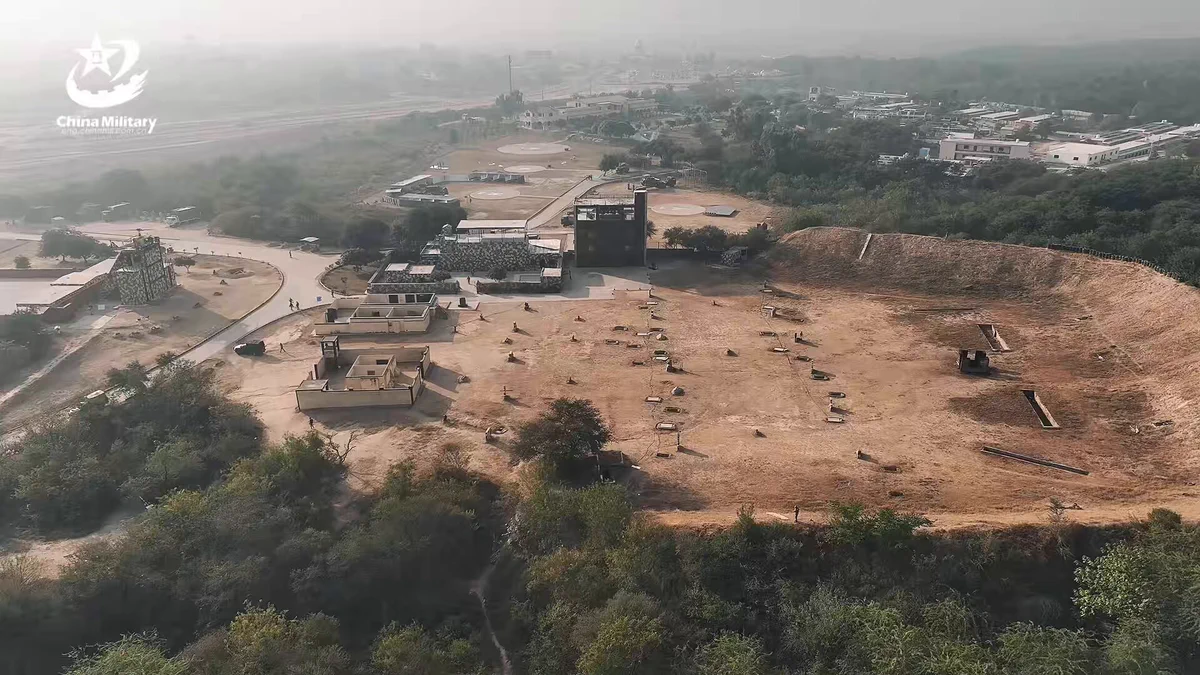
On October 14, the Chinese and Pakistani armies commenced a joint exercise designated as Karakoram-2026 at a training base in Korla, in China’s Xinjiang region. Beijing’s defence ministry called it “the first joint army training between the two countries” and said it would concentrate on counter-terrorism operations in high-altitude areas. The programme covers drone operation, shooting at moving targets, long-range sniping, joint command and live-troop drills.
The exercise is modest in scale, and reports have not given the size of the contingents. Its significance lies in a wider debate about the two countries’ defence ties. A US congressional commission said in November that Beijing had used the May 2025 India-Pakistan conflict to test and advertise its weapons, according to the South China Morning Post, although it also cautioned that a proxy-war label might overstate China’s role. Accounts of this kind tend to portray Pakistan mainly as a place where Chinese weapons are tested. The Karakoram drills suggest a more balanced picture. Experience, as much as equipment, now moves between the two armies, and it moves in both directions.
What each side brings
Each army brings experience of a different kind. The Pakistan Army has spent years in counter-insurgency operations in mountainous terrain, including Operation Zarb-e-Azb in North Waziristan from June 2014, which involved up to 30,000 soldiers. China brings drones, robotics and a deep defence-industrial base, and it has supplied all the weapons and equipment for this exercise, Global Times reported.
The two contributions fit together. A Chinese military affairs expert, Zhang Jueshe, told Global Times that the two countries “complement each other well” in counter-terrorism. According to CCTV, one Chinese soldier said the Pakistani army’s combat experience is worth learning from. The arrangement is therefore an exchange: operational insight on one side, and training, technology and familiarity with systems on the other. Hardware tested in any conflict yields performance data. The people who employ it, integrate it and adapt under pressure gain operational experience, and that remains an asset of the force that gained it.
From specialised units to regular formations
The two armies already train together. Arab News, reporting on the ninth Warrior counter-terrorism exercise at the National Counter Terrorism Centre in Pabbi in December 2025, described a relationship that includes co-production of the JF-17 fighter, naval and air exercises, intelligence sharing, border security work and counter-terrorism training. The air forces train together under the Shaheen series and the navies under Sea Guardian, whose 2023 edition included a first joint patrol in the Arabian Sea. The army’s regular formations had no comparable channel. Earlier Warrior drills mostly involved special forces or border units, according to Chinese-language press reports, and Zhang Jueshe described Karakoram as an expansion of cooperation “from specialized units in specific areas to regular army forces”.
That change matters for a practical reason. Special forces are small and selected, which makes them easy to secure and a good channel for exchanging technique. Regular formations carry most of the weight of counter-terrorism in practice, and Pakistan’s campaigns in the tribal districts were carried largely by regular units. Bringing such units into a joint format suggests that the two armies are interested in exchanging organisation as well as skill, meaning how a force searches, communicates and commands in difficult terrain. This could give a broader familiarity over time to both armies, and many more could pass through such a format than a special forces course.
The training programme is a miniature of a counter-terrorism sequence. Drones can be used to observe on difficult ground, moving targets are tracked and engaged, precision fire is applied at long range, and a joint command controls all the elements. Beijing has said that the training is supposed to enhance the interoperability of counter-terrorism operations. At practice, interoperability is achieved by process – how orders are passed around, how fire is coordinated, how infantry are able to operate alongside drones and counter-drones. China Military reported the mixed teams’ successful unification of command in the live-force phase. The way the command arrangement functioned and to what extent would have revealed the depth of integration. Future stages would provide further details.
A shared security agenda
The counter-terrorism theme reflects concerns both countries have. China and Pakistan resumed the Warrior series in late 2024, after a gap since 2019, following deadly attacks on Chinese nationals in Pakistan earlier that year. In July, the two governments also agreed to form a joint border working group on border management and security. On the ground, Pakistan’s Khunjerab Security Force and Chinese military units held a joint patrol at Mantika Pass, at about 4,700 metres, in September, Dawn reported. The defence ministry’s announcement names no third party, and protecting people and projects is a goal that both sides can pursue in their own right.
Looking ahead
As the relationship grows, there are some points that may be worth noting. Reciprocity is the first. The air and naval series have already been conducted in both countries, with a later army phase in Pakistan, and equipment provided by Pakistan, and command rules set by China, would complement the current format with China hosting and providing the equipment. Korla is at approximately 900 metres whereas the September patrol was at approximately 4,700 metres, therefore a phase in real mountain terrain would be more testing of the high altitudes theme. Another factor is capacity. Experience and depth are best matched by joint investment, maintenance and reserve stocks and a close and long-standing supply relationship.
Army’s can also learn from the exercise. The best lessons for Pakistan might be procedural. Operating drones and counter-drone systems, along with infantry and other arms, is different skill to possessing them and it has practical use at home to counter the militant drone threat in the operational areas. Another is working in a joint headquarters. It reflects how a larger army organizes staff work and the authorization to fire and it blends into Pakistan’s own planning. The all-Chinese cast is also a testament to the fact that a force’s routines are closely tied to the kit that it carries.
China may gain in different ways. The Pakistan Army’s years of counter-terrorism in mountain terrain offer lessons in intelligence-led operations and in holding ground once it has been cleared, areas where the PLA has less recent practice. Working beside a partner army outside China’s borders also teaches things a briefing cannot, such as how language and liaison problems are handled in the field. Chinese manufacturers may learn as well, since another army’s soldiers will use the same vehicles and drones in ways their designers did not foresee. The exercise is small, but the direction it suggests is clear. Hardware began this partnership, and shared procedure and experience are where it is now heading.
This article was published by the Global Defense Insight in another form at https://defensetalks.com/karakoram-2026-exercise-pakistan-china/


Syed Ali Abbas is Research Officer & Comm Officer at the Center for International Strategic Studies (CISS) Islamabad. He is also an MPhil scholar in the Department of Strategic Studies at the National Defense University (NDU) Islamabad.