Press Release
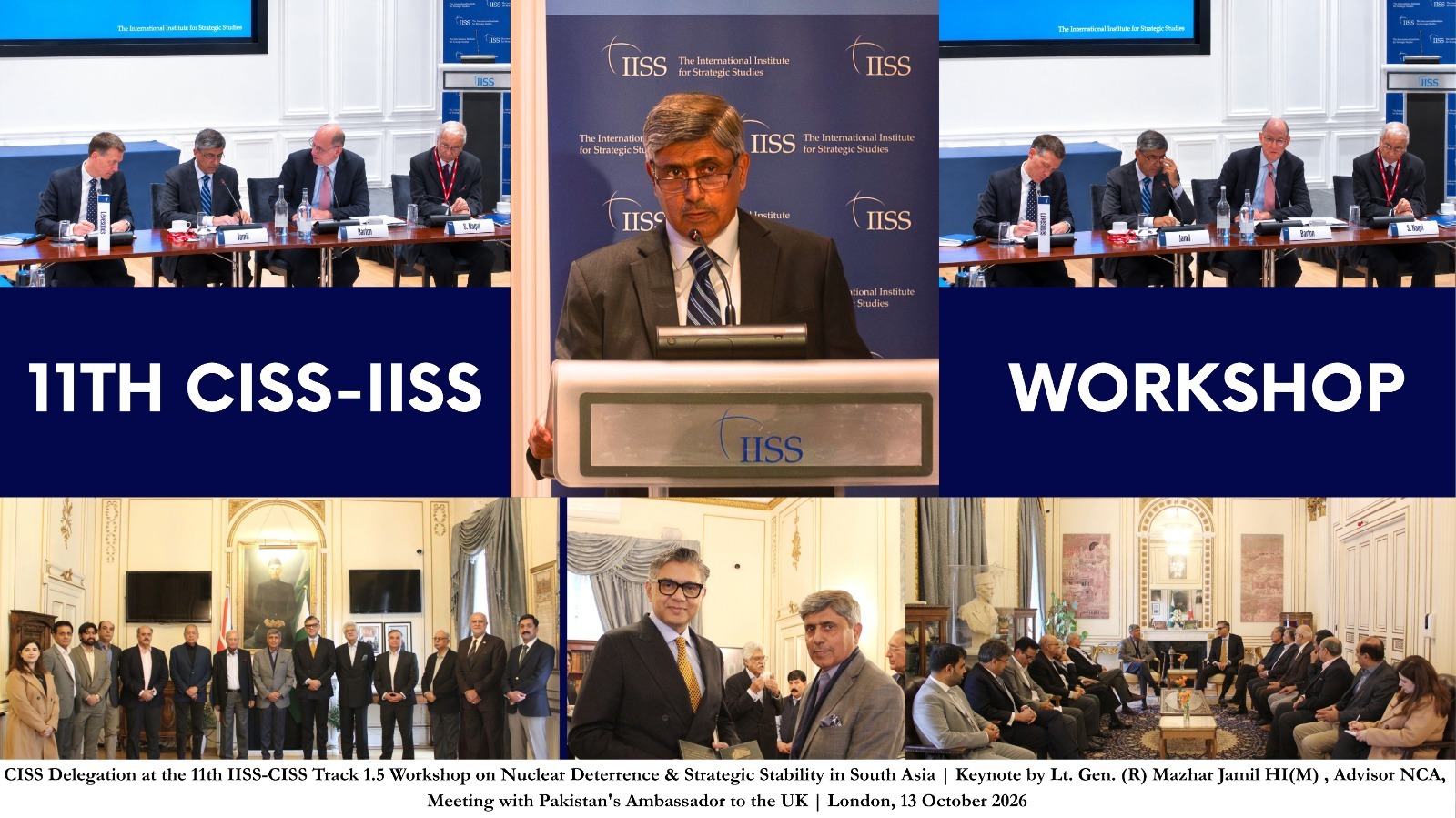
Lieutenant General (Retd) Mazhar Jamil, former Director General, Strategic Plans Division (SPD), highlights Political Dialogue, Credible Deterrence, and Crisis Management as essential to Strategic Stability in South Asia.
In his keynote address at the workshop on ‘Nuclear Deterrence and Strategic Stability in South Asia’, jointly organised by the Centre for International Strategic Studies (CISS), Islamabad, and the International Institute for Strategic Studies (IISS), London, he underscored the need for political engagement, credible deterrence, and effective crisis-management mechanisms to prevent escalation and promote lasting peace in the region.
Lieutenant General (Retd) Mazhar Jamil underscored that political beliefs and strategic thinking of states form the basis of policies that shapes the strategic and security environment of the region. In recent years, political transformation in India, led by the extremist Hindutva doctrine that seeks to marginalize and delegitimize non-Hindus specially the Muslims of India, has introduced additional layer of complexity to the regional security environment. He further underlined that this dangerous political philosophy has not only trickled into the Indian political, strategic, organizational, and societal culture, but also, penetrated deeply into Indian military thinking. As a result, the Indian military thinking is being shaped by a very dangerous ideology that conflates mythology with national power.
He emphasized that regional stability must be understood in the context of the region’s distinct political realities, unresolved disputes and competing security perceptions, rather than through conventional Cold War frameworks. He stressed that sustainable strategic stability requires political leadership to prioritize dialogue and conflict resolution over military adventurism and coercive policies, particularly in a nuclearized environment.
Highlighting the unresolved Kashmir dispute, Lt Gen Jamil observed that persistent political tensions and recurring military crises continue to complicate the regional security landscape. He emphasized that unresolved disputes require political solutions and sustained engagement, warning that military escalation between nuclear-armed states carries serious risks and cannot provide a durable basis for regional peace.
Reflecting on the Pakistan-India crises of 2019 and May 2025, he stressed that responsible political leadership, strategic restraint and clear communication remain essential to crisis management. He argued that assumptions about controlling escalation during a military confrontation can prove dangerously misplaced, particularly when decision-making takes place under conditions of uncertainty and compressed timelines. The May 2025 crisis, he maintained, reaffirmed the importance of credible deterrence and the need to prevent conventional military action from generating wider strategic consequences.
Explaining Pakistan’s approach, Lt Gen Jamil highlighted the concept of Quid Pro Quo Plus (QPQ+), a strong and calibrated conventional response within the framework of effective nuclear deterrence. He emphasized that deterrence rests not on rhetoric but on credible capabilities, strategic clarity and disciplined decision-making. He underscored Pakistan’s commitment to strategic stability and responsible nuclear stewardship, while maintaining the capability to safeguard its sovereignty and national security.
He further addressed India’s evolving sea-based nuclear capabilities and the broader maritime dimension of strategic competition. He expressed concern that the development and potential operational deployment of nuclear-capable sea-based systems, in the absence of adequate transparency and notification arrangements, could introduce additional uncertainty into regional crisis dynamics, and stressed the need for appropriate confidence-building and risk-reduction measures.
Concluding his address, Lt Gen Jamil emphasized that lasting peace in South Asia requires a shift towards political engagement, peaceful resolution of outstanding disputes and effective mechanisms for crisis prevention and management. He reiterated Pakistan’s readiness to pursue dialogue on all outstanding issues and called for objective international engagement in support of conflict resolution and regional stability. The keynote contributed to the workshop’s wider discussion on nuclear deterrence, limited conflict and strategic stability, highlighting the importance of responsible state behaviour, strategic communication and sustained diplomatic engagement in reducing the risk of escalation in South Asia.
Media Coverage
Pakistan nuclear adviser warns India may be moving toward first-strike posture
India’s NFU is a ‘diplomatic ruse’, Pakistan nuclear adviser says · The Thursday Times
track-1.5-workshop-on-nuclear-deterrence-and-strategic-stability-in-south-asia.pdf
Indian military doctrine risks nuclear stability in South Asia, warns Pakistan – Daily Times
Pakistan flags increased Indian support for terrorists at London forum | SAMAA TV
Mazhar Jamil Claims Doval Doctrine Destabilises Pakistan
Indian military doctrines threaten South Asia’s nuclear stability, NCA warns