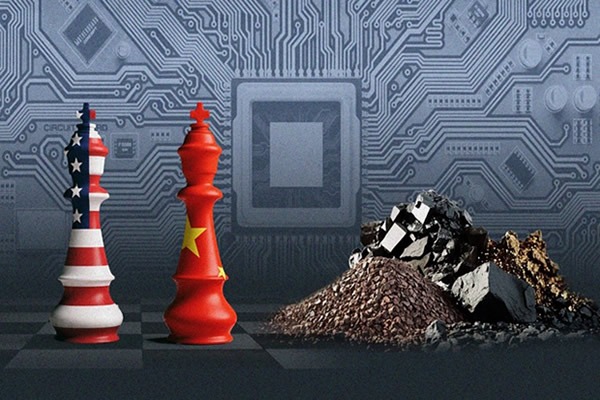
Recently, the President of the United States (US), Donald Trump, and the President of China, Xi Jinping, met in South Korea to step back from the brink of a global trade war. After the meeting, Beijing agreed to suspend export controls on rare earth minerals and to purchase agricultural products, including soybeans, from the United States. In return, Washington reduced the fentanyl tariff from 20% to 10% and paused the expansion of the export control list that had previously penalized Chinese companies. The Seoul meeting exemplifies a shift in US-China competition from tariff diplomacy to resource security. The US-China race to secure critical resources will increasingly determine global power dynamics, as both states aim to control key technologies, supply chains, and trade flows. As strategic rivalry at the international level intensifies, Pakistan faces challenges that require it to balance between the two great powers.
Resource security refers to access to vital resources that dictate global power dynamics and national stability. It increases one side’s leverage and reduces vulnerability in its competition with rival states. Due to African vast natural resources, particularly in the latter part of the 19th century, European powers scrambled for control of Africa. The purpose was to expand territories and secure resources to enhance leverage, which determined relative power. Likewise, the oil embargo following the Arab-Israeli War of 1973 highlighted the US’s foreign oil dependence. As a result, the Nixon administration signed a Petrodollar cycling deal with the Kingdom of Saudi Arabia, which reduced vulnerability and brought critical resource security to the US.
The current US-China rivalry is also driven by resource scarcity. As put by Edward Luttwak’s understanding of the horizontal dimension of strategy, the cycle of action, reaction, culmination, overextension, and reversal explains when one side tries to overpower or secure vital resources, the other side responds with a countermove that shifts the leverage balance. Beijing tightened its rare earth export in response to Washington’s efforts to limit China’s access to cutting-edge technologies. As the Atlantic Council warned that the mineral supply chain is becoming brittle, largely concentrated in China, causing overstretching of advanced economies. It automatically compelled the US to explore other options for secure supply chains.
Beijing’s recent trade moves have, as one analyst noted, brought China much closer to operating as a true peer to the United States. When President Trump initiated the trade war with China in 2018, Beijing fortified the economic supply chain to withstand US pressure. Through comprehensive planning and long-term vision, China managed to secure stable supply chains. For instance, in the wake of tariffs on soybeans, Beijing turned to Brazil and Argentina. Since China was the largest importer of soybeans, the exports in the US plummeted by 75%, from $12 billion in 2017 to just $3 billion in the following year.
China’s control over rare earth minerals has been pivotal in shifting the balance of negotiating leverage. During the trade war, Beijing announced that companies worldwide would need approval of the Chinese government to export goods containing their rare-earth minerals. This is not to say that Earth lacks these minerals, but their processing and extraction remain concentrated in Beijing, which controls 70% of rare earth minerals. It holds effective leverage over the export and procurement of these minerals, which are used in smartphones, fighter jets, and electric cars. Simultaneously, the US turned to Australia, Pakistan, Africa, and Ukraine to satisfy its rare earth mineral needs; however, it will take time to form a secure and new supply chain to replace China. It shows that the current competition is not primarily about trade deficits, but rather about securing the foundation of military and technological power.
Pakistan and China have been enjoying cordial geopolitical relations. Since Xi Jinping became the president in 2013, strategic and economic integration between the two has intensified. For instance, the inauguration of the China-Pakistan Economic Corridor (CPEC) and the joint production of defense equipment are a few examples of the strength of this relationship. Despite collaboration against the erstwhile Union of Soviet Socialist Republics (USSR), now Russia, in the Afghan war and terrorism, Islamabad and Washington had hiccups in their bilateral ties. The US, in its bid to counter China, put its weight behind India, providing the latter with economic and military assistance. However, since President Donald Trump assumed the second term of his US presidency in 2025, the relations between Washington and Islamabad have strengthened. Whether this deepening of ties is a short-term US strategy or not, it remains to be seen.
In contemporary US-China competition, Pakistan sits at a critical juncture. On the one hand, it is playing a vital role in China’s Belt and Road Initiative (BRI) through the CPEC. Simultaneously, the US is also working to secure Islamabad’s stock of critical minerals. On 31 October, the chairman of the US Critical Minerals Forum met with Pakistani authorities to deepen the collaboration. The logic of maintaining leverage with China is driving the US strategy of forming a stable supply chain from Pakistan to address resource scarcity. So, Islamabad faces two options: accommodate US interests and keep its cordial ties with China.
Against this backdrop, Pakistan should guard its economic and strategic interests. Islamabad should craft a foreign policy strategy that maintains relations with both Washington and Beijing, without succumbing to either of the great power’s influence. It should communicate to both powers that it does not want to be a party in their rivalry. Undoubtedly, the US investments are lucrative, yet Islamabad should maintain its strategic maneuvering by not compromising its foreign policy choices, especially with Beijing. Similarly, Islamabad should convey to Beijing that the minerals deal with Washington is for economic dividends only. To sum up, the Seoul meeting signals the intent to secure vital resources to maintain leverage. Although China has a sustainable supply chain of rare earth minerals, the US is forming new supply chains. Washington’s growing ties with Pakistan to secure rare earth minerals are an economic imperative, while simultaneously Islamabad’s ties with Beijing have been cordial and sustainable in economic and strategic aspects. In this situation, Pakistan should watch its economic and strategic interests by keeping its independent foreign policy and avoiding being a part of the US-China rivalry.
This article was published in another form at https://ipi.org.pk/pakistan-at-the-crossroads-of-the-us-china-strategic-minerals-rivalry/


Muhammad Kumail Mehdi is a Research Assistant at the Center for International Strategic Studies in Islamabad.