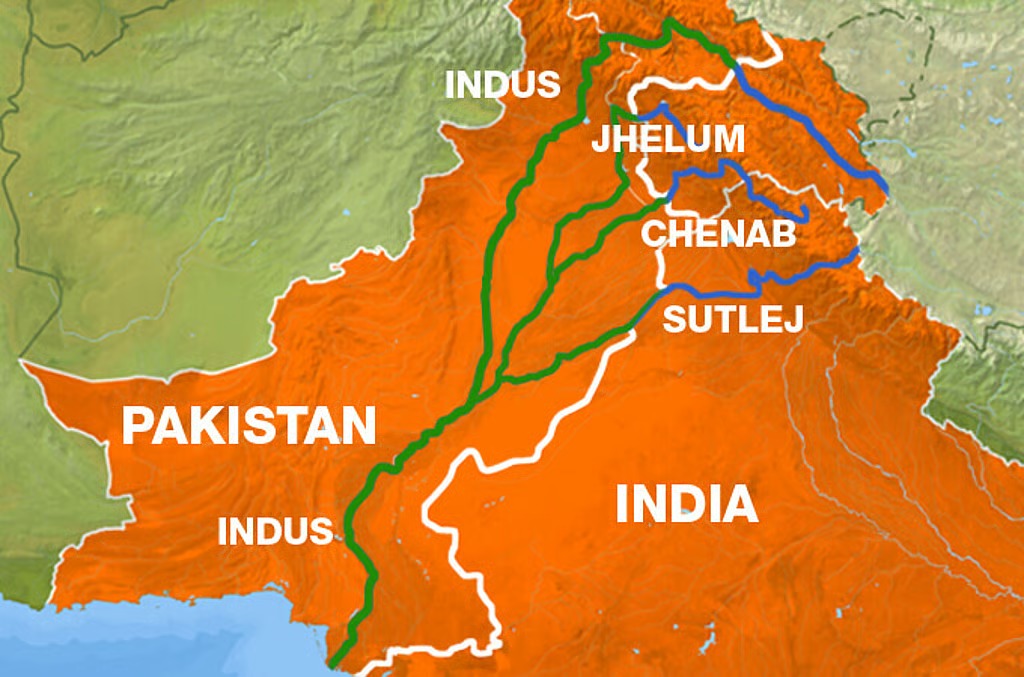
By holding the Indus Waters Treaty (IWT) in “abeyance” since April 23, 2025, India has transformed water from a shared resource to a tool of geopolitical leverage. Mediated by the World Bank, the IWT was signed in 1960 to regulate interstate water tensions between Pakistan and India. The treaty has long served as a mechanism for managing water-related tensions between two nuclear-armed states amid recurring crises and diplomatic freezes. The Indus Basin serves as a lifeline for both Pakistan and India, sustaining the livelihoods and agriculture of more than 300 million people. During the partition of British India in 1947, boundaries were demarcated along the Indus watershed, creating an upstream-downstream asymmetry that India has leveraged as the upper riparian state. Owing to this upstream-downstream asymmetry, India controls the flow of water from critical barrages into Pakistan. Islamabad relies heavily on the Indus Basin river system for irrigation, hydropower generation, and ensuring its water security. By placing the IWT in “abeyance,” New Delhi has not only undermined the spirit of cooperation but also violated the legal foundation of the treaty.
The IWT has remained in abeyance since the Pahalgam attack in April 2025, with India accusing Islamabad of cross-border terrorism, an allegation that Pakistan denied. Following India’s decision to place the treaty in abeyance, water flows through the Baglihar and Kishanganga dams were restricted for short periods, reflecting a dangerous pattern in the hydro-politics of the Indus Basin.
There is no provision in the IWT that allows for its unilateral suspension or termination. Article 12(4) of the IWT requires mutual agreement for any amendments to the treaty. In May 2026, the Permanent Court of Arbitration (PCA) issued a supplemental award, reinforcing Islamabad’s concerns regarding India’s hydroelectric projects on the western rivers, particularly the Ratle and Kishanganga dams. The award clarified that treaty imposes “substantive limits” on India’s storage capacity on the western rivers allocated to Pakistan. The PCA’s ruling addressed the issue of maximum pondage – the volume of water permitted to be stored in a reservoir – holding that pondage for run-of-the-river hydroelectric plants must be justified by project requirements, site hydrology, and hydraulic conditions. Building on its August 2025 award on the general interpretation of the IWT, the PCA’s latest legal development rejected attempts to justify expanded water-control capabilities based on bare assertions of compliance, emphasizing that installed hydropower capacity must be realistic and well-founded.
The PCA’s August 2025 award also strengthened Pakistan’s review rights by obliging India to provide sufficient technical information for any proposed project. The Court held that failure to do so meant New Delhi’s proposed project could not justify the conditions outlined under paragraph 8(c) of Annexure D of the treaty. However, India outright rejected the PCA’s ruling, describing it as the decision of an “illegally constituted so-called Court of Arbitration.” Such a response reflects New Delhi’s reluctance to engage through the legal mechanisms embedded within the treaty’s framework
The IWT has successfully resolved controversies through its sophisticated dispute resolution mechanism. The Permanent Indus Commission, established under the framework of the IWT, has encouraged both Pakistan and India to exchange information and address bilateral disagreements in an amicable manner. Furthermore, the treaty provides a comprehensive institutional framework to prevent such escalation. In the event of a dispute, both the neutral experts and the PCA maybe be approached for its resolution. The settlement of the Baglihar Daam dispute demonstrates that technical disagreements can be resolved through the treaty’s dispute resolution mechanisms rather than through political confrontation.
However, since 2022, India has refused to participate in meetings of the Permanent Indus Commission, raising objections to the competence of arbitration forums within the IWT framework. By sidelining these institutional processes and linking water cooperation with broader regional security disputes, India has undermined South Asia’s last surviving confidence-building framework
New Delhi asserts that the treaty is outdated, ill-equipped to address contemporary challenges, and biased in favour of Islamabad. There is no denying that the treaty itself is not without its shortcomings. Experts on both sides argue that it lacks a robust climate adaptation mechanism and fails to address the issue of groundwater depletion. Islamabad also highlights loopholes in the treaty, particularly its inability to impose quantitative limits on India’s hydropower development on western rivers. Nevertheless, reform remains a better approach than unilateral suspension. Treaties evolve through negotiation, and India’s coercive approach of imposing changes outside the agreed framework highlights New Delhi’s preference for power politics over cooperative governance.
The increasing number of run-of-the river hydropower projects on western rivers allocated to Islamabad has further exacerbated Pakistan’s concerns. Islamabad has repeatedly raised objections to projects such Kishanganga and Baglihar, arguing that the security of the downstream state has been jeopardized by the manipulation of water flows. Even technical disagreements have become politicized, normalizing the use of water as a tool of geopolitical leverage. From a shared resource, water has now been turned into a strategic weapon that was once a source of interstate tension between Pakistan and India In such challenging times, global experiences offer important lessons. Israel and Jordan have signed a peace treaty in 1994, establishing a Joint Water Committee to manage their mutual dependence on shared water resources. This agreement demonstrates that cooperation can endure amid deep political hostility. Under the peace treaty, Israel agreed to supply Jordan with 75 million cubic meters of water annually. Along similar lines, Islamabad and New Delhi could reach a to manage the waters of the Indus Basin, recognizing the strategic necessity of water cooperation. The restoration of IWT could serve as the foundational step toward rebuilding trust in an otherwise fractured bilateral relationship. Therefore, the future of the Indus Basin must be shaped by cooperation, legality, and shared survival rather than hydro-political brinkmanship.
This article was published in another form at https://ipi.org.pk/the-indus-waters-treaty-at-a-crossroads/


Ms Nawal Nawaz is Research Assistant at the Center for International Strategic Studies (CISS), Islamabad.