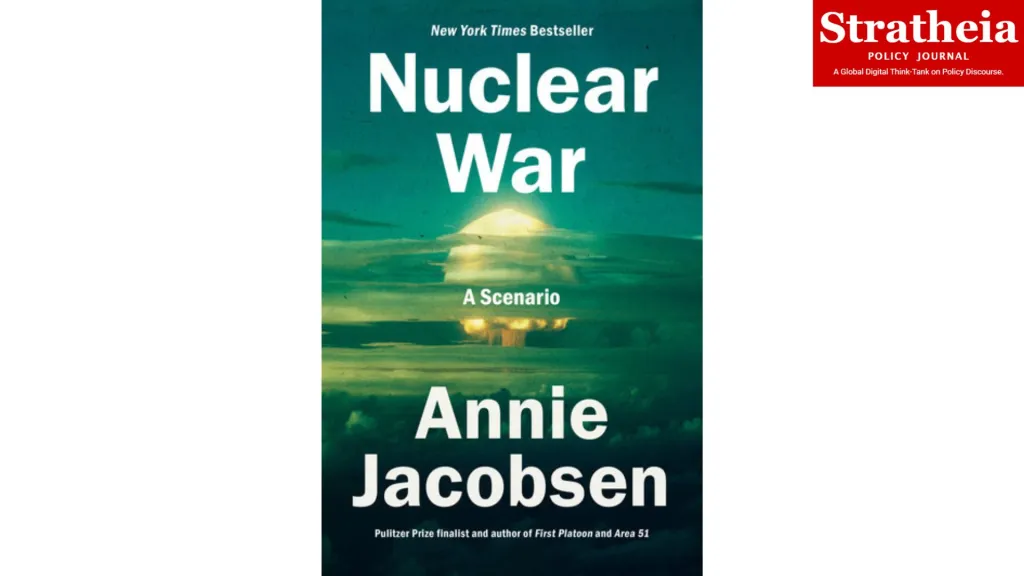
Annie Jacobsen’s Nuclear War: A Scenario is a compelling and thought- provoking analysis of the risks associated with modern nuclear weapons and the structural weaknesses of contemporary deterrence mechanisms. Jacobsen blends investigative journalism and a fictional scenario-based story of a nuclear crisis that starts with a North Korean strike on the United States and quickly spirals into a worldwide nuclear war. She provides insights into the speed with which a nuclear crisis can spiral beyond political control, based on interviews with former military officers, nuclear scientists, intelligence experts, policy makers and on declassified documents. The outcome is an engaging and insightful contribution to nuclear strategy, escalation, deterrence and crisis management.
Nuclear War: A Scenario is fundamentally about the fragility of contemporary nuclear command and control systems and the very short time frame for political decision-making that is at stake in the event of a nuclear war. In minute-by-minute detail, Jacobsen shows how any one missile could set off a chain reaction among several nuclear nations, leading to escalation, as a result of miscalculation, technological limitations, and military procedures. It also explores how early-warning systems work, how the “launch-on-warning” doctrine operates, how U.S. presidents make decisions, and the human and humanitarian implications of nuclear war. After all, is the current deterrence system adequate to deter catastrophic escalation in the nuclear era?
The book’s main thesis is that the current systems of nuclear command and control are based on very short decision-making cycles. National leaders can be given just a few minutes to consider threats and give approval for a response. In great detail, Jacobsen describes the operation of missile detection systems, early-warning systems, the process by which the President makes decisions, and retaliatory doctrines. She chronicles minute-by-minute the events that might lead to a large-scale nuclear exchange between multiple nuclear powers following a single nuclear launch, given uncertainty, technological limitations, and institutional pressures.
A significant strength of the book is its ability to translate complicated strategic and technical concepts in an engaging, clear and accessible manner without oversimplifying them. Things such as launch on warning and ballistic missile trajectories, electromagnetic pulse (EMP) effects and nuclear command and control (C2) systems, and deterrence are explained understandably. This accessibility is especially helpful in view of the technical aspects of nuclear policy debates. In this book, Jacobsen manages to convey the expertise of specialists in a way that is accessible to policymakers, students, researchers, and the general public without being superficial.
The book also importantly brings attention to the humanitarian impacts of nuclear war. Jacobsen vividly describes the immediate effects of a nuclear detonation, such as blast destruction, thermal radiation, firestorms, and radioactive fallout. More importantly, she explores the enduring effects of a nuclear war, including nuclear winter, crop failure, famine, and a general breakdown of society. In doing so, she invites readers to consider a wide range of considerations apart from military and strategic ones, and to contemplate the human toll of nuclear arms.
Meanwhile, the book challenges the reader to think critically about the assumptions it makes and its analytical method. However, Jacobsen argues that nuclear systems remain vulnerable to rapid and potentially systematic breakdown. Through her narrative, she portrays a highly pressurized strategic environment, where leaders are given little opportunity to make any real decisions once a crisis has started. Such a portrayal reinforces the book’s main argument that nuclear decision-making processes are fragile and that an accelerated timeline can be dangerous. Her concerns are shared by Thomas Schelling, who alerted to the potential of coercion, brinkmanship and unintended escalation in nuclear crises. When it begins, it’s difficult to stop it from escalating, as in the event of Jacobsen’s scenario.
The methodology employed in the book is also noteworthy. Most of Jacobsen’s work involves interviews with former officials and subject-matter experts and is based on publicly accessible documents and scientific research. This will allow some interesting information and make the story more realistic. Expert testimony plays a large role in the discussions about military procedure and the effects of nuclear weapons, giving the discussions credibility. But there are drawbacks to interviews. Experts’ views and opinions are shaped by personal experience, institutional culture and professional bias. Moreover, much of the information about the elements of nuclear plans and command organizations remains classified and is therefore unconfirmed. Hence, it can be considered as an analytical exercise, and not as a prediction of how a nuclear crisis would play out.
A second problem is how rising tensions are dealt with in the book. Jacobsen outlines a series of events that happen in a very short amount of time and in a way that might seem too deterministic. The storytelling approach has the power to build a sense of urgency but can also make it seem like there is no choice. The scenario is predicated on the assumption that there is limited space for diplomacy, crisis management, political restraint and strategic adaptation until escalation progresses towards global catastrophe. It might be argued, of course, that this is a “worst case” scenario, which was selected to raise awareness of the dangers of nuclear weapons and not necessarily an accurate and unbiased representation of the state’s behaviour. In principle, thinkers such as Kenneth Waltz have suggested that for rational states, nuclear deterrence makes war costly and thus helps to create strategic stability. Jacobsen’s account challenges this positive perspective and warns that deterrence fails through accident, misconception and erratic decision-making with potentially deadly consequences.
Even with its shortcomings, the book is an effective reminder of the catastrophic effects of miscalculations and rapid escalation. The book also has some drawbacks in the discussion of international politics from the present perspective of security studies. The book deals mostly with the nuclear situation in the United States, Russia and North Korea; and less attention is paid to the situation in other nuclear regions, particularly South Asia. The analysis could have been more comparative in nature in the context of the current deterrence equation between India and Pakistan and the crisis. Similarly, in the field of strategic stability and nuclear decision-making, the role of new technologies like Cyber warfare, AI, autonomous systems etc is also relatively small considering the significance of these technologies.
Yet for all these drawbacks, Nuclear War: A Scenario is a valuable addition to the debate on nuclear security and strategic stability. It does not provide a completely new theory or point of view on nuclear war, but it does make people think about the reality and the potential for destruction of nuclear war. Jacobsen succeeds in making the technical world of strategy accessible to a lay audience and conveying this world as a lively and entertaining story. Those who don’t agree with her assumptions or conclusions will find it hard to ignore the issues raised. Nuclear War: A Scenario is a timely and thought-provoking book deserving the attention of scholars, policymakers, strategic analysts and informed readers. Although it may not be analytically balanced as it uses a worst-case scenario, the advantages of this far outweigh the drawbacks. Jacobsen points to the irreversibility of nuclear decisions, their swiftness, and their increasing complexity, to remind us that nuclear risks remain one of the most pressing threats to international security. The book also invites dialogue with other studies of nuclear deterrence, strategic stability and escalation by such figures as Thomas Schelling and Kenneth Waltz. Nuclear policy, deterrence and escalation are major themes in the book and for students and practitioners in strategic studies and security affairs, it can be a cautionary tale and a valuable contribution to the ongoing debates about deterrence, escalation and global stability.
This book review was published by the Stratheia in another form at https://stratheia.com/book-review-nuclear-war-a-scenario/


Shahwana Binte Sohail is is Research Assistant at the Centre for International Strategic Studies Islamabad.