Executive Summary

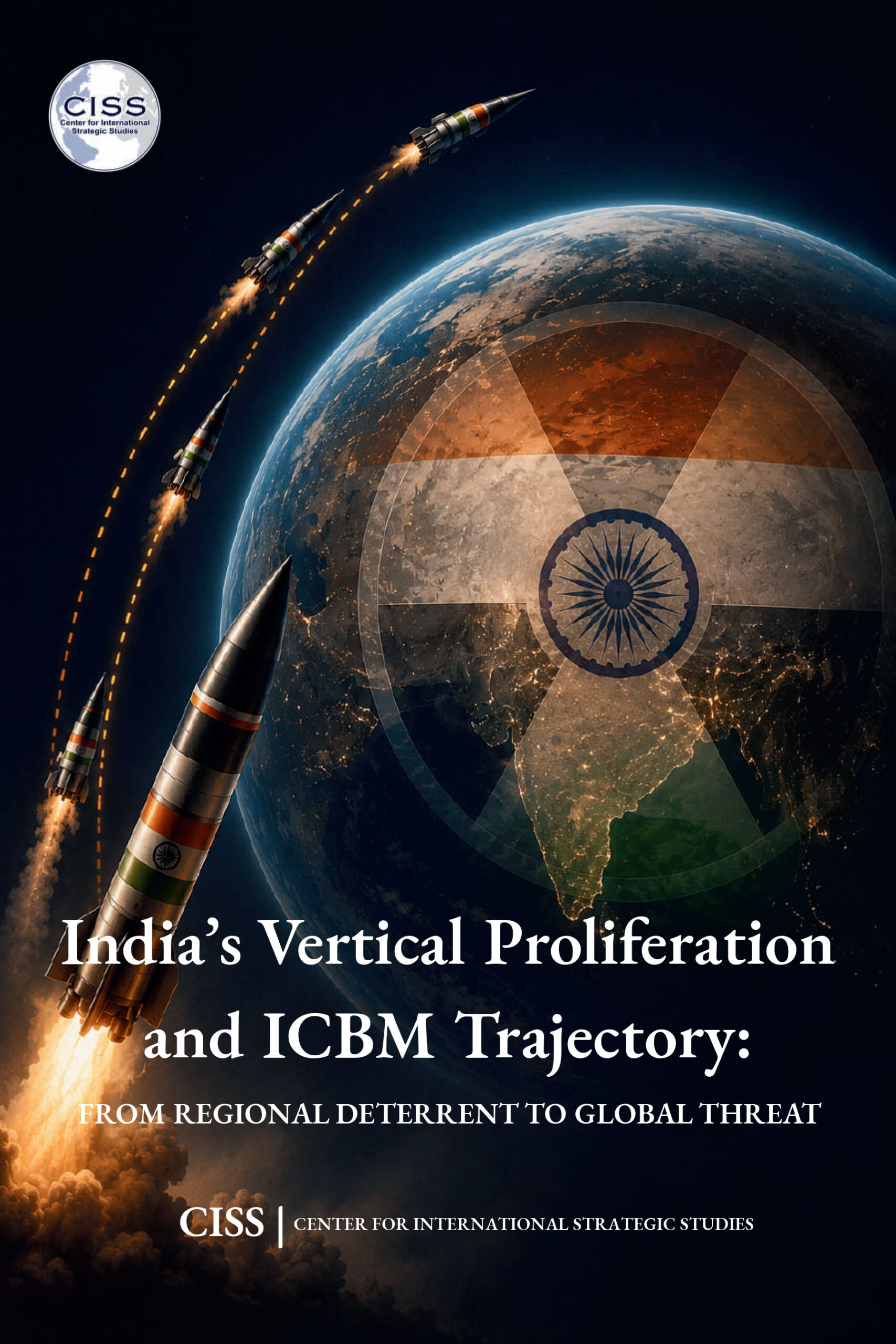
In mid-2026, two developments occurred to alter the terms on which India’s nuclear programme could be assessed. First, the Defence Research and Development Organisation (DRDO) announced technical readiness to begin full-scale development of the Agni-VI, a four stage,MIRV-capable intercontinental ballistic missile (ICBM) with a projected range of 10,000-12,000 kilometres. Second, the SIPRI Yearbook 2026 reported, for the first time in the history of India’s nuclear programme that a portion of its arsenal is operationally deployed with twelve warheads carried to sea aboard its ballistic missile submarine fleet. Also, the total stockpile rose from an estimated 180 warheads in 2025 to 190 warheads in 2026.

Together, these developments marked a departure from the framework under which India’s programme has been perceived for two decades i.e., a regionally bound deterrent, held in de-mated storage, against Pakistan and China. However, the two developments that occurred belied this perception. This assessment examines what that departure means for global security, credibility of the global non proliferation order, and Western security establishments that continue to read India’s arsenal through a purely regional lens India’s declared doctrine no longer explains its capability trajectory. India’s official posture rests on credible minimum deterrence (CMD), No First Use (NFU), and a two-adversary frame directed at Pakistan and China. By that doctrine’s own logic, the requirement was met when the MIRV-capable Agni-V with a 7,000-8,000 km range covering all of China and Pakistan, was tested and inducted. The Agni VI’s projected reach extends well beyond both adversaries, into Western Europe, North Africa, the Middle East, and the eastern seaboard of North America. No regional threat justified this step; and the extension is contrary to India’s own stated deterrence rationale.

Read the complete Strategic Assessment below in pdf format

Share.

Comments are closed.

Cek DA PA Gratis

Mr Syed Ali Abbas

Research Officer/ Comm Officer/ Managing Editor CISS Insight

Syed Ali Abbas is a Research Officer/Communication Officer at the Center for International Strategic Studies (CISS), Islamabad. Previously, he served as an associate editor at Indus News Network. His areas of interest include Middle East politics, military modernization, foreign policy, and nuclear politics. He has contributed to various platforms, including The National Interest, South Asian Voices, and others.

Dr Anum Riaz

Associate Director Research

Dr. Anum Riaz is the Associate Director Research at the Center for International Strategic Studies, Islamabad. She holds a Ph.D. in Political Science from the Department of Political Science at Bahauddin Zakariya University, Multan. She also possesses M.Phil. and M.Sc. degrees from the Department of Defence and Strategic Studies at Quaid-i-Azam University, Islamabad. Additionally, she has taught BS and Master’s students at the Department of Political Science at Bahauddin Zakariya University, Multan. Her areas of interest include strategic studies, international relations, international nuclear politics, the nuclear non-proliferation regime, arms control and disarmament, as well as traditional and non-traditional security issues.

Dr Bilal Zubair

Director Research

Dr. Bilal Zubair has worked as an Assistant Professor at the National Defence University Islamabad and Lecturer at the National University of Science and Technology. He holds a Ph.D. and M. Phil. in International Relations from Quaid-e-Azam University, Islamabad. Dr. Zubair is author of the book Chinese Soft Power and Public Diplomacy in the United States (Palgrave Macmillan, 2024) and contributed to several journal articles and book chapters focusing on soft power, diplomacy, and China’s role in international relations.

His research has been published in various academic journals, and he has presented at international conferences Dr. Zubair has also been an active reviewer and editorial board member. His professional interests include great power politics, and the role of communication in global diplomacy.

Mr Mobeen Jafar Mir

Research Officer

Mobeen Jafar Mir is a Research Officer at the Center for International Strategic Studies (CISS), Islamabad. His research focuses on U.S. foreign policy, particularly in the areas of strategy, technology, and arms control. He is currently pursuing an M.Phil. in International Relations at the School of Politics and International Relations, Quaid-i-Azam University, Islamabad. He can be found on Twitter @jafar_mobeen.

Exit mobile version