The Nuclear Non-Proliferation Treaty (NPT) is a cornerstone of the global nuclear non-proliferation regime. It was opened for signature in July 1968, and it entered into force in March 1970 after extensive negotiations within the Eighteen-Nation Committee on Disarmament (ENCD) in Geneva. Initially, the treaty was ratified by the three depositary governments that were also de jure Nuclear Weapon States: The United States (US), the United Kingdom (UK), and the Union of Soviet Socialist Republics (USSR), along with forty other non-nuclear weapon states. Today, NPT has 191 member states, including five de jure nuclear weapons states that are part of it and four nuclear weapons states outside it. The treaty’s main objectives are promoting the peaceful use of nuclear technology, complete nuclear disarmament, and promoting arms control initiatives. To assess compliance and implementation of the three pillars of NPT and to strengthen the nuclear non-proliferation norms, Article VIII(3) of the treaty mandates the signatories to convene in Geneva every five years at the NPT Review Conference after the entry into force of the Treaty.
The Review Conference cycle has gradually evolved as the governing mechanism for the NPT, as a political meeting to review NPT implementation, discuss future strategies and formulate plans of action. Each Review Conference is based on a multi-year Preparatory Committee (PrepCom) process. With the formalization of the decision “Strengthening the Review Process” in the 1995 Decision, the PrepCom usually holds three sessions over four years leading up to every preceding RevCon. The PrepCom is charged with taking into account the principles, objectives and means to achieve the complete implementation of the Treaty and to recommend to the Review Conference on the procedural, organizational and substantive aspects.
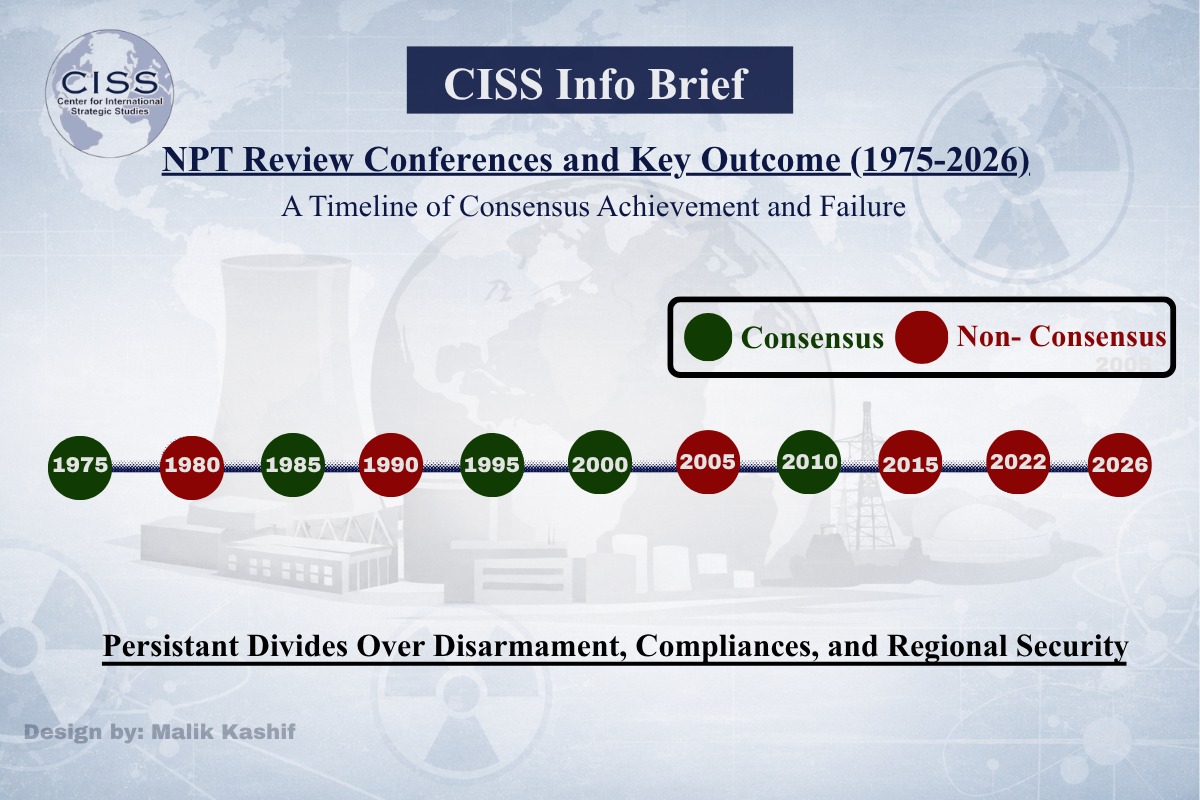
These sessions provide a forum for States Parties to present working papers, conduct preliminary debates, and draft recommendations to reach a consensus before the main conference. Success is usually judged by one test: whether the States Parties adopted a consensus in the form of a final document or not. By that test, five of the eleven Review Conferences held to date succeeded (1975, 1985, 1995, 2000, 2010) and six failed (1980, 1990, 2005, 2015, 2022, 2026) to achieve consensus.
First Review Conference – 1975: The first conference held in Geneva shortly after India’s May 1974 so-called “peaceful nuclear explosion” at Pokhran, which exposed a gap between peaceful and military uses of nuclear explosives and raised doubts about IAEA safeguards. Ninety states were parties to NPT, excluding France, China, India, Israel and Pakistan, adopted a consensus declaration. It reaffirmed the treaty’s core bargain, noted concerns over the Indian test, urged a comprehensive test ban, hoped SALT would produce real cuts rather than mere ceilings, and called for better technology transfer and international or regional fuel-cycle arrangements.
Second Review Conference – 1980: The 1980 RevConheld in Geneva after the Soviet invasion of Afghanistan and the failure of SALT II, the conference drew over 110 states parties. State parties’ concerns about unsafeguarded facilities in Israel and South Africa added friction in the conference process. The decisive grievance came from non-aligned and non-nuclear states, which were frustrated by the lack of a comprehensive test ban and by continued stockpile modernization. Egypt, Nigeria, Mexico and Yugoslavia pressed for accountability language and talks on Article VI collapsed. This was the first failure, and it set a pattern: disagreement over the pace of disarmament, with the treaty’s legal continuity unaffected.
Third Review Conference – 1985: Despite the strained Cold War environment, delegates agreed and a consensus-based final declaration was published. The final declaration of the 1985 RevCon strongly urged the nuclear power states to prioritize a Comprehensive Test Ban Treaty (CTBT) and demanded full scope IAEA safeguards for all nuclear exports. It also made a landmark breakthrough by declaring armed attacks on peaceful nuclear facilities a violation of international law.
Fourth Review Conference- 1990: Disputes over a comprehensive test ban and the Middle East blocked agreement; even as the Cold War ended, the state parties were unable to agree and to develop consensus on a final document.
Fifth Review Conference- 1995, a landmark: The Review and Extension Conference extended the treaty indefinitely, but only as part of a package: decisions on strengthened review and on principles and objectives, plus a resolution on the Middle East calling for a zone free of weapons of mass destruction. That resolution became a lasting source of tension, because Arab states treated it as an enduring commitment.
Sixth Review Conference- 2000: States adopted “13 practical steps” for disarmament, including an unequivocal undertaking by the nuclear-weapon states to eliminate their arsenals. Many regard it as the high point of the cycle, though implementation proved weak.
Seventh Review Conference-2005: In the 2005 conference, procedural disputes over the agenda and working methods took most of time of the conference, which ended with nothing substantive. Iran and North Korea dominated the proliferation debate, and the 2000 commitments were fading.
Eighth Review Conference- 2010: After the 2005 collapse and a period of renewed arms-control optimism, states adopted a 64-point action plan covering all three pillars. It also called for a 2012 conference on a Middle East WMD-free zone. The 2010 Action Plan remains the last substantive consensus outcome in NPT history.
Ninth Review Conference – 2015: The 2012 Middle East conference on a Weapons of Mass destruction free zone (WMDFZ) never took place, and it become the primary factor for the collapse of the 2015 conference over the zone issue. The United States, United Kingdom and Canada declined to accept the final draft, citing the Middle East language, while Arab states insisted it was essential.
Tenth Review Conference – 2022: The review conference of 2020 waspostponed due to COVID-19 and held in August 2022 and ended without consensus. Russia objected to a draft that included language on the Zaporizhzhia nuclear plant during its invasion of Ukraine.
Eleventh Review Conference – 2026: The Eleventh Review Conference ran from 27 April to 22 May in New York. Despite four weeks of meetings and negotiations, delegates could not bridge outstanding differences, making it the third consecutive conference to fail to reach a consensus outcome. The president chose to withdraw a final document that was unlikely to command consensus and calls for nuclear-weapon states to adopt no-first-use policies, present in early drafts, were deleted. The United States expressed regret at the failure and said some parties had not taken the threat from Iran seriously. The conference took place amid rising nuclear risks, including the spectre of nuclear use in active conflicts, attacks on nuclear facilities, and the effects of emerging technologies such as artificial intelligence.
Outcomes and Lessons for the Future of Review Conferences
In the history of fifty years of NPT review conferences, three prominent patterns run through this record. First, the pace of disarmament is the most common fault line, driving the failures of 1980 and 1990 and underlying 2005. Second, Middle East issues are the other major trigger: the 1995 resolution produced the 2010 action plan, and the unfulfilled 2012 conference led to the 2015 collapse. Third, geopolitical shocks carry into the conference room, from Afghanistan in 1980 and Iran and North Korea in 2005 to Ukraine in 2022 and the tensions around Iran in 2026.The history of RevCon suggests that the consensus rule, not the treaty, is under strain. A final document requires every state party to accept every paragraph, so a single determined delegation can block an outcome that 190 others support. That worked when the great powers still shared an interest in a functioning regime, as in 2000 and 2010. Today there is no such shared interest, since the nuclear-weapon states are modernizing arsenals, major arms-control agreements have eroded, and in active conflicts nuclear powers and nuclear facilities are under attacked. Three consecutive failures signal a structural problem rather than bad luck with individual presidents or drafts. Crucially, while these final documents carry no legally binding obligations, the failure to adopt even a text of purely political value underscores the depth of the current diplomatic failure. Still, experts caution against confusing the lack of a final document with the lack of a review. The treaty remains in force with near-universal membership, and the conferences continue to serve as a forum where states state positions, name compliance concerns and keep diplomatic channels open. The practical approach for the next cycle is to measure success more flexibly. This means separating procedural decisions from contested substance, so that reforms such as a more interactive review process can survive even when the political text does not, and favoring concrete, voluntary commitments by smaller groups of states over a single all-or-nothing consensus text. Without such adjustments, the Review Conference risks becoming a recurring ritual of disagreement, and the treaty’s authority will depend increasingly on what happens outside the conference hall.