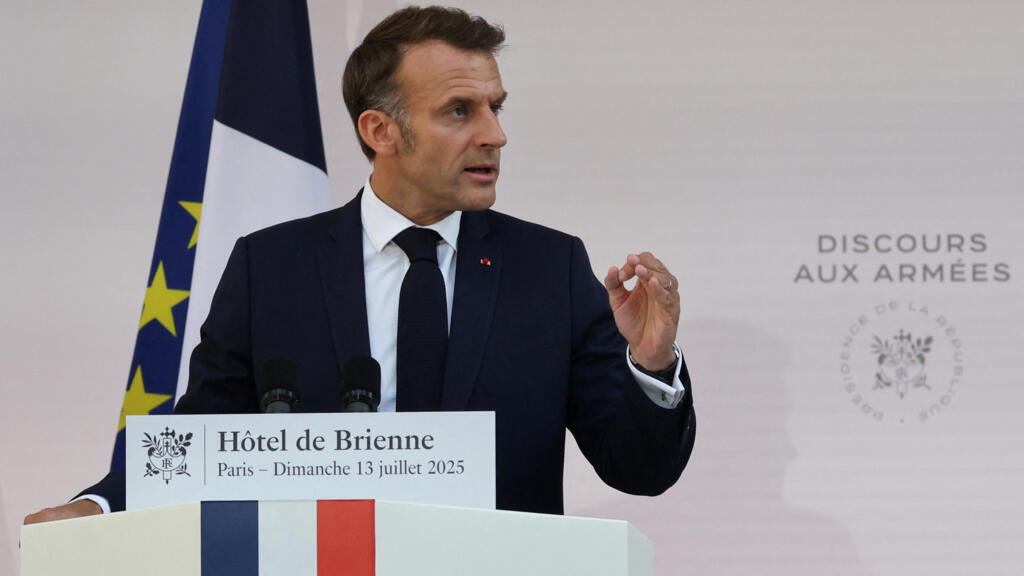
When Emmanuel Macron stood at the Île Longue submarine base in March 2026 and announced that France would extend its nuclear deterrent to willing European partners under what he called “forward deterrence,” the applause was understandable. Europe needed reassurance as New START expired, the transatlantic alliance visibly frayed under the leadership of Donald Trump, and Russia-Ukraine war was now in its fourth year. Nine countries have signed on, including Belgium, Denmark, Germany, Greece, the Netherlands, Poland, Sweden, the United Kingdom and, most recently, Norway. The optics are quite impressive. The material is much more opaque.
France has not declared that it will keep nuclear weapons in friendly countries permanently, and retains sole right over any such decision. The discussions, planning and exercises will involve partner countries, with France indicating that security in Europe is becoming increasingly linked with security of France. In simple terms: Nine countries are in an agreement where its main pledge – what the country actually would do and when – is intentionally vague. It is a choice that has consequences which transcend the immediate security calculations of Europe.
The NATO Problem
France has had a checkered history with the NATO nuclear architecture. In 1966, Charles de Gaulle withdrew France from the integrated military command of the Alliance, just to maintain the French nuclear sovereignty. It was only in 2009 that France completed its reintegration. That history is important because France remains outside of the NATO Deterrence programs, such as the Nuclear Planning Group, where the United States coordinates its nuclear deterrent with other allies and shares targeting doctrine, and maintains the credibility of extended deterrence via institutionalized embeddedness. Macron’s plan does not establish a similar mechanism. France will not implement a corresponding consultation process with its new partners and, more significantly, will not join NATO’s Nuclear Planning Group.
The outcome is a dual-track deterrence framework in Europe in which neither is superior to the other. Some of France’s nine partners, such as Germany, Belgium and the Netherlands, already host US nuclear weapons under NATO’s existing sharing arrangements and are members of the Nuclear Planning Group. They are now enrolled in a French deterrence framework that takes place outside those structures, and there is no shared protocol for the interaction of both (NATO and French Extended Deterrence) during a crisis. This makes adversary calculations more difficult and requires new coordination venues for allies other than NATO’s nuclear planning process – venues that are not yet established.
NATO Secretary General Mark Rutte has sought to solve this puzzle, welcomed the French plan and stressed that the ultimate and supreme protector of European security is still the United States’ nuclear umbrella. This is politically comforting, but it doesn’t make any sense strategically. What does France’s “forward deterrence” bring to the table if the US umbrella is ultimate? If it adds some substance, then there’s no more ultimate US umbrella. Rutte can’t have it both ways, and neither can Europe.
The Credibility Question France Cannot Answer
Extended deterrence means that the adversary assumes that the guarantor would use nuclear weapons on the partner’s behalf. The United States spent decades, and enormous political capital, building that credibility through treaty commitments, forward deployments, dual-key arrangements, and institutionalised consultation. France is trying to speed up that process by being deliberately vague, hoping Russia will not bluff.
Nonetheless, there’s a catch to the ambiguity. The French nuclear arsenal is too weak and ineffective to provide significant damage limitation in the event of a nuclear war. France can only retaliate on behalf of its allies and cannot act preemptively, unlike the United States. The assurances of a French “retaliation” against a distant country like Norway (bordering Russia) or Poland (on NATO’s eastern flank) require a response to the question de Gaulle was forced to ask Kennedy in 1961: if the US would be willing to “trade New York for Paris” in the event of a Soviet nuclear attack on Western Europe. Macron hasn’t been more ambiguous than Kennedy.
The Arms Control Damage
Macron’s plan faces strategic risks beyond Europe’s borders. They arrive in an already crisis stricken arms control environment. On February 5, New START lapsed without a replacement, marking the first time since 1972 that the US and Russia do not have legally binding limits on their strategic nuclear arsenal. The treaty, widely viewed as the foundation of nuclear non-proliferation, is in a state of crisis – the three previous NPT Review Conferences have not resulted in a consensus document.
France has thrown a number of destabilising factors into this void at the same time. Macron announced an increase in France’s nuclear warhead stockpile and, in a significant departure from past doctrine, France will no longer publish the number of nuclear weapons it possesses – a move toward opacity at precisely the moment when transparency is most needed. This opacity is consistent with the trend of fewer disclosures by the US and Russia as New START has expired.
More fundamentally, France’s initiative establishes a precedent without a framework of governance. The five recognised nuclear weapon states are allowed to keep nuclear weapons under the NPT. It does not explicitly state anything about new extended deterrence architectures built outside the framework of the Cold War-era grandfathered architectures. Germany’s close engagement with different aspects of French nuclear deterrence will create a dangerous precedent: other nuclear-weapon states may follow France’s example and provide their regional partners with nuclear ‘umbrellas,’ which would further erode the goals of the NPT. If this is normalised without challenge, it’s not too far-fetched to imagine India signaling nuclear protection to friendly nations in its neighbourhood.
The Political Fragility
One aspect of strategic analyses that is often overlooked is that of relying on one political figure in the country with elections coming up in 2027. Within a year, France may elect its first right-wing president from the National Rally party, which would have no hesitation in backpedaling from Macron’s modest advances. An extended deterrence guarantee that can be revoked by an electoral victory is not a deterrence guarantee – it is a political gesture covered in the language of strategy. Europe’s security deserves better than that. The continent faces security threat, a genuinely unreliable American patron, and a genuine capability gap in nuclear deterrence. Macron’s initiative is a serious attempt to address all three. But seriousness of intent does not substitute for clarity of commitment. Nine countries have taken shelter under an umbrella whose terms are undefined, whose institutional foundations are absent, and whose political durability extends only as far as the next French election cycle.
This article was published by Policy East in another form at https://policyeast.com/frances-nuclear-gamble-and-changing-european-security-architecture/


Maryyum Masood is working as a Research Officer & Associate Editor at the Center for International Strategic Studies (CISS) Islamabad. She is an MPhil scholar in the Department of Strategic Studies at the National Defense University (NDU) Islamabad.