
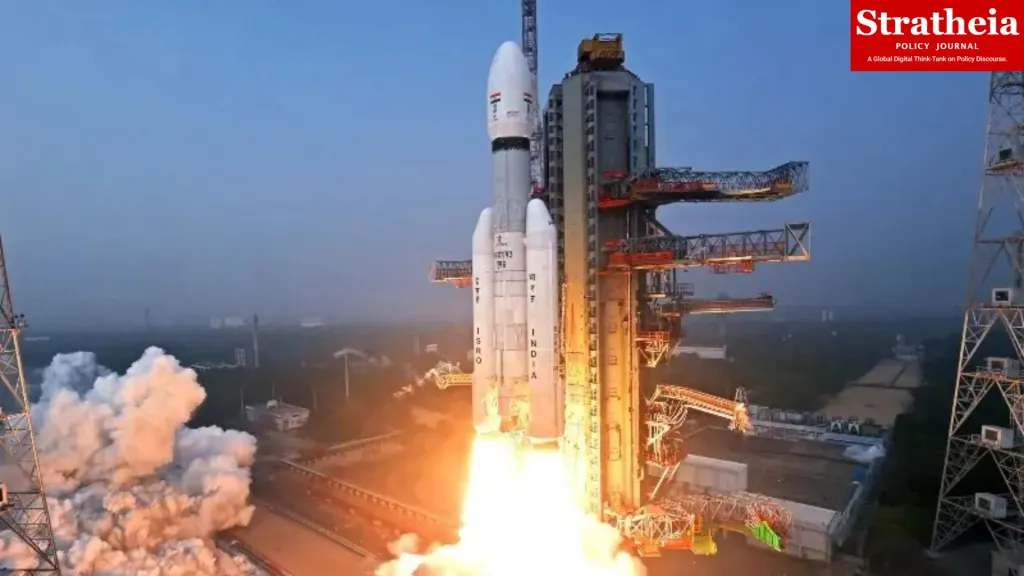
Outer Space exploration is a complex and risky phenomenon where even the launch of a satellite or a payload may not be the benchmark of success. Instead, the success of the space mission is determined by the stated objectives, payload effectiveness, system performance, and the technical outcome of the project. India’s space program, which it claims is mature and a symbol of national power, could not mark the foremost check box of a successful mission (launch). The Indian Space Research Organization (ISRO) portrayed the Polar Satellite Launch Vehicle (PSLV) as the backbone of India’s space missions and a reliable and cost-effective launch service for international customers. The failure of PSLV launches, twice in eight months, raised questions about the credibility, reliability, and sustainability of India’s launch capability.
In May 2025, the PSLV-C61 vehicle failed to launch the EOS-09 surveillance satellite with Synthetic Aperture Radar (SAR) into its desired orbit. In January 2026, the PSLV-C62/ EOS-N1 mission failed to launch the Earth Observation Satellite EOS-N1 and 15 other co-passengers from other countries. Consecutive failures of the “workhorse ” of the Indian space program are a setback to the nation’s space ambitions. It raises doubts about the country’s operational preparedness and technical capacity. It has implications beyond technical embarrassment and the years of hard work involved in developing satellites going into a vein. For a country that aims to hold a place in the space industry, failure of a mission affects its international trust and strategic objectives.
The most immediate loss of failed missions is financial. The destruction of EOS-N1, along with 15 payloads, resulted in the loss of significant financial investment. The estimated loss of PSLV-C61 is ₹450-500 crore, and PSLV-C62/EOS-N1 and payloads are 650-750 crore. The total cost of five failed missions, since 2021, is ₹2,200-2,800 crore (approximately $265-335 million). This amount is equivalent to 15% of ISRO’s 2025-26 budget of ₹24,000 crore.
This is not just a financial loss, but it also costs India lost opportunities. India had generated revenue of $100 million from foreign ride-share payloads. However, countries like Nepal and Brazil have cancelled future projects with India, resulting in a $50-70 million revenue loss for FY26. There is a continuous decline in India’s share in the global small-satellite launch market from 35% in 2017 to nearly zero by 2024- 2025. It depicts declining trust in the commercial arm, NewSpace India Limited, of the Indian Space Research Organization.
The global space economy is a highly competitive field where trust and reliability are decisive factors. When international payloads are lost during launch failures, satellite operators may reconsider their future launch choices, particularly when alternative providers offer more dependable services. Private launch companies such as SpaceX have already intensified competition in the commercial launch sector. High launch frequency and reusable rocket technology by SpaceX have reduced the cost of launch while offering reliability. Recurring failures of Indian space missions bring reputational damage and undermine its wish to be a major commercial space partner in the global launch industry.
There are also technological implications of recurring failure. It does not only mean the loss of the rocket and payload. The reliable and smooth functioning of the space program is dependent upon a careful sync of satellite development, mission planning, and launch windows. Launch failures cannot be brushed under the carpet and entail extensive investigations, engineering reviews, and redesign processes. Failure often leads to delays in future missions, slowing the deployment and interrupting technological progress. The probe into the causes of fault in the third stage of PSLV slowed down the progress of future launches, Gaganyaan-G1.
Moreover, India has lost Earth Observation (EO) Satellites that could have added to Indian security architecture. The loss of the EO satellites with Synthetic Aperture Radar (SAR) and failure of other satellite launches over the years reflects that India is losing ground in geospatial intelligence. The latest PSLV-C62 mission lost EOS-N1, equipped with hyperspectral imaging technology that captures data across hundreds of spectral bands. It could have detected subtle differences in material composition and surface characteristics. If it entered its orbit successfully, it could have assisted in identifying military installations, logistical infrastructure, and terrain features. The loss of EOS-N1 therefore delays the integration of advanced hyperspectral intelligence into this broader surveillance network. In a nutshell, India’s space ambition contradicts its credibility, as it has faced consecutive failures in launching space missions over the course of the last five years. Failed missions do not only mean the loss of satellites, but their implications go far beyond. Indian commercial space missions carried an international payload of fifteen countries. Setbacks in space missions carry more than immediate financial and technological loss. It also delays future missions and challenges the strategic goals as well. Most importantly, it undermines the trust and reliability of Indian commercial launch services.
This article was published by Stratheia in another form at https://stratheia.com/indias-space-setback-the-costs-of-consecutive-launch-failures/


Areesha Manzoor is Research Assistant at the Center for International Strategic Studies (CISS), Islamabad.