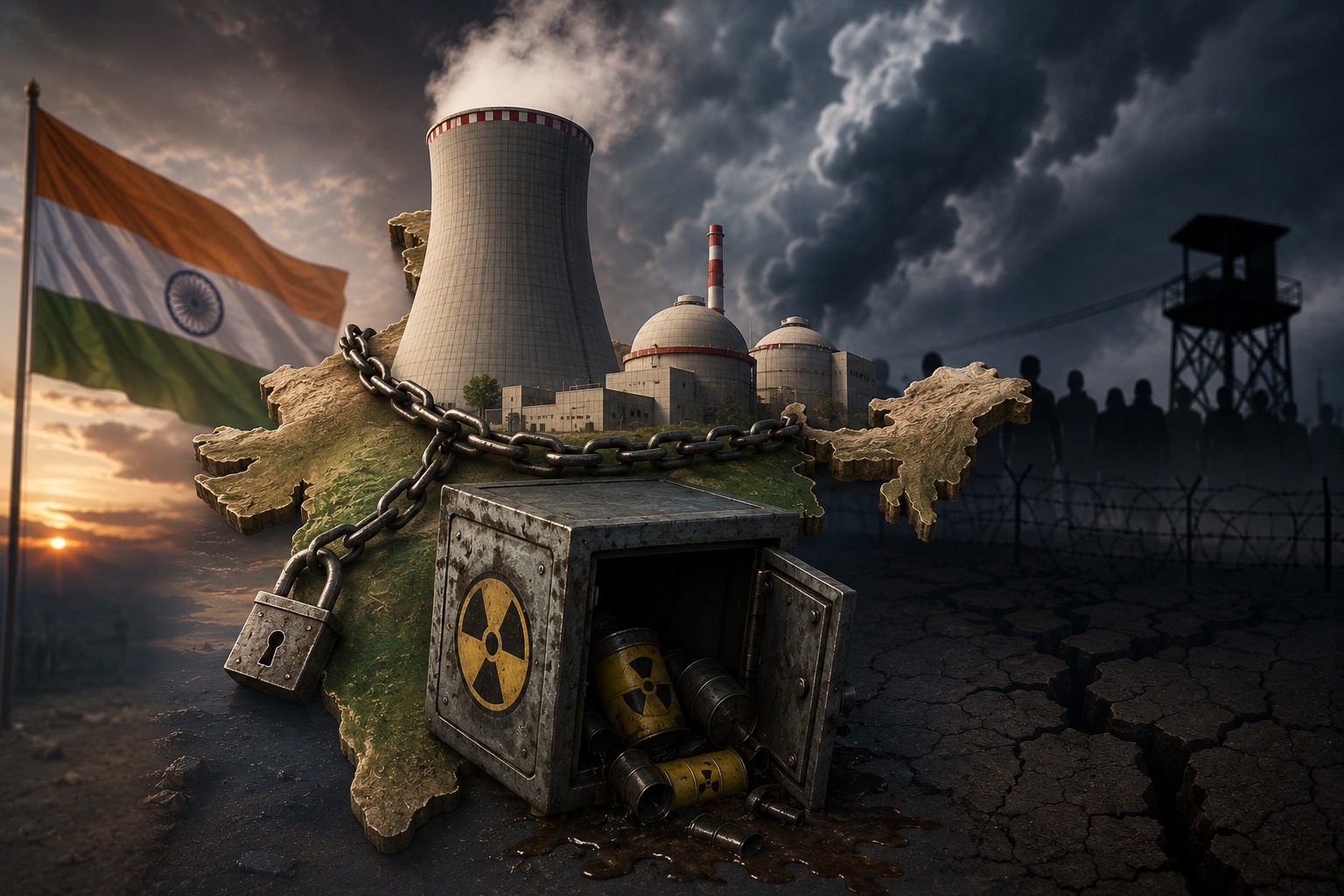
In December last year, India introduced a bill in its lower house entitled “Sustainable Harnessing and Advancement of Nuclear Energy for Transforming India” also known as the “Shanti bill”. The bill aimed at encouraging partnership of private firms to partner in the nuclear sector with regard to peaceful uses of nuclear technology. Though the participation of private firms in the nuclear sector is believed to strengthen India’s capacity to construct and operate, and safely decommission Nuclear Power Plants (NPPs), however grave concerns over India’s nuclear safety persist. Encouraging greater private partnership may contribute in the increase of the output of nuclear reactors to meeting rising demand of energy, expand nuclear facilities and increase fuel efficiency, but India’s past reports of nuclear incidents/accidents and of its associated material raises important question regarding the inclusion of the private firms in such a sensitive domain.
The act was introduced by the Government of India, through the Department of Atomic Energy and passed by Parliament, after which it received Presidential assent. The Act repeals and replaces the Atomic Energy Act, 1962 and the Civil Liability for Nuclear Damage Act, 2010, creating a unified legal framework for India’s nuclear energy sector. As the bill lays down the target of 100 gigawatts (GW) production from the nuclear technology by 2047, India intends to seek the cooperation of private firms, something which was prohibited under Indian Atomic Energy Act of 1962. The concept of the Shanti Bill is aimed at unlocking the full potential of nuclear energy through the maximization of use of nuclear energy and with the cooperation and collaboration of private sectors. During the presentation of the Bill in the Lok Sabha, the Indian Atomic Energy Department stated that “India needs to harness its own nuclear resources more fully and enable active participation of both public and private sectors. Moreover, it is aimed at positioning India as a contributor to the global nuclear energy ecosystem, if it is to meet its decarbonisation goals and its target of achieving 100 GW of nuclear power capacity by 2047”. Between 2024 and 2025, India generated approximately 3% of its electricity from nuclear power.
The public-private partnership in the nuclear domain has already been practiced by the major powers including the United States, the United Kingdom, France and Japan, along with others to meet their energy requirements. In many of these countries, nuclear utilities account for approximately 70% of the nuclear energy projects. While seeking inspiration from this practice, the Indian government has also begun to pave the way for public-private partnerships by following a similar approach.
As per the Shanti Bill, private companies are allowed for greater participation in the nuclear sector including power plant operations, power generation, equipment manufacturing with selected activities of nuclear fabrication including conversions, refining and enrichment of uranium up to a prescribed limit set by the Indian government. The Shanti Act specifies that “certain activities of a sensitive nature will remain exclusively under government control”. However, given its potential risks and implications, associated with nuclear technology, the sector has always remained under strict state control with regard to its safety and security concerns.
Despite all efforts at precautions, the repeated instances of nuclear mishandling expose serious flaws in India’s nuclear safety and security structure, revealing weaknesses in regulatory oversight and deficiencies in existing safety and security mechanisms. In this context, the inclusion of private firms in the nuclear domain without first addressing these structural shortcomings could further complicate the management of nuclear risks and undermine the overall safety and security of India’s nuclear sector.
According to Ambassador Ali Sarwar Naqvi, Executive Director at Center for International Strategic Studies (CISS), it is essential for a state to have a proper regulatory mechanism, when there is a proposal for cooperation between the government and private entities. Having enhanced regulatory mechanism can regulate such collaborations/partnerships between the government and private entities. If this is not done, then there will be frequent incidents of sensitive nuclear material that is often misplaced or lost as has happened in India, a number of times. Since 1990s India has experienced the frequent nuclear incident and accidents. This includes nuclear incidents and accidents at Kalpakkam nuclear power generation in 1987, Tarapur nuclear power plant in 1989 and 1992, Narora fire incident in 1993, Rajasthan Atomic Power Station (RAPS) leakage incident in 1995, Kalpakkam incident in 2002, and Mayapuri incident in 2010. Moreover, more than 20 attempts of theft of uranium and radioactive material have been reported in the last three decades.
Presently, India operates 24 nuclear reactors that have an energy capacity of 7,943 MW while an additional six are under construction. Out of these 24 operational nuclear reactors, 7-8 remain outside the International Atomic Energy Agency (IAEA) safeguards, underscoring the need for India in maintaining effective safety and security. Additionally, it is speculated that 49% of its shares will be held by the private firms including foreign industries, while 51% will retained by the government. US companies have already shown interest in the partnership in the nuclear industry of the country. Furthermore, with the inclusion of the private firms, the responsibilities relating to equipment supplies will be shared by both the private and government entities, depending upon the provisions outlined in the contracts. This can be a concern as it makes the supplier less responsible for the criticism with regard to incidents/accidents, as it when occurs. Several countries with public-private partnerships in the nuclear domain have experienced nuclear incidents and accidents in the past. In 2011, an accident occurred at Fukushima Daiichi NPP operated by Tokyo Electric Power Company (TEPCO), a private firm. This accident demonstrated that the nuclear safety and security cannot only be relied on technology alone. It requires robust and enhanced regulatory bodies with efficient monitoring mechanism by the operators. With the inclusion of the private firms, robust oversight can become more critical in preventing the lapses in safety and security. For India, this illustrates the importance of the enhanced and robust safety and security mechanism, especially when there is a quest for greater private partnership involving foreign firms. Contextually, given India’s diverse institutions and a very extended bureaucracy, it is unlikely that India can effectively work out this kind of joint enterprise, primarily when there are lapses in the existing nuclear safety and security architecture. Including the private firms in such a sensitive matter entails huge responsibilities and a clear willingness to adhere to robust safety and security mechanisms, regular and rigorous monitoring and transparency. A strong coordinated approach and mutual trust are the two key essential requirements for such joint ventures. Moreover, the absence of enhanced coordination and mutual trust, could challenge/hinder the effective implementation of India’s joint venture of its public-private partnership in the nuclear sector.
This article was published in another form at https://ipi.org.pk/indias-new-nuclear-energy-bill-a-risky-expansion-without-adequate-safeguards/


Dr Rahat Iqbal is Associate Director Research at the Center for International Strategic Studies (CISS), Islamabad.