A team of Chinese scientists at the National University of Defense Technology in the Hunan province revealed in June 2025 a prototype of a tiny Unmanned Aerial Vehicle (UAV) to be used in stealth missions, capable of measuring just 70cm in length and weighing 900g. It looks like a mosquito, but it is actually quite small. It has a very thin body, two delicate, leaf-like wings and three hair-thin legs, replicating the anatomy and flight dynamics of insects. Its wings flap, imitating the motion of insects, a bionic design which reduces its acoustic and visual signatures and thus makes it very hard to detect. The developments illustrate a basic paradigm shift especially in stealth technology. The global trend in Intelligence, Surveillance and Reconnaissance (ISR) operations is moving towards stealthy, discrete and agile platforms. As India – the largest importer of major arms globally for its military modernization – disrupts and threatens the fragile stability of regional security architecture of South Asia.
At the moment, insect-sized bionic drone design is based on the integration of aerospace engineering, nano technology, biology, artificial intelligence (AI) and robotics. These tiny machines are spreading around the world due to research and development. Aside from Harvard’s RoboBee, which weighs less than a tenth of a gram, and Germany’s SWARM Biotactics, which is turning to paying NATO customers for cyborg insect swarms, the race to turn tiny machine robotics into weaponry is warming up. The Bumblebee drone, which uses AI to identify targets, has already been fielded by Ukraine in combat and the Norwegian Black Hornet nano drone was used by British forces on the battlefield in Afghanistan for intelligence.
Importantly, there are numerous challenges during the evolution of these bio-mechanic creations. Some of the main hurdles for models like dragon flies and beetles are replicating the dynamics of flapping wing flight using micro-actuators, building a lightweight chassis using carbon fiber or polymer composites and adding sensors like micro-cameras, (Light Detection and Ranging) LiDAR, and Inertial Measurement Units (IMUs) for real-time reconnaissance. Power efficiency is also a key limitation which is solved with high density batteries, solar powered wings and adjustable power management algorithms. Yet, scientists are successful enough to make them operational.
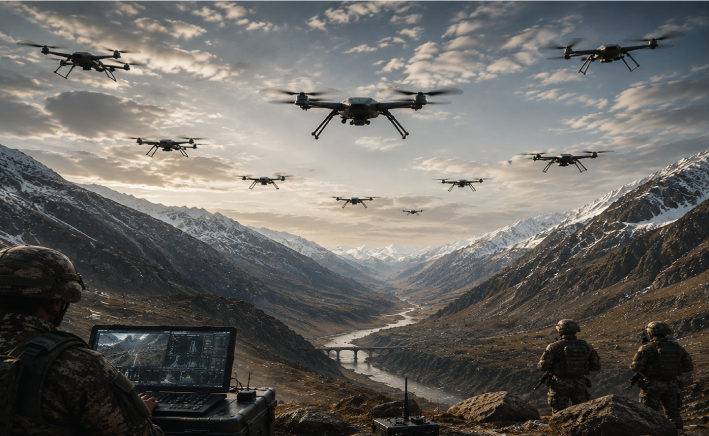
Amazingly, the AI enabled small bio-machines are autonomous and semi-autonomous. AI provides it navigation systems to travel on its own towards the extraction point. Its learning algorithms adapt in real time. The sensor fusion helps in precise situational awareness. All crucial features of machine decision making autonomy are available in this new marvelous technology. Inspired by the swarm behavior of insects, collaborative tasks like area mapping, target tracking, and distributed sensing are also possible among these little robots. Early successful prototypes showed flapping-wing mechanisms. It helped avoid obstacles. This became effective and possible with autonomous navigation, and real-time imaging. Despite this, there are several challenges present with this robot technology along with its threat to security implementation in the regional environment.
In the meanwhile, the development of bio-inspired drone technology has significant implications for the South Asian region where the strategic rivalry, nuclear deterrence and disputed border issues are part of the package. Here, Indian military modernization plays an important role to destabilize the security architecture of the region with these technologies. The rapid adoption of AI, advanced drone capabilities, and biomimetic systems for example, the Indian E-Raptor inspired by the falcon and built in collaboration with French companies, could lead to a major surveillance imbalance between India and Pakistan. Also, on 29 June 2026, outgoing Indian Army Chief General Upendra Dwivedi announced the raising of specialized Baaz battalions under the Army Aviation Corps. As pointed out in regional security analyses, the May 2025 crisis between New Delhi and Islamabad also demonstrates how quickly tensions can flare up without effective dialogue. This trajectory that India is institutionalizing drone-centric ISR and strike as a standing part of its force structure, across the Army, Air Force, Navy, and paramilitary forces at the same time.
Pakistan’s induction as a member state of the World Artificial Intelligence Cooperation Organization (WAICO) is a testament to its support for international frameworks for AI governance. On the other hand, India’s non-participation in this exercise indicates a difference in methodology which makes it difficult to put in place bilateral as well as such regional Confidence Building Measures (CBMs) for emerging technologies. Lack of a common framework for controlling AI-powered surveillance and autonomous systems leaves uncertain emerging risks. While the Cold War era nuclear near-miss scenarios entailed human judgment ultimately triumphing over the automated system, the role of AI and autonomous systems in surveillance and, potentially, in targeting introduces new elements such as lethal autonomous weapon systems that current institutional safeguards may not be able to resolve. Overall, the design and development of insect-sized bio inspired drones for autonomous reconnaissance have the potential to revolutionize various fields, including military modernization. Continued advancements in biomimicry, materials science, and AI are paving the way for more efficient and autonomous insect-inspired UAVs. But, with the increasing spread of this technology, South Asia is at a crossroads. The region’s security analysts have no choice but to acknowledge that the distinction between known and unknown risks has become increasingly indistinct with conventional as well as non-conventional forces particularly in the development of stealth bio-inspired monitoring systems. Going forward, future development work will need to not just enhance flight endurance and swarm capabilities, but also consider governance, ethical and strategic issues raised by these technologies to regional stability. The technological prowess of nano drones can inadvertently draw South Asia towards an unpredictable and unstable security path if there are not cooperation and risk-reduction in place.
This article was published by the Strategic Forecast in another form at https://strategicforecast.cissajk.org.pk/?p=23613


Mr Muhammad Ali Baig is Research Officer at the Center for International Strategic Studies (CISS), Islamabad.