The existing Confidence building Measures (CBMs) between India and Pakistan are no longer sufficient to control the future of arms control in South Asia, considering the threats posed by the emerging technologies. These CBMs were designed to maintain strategic stability in South Asia characterized by single role delivery systems. With the emergence of dual use missile systems, the old CBMs seem obsolete. The 1998 agreement on the prohibition of attack against nuclear installation and facilities as well as the 2005 agreement on the pre-notification of flight testing of ballistic missiles are still in place and have survived major conflicts since their inactions. However, they were adopted before the emergence of dual use missiles system. Hence, they fail to adequately address one of the most serious challenges to the strategic stability of South Asia; the regulation of dual use missiles system.
Dual-use system could ruin crisis stability in South Asia in two ways. First, it creates uncertainty whether it is loaded with conventional weapons or nuclear warheads. Their use can present a perception of “use it or lose it” dilemma to enemies who might interpret the incoming missiles as a preemptive first strike rather than a conventional attack. Second, since dual-use systems present an ambiguity between conventional and strategic forces, the enemy’s conventional strikes on such system can be misunderstood as an attempt to attack nuclear forces. Consequently, this system presents a precarious condition of creating space for misperception, and inadvertent escalation.
Recent incidents between India and Pakistan demonstrate that the South Asian security dynamics have fraught with conventional conflict evolved from limited stand-off such as 2019 Balakot strike to a comparatively prolong conflict of four days in May 2025, exchanging missiles, drones and electronic warfare. The risk of the dual-use systems leading to escalation would only grow if the next confrontation between Pakistan and India continues for long period of time. There is a growing concern in Pakistan that India has shifted toward a counterforce posture which would probably make the dual-use system quite alarming and created escalation risks in future.
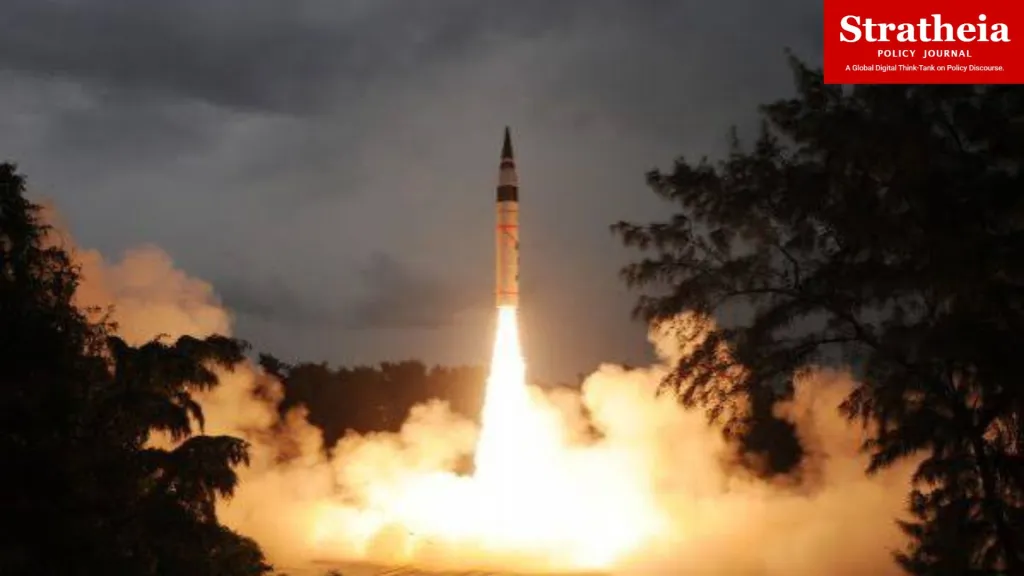
The entanglement between the conventional and non-conventional spheres has been worsen in South Asia by India’s evolving deployment of dual-use missile systems. Number of incidents in the past take us to the grim reminder that how significant it needs to establish a transparent division between conventional and strategic delivery systems. In March 202crisisl launch of BrahMos missile in normal time, trespassed the Pakistani territory and hit near Mian Channu, followed by another incident in the May 2025 during crisis situation, the deployment of BrahMos missiles, reflected how the use of dual missile system during particularly during crisis could provoke ambiguity and enhance the risk of misperception and inadvertent escalation. As a result of dual use missile system by India, Pakistan may mischaracterize the incoming missile and wrongly assess how it is armed or be unable to characterize it. Mischaracterization can aptly lead to a false positive (misunderstanding of a nonnuclear missile as a nuclear missile) or a false negative (mischaracterization of a strategic missile as a conventional missile).
On other hand, Pakistan has a separated between its conventional and strategic missile capabilities. Pakistan established an Army Rocket Force Command (ARFC) in this direction. ARFC has separated the operational employment of land based conventional missiles from that of land based nuclear delivery systems of the National Command Authority (NCA). India should also replicate this model and reduce the risk of misperception from duel-use systems.
Therefore, it urgently needed to formulate a new stream of confidence building measures on dual-use system between Pakistan and India. The major challenge is not stemming from the structural ambiguity presented by dual-use missile systems. To address this challenge, it is important to verification based on observable features rather than declared intentions. Ther are four recommendations to achieve the new CBMs on dual-use system between India and Pakistan.
First, the already existing protocol related to missile pre-notification agreement of 2005 should be expanded to incorporate cruise missiles, hypersonic weapons, and re-entry vehicles. Second, both Pakistan and India should start negotiation on reciprocal transparency pertaining to the separation of conventional and strategic missile system. This would not require disclosing any other sensitive information such as targeting plans, and warhead inventories. It would create adequate structural clarity to figure out by both sides whether the system is assigned for conventional purpose or for strategic role. Similarly, Pakistan and India should carve out a permanent missile risk-reduction mechanism, assigned exclusively to missile related activities such flight test notification, force movements, and mega-scale military exercises that involve dual-use systems.
Last, this arrangement for missiles system should be extended to the maritime forces as well. India’s growing sea-based deterrence created an asymmetrical maritime calculus in South Asia, with Pakistan lacking the SSBNs system. Both Pakistan and India need to establish bilateral Incidents at Sea (INCSEA) arrangement, to avert the strategic vulnerability. In a nutshell, the ambiguity of the dual-use system in South Asia is not symmetrical, but it is the corollary of India’s doctrinal and force postures. This operational ambiguity has been created deliberately by India.
This article was published by the Stratheia in another form at https://stratheia.com/addressing-the-dual-use-missile-challenge-the-need-for-new-cbms-in-south-asia/


Mr Murad Ali is a Research Officer at Center for International Strategic Studies (CISS), Islamabad