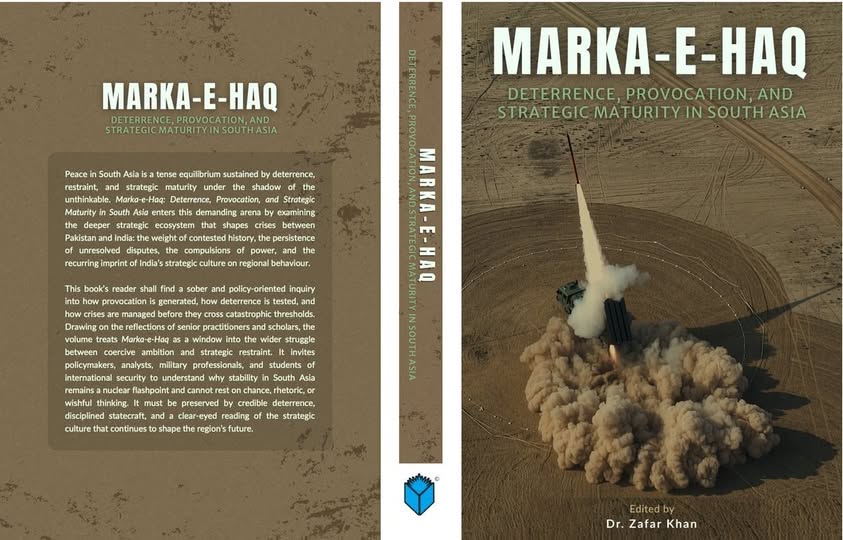
‘Marka-e-Haq: Deterrence, Provocation and Strategic Maturity in South Asia,’ is a book that is both theoretically ambitious and grounded in the practical developments of the May 2025 India-Pakistan crisis. This book seeks to analyze the deterrence stability, strategic, military, diplomatic, and technological aspects of the May 2025 India-Pakistan crisis, named Mark-e-Haq by Pakistan. The book assesses broader questions of deterrence stability, strategic culture, escalation management, strategic stability, and regional security concerns in South Asia. This book consists of chapters written by policy makers, academicians, and experts in the field. This book is thus a valuable source material for various stakeholders and readers, such as policy makers, security practitioners, researchers, strategic studies scholars, military officers, defence professionals, students, analysts and nuclear policy analysts.
This book contains ten chapters. Each chapter is relevant to a specific theme related to security in South Asia. Dr. Zafar Khan is the editor of the book. He has compiled the chapters and preserved the theme of the book in accordance with its title. He is the Executive Director of the Balochistan Think Tank Network (BTTN). A Professor of International Relations, he holds a PhD in Strategic Studies from the University of Hull, Yorkshire, UK. His well-known national, and international publications, diversified experience, and credentials help the readers assess each chapter through the lens of a strategic studies and defence expert. The volume helps readers gain deeper insights into the strategic episode of Marka-e-Haq in South Asia’s contemporary history.
This review first provides a glance at each chapter, along with its core argument, key elements, strengths, and key takeaways. Chapter one, ‘India’s Strategic Drift and South Asia’s Security Dilemma’ is written by Ambassador Zamir Akram (Retd.). The chapter focuses on the relationship between India’s evolving strategic direction and its implications for regional security. To analyze this relationship, the concept of a security dilemma has been developed and is central to the chapter. The main points of the chapter are regional security risks, strategic behavior, and the impact of policy shifts on deterrence and stability. The author examines how India’s strategic choices influence the regional security environment and push other states towards a security dilemma.
The second chapter has been written by Dr. Zafar Nawaz Jaspal, titled, ‘India’s Terror Industry: Threat to International Peace and Security.’ He talks about how the acts of Indian sponsored terrorism and cover operations have become important causes of instability not only in South Asia but even worldwide. He says that such acts work as a means of creating tension between India and Pakistan while India creates chaos in Indian Occupied Jammu and Kashmir merely for blaming Pakistan. Terrorism, he writes has become an instrument of foreign policy of India. The chapter also discusses the international legal and political repercussions of such acts of terrorism.
This Chapter ‘Kashmir and Water Resources: Nuclear Flashpoints in South Asia,’ has been written by Dr. Rizwana Abbasi who discusses the connection between water security and the dispute over Kashmir, in the back drop of South Asia’s nuclearized and militarized environment. She writes about the issue of water i.e. rivers originating from Kashmir and entering into Pakistan as becoming a strategic asset of India to be used against Pakistan. She talks about the concerns of water security and human rights issues under international law. She discusses the consequences of environmental strain coupled with Indian political hostility in terms of regional security and their escalation.
Lieutenant General Mazhar Jamil (Retd.) has written the fourth chapter titled, ‘Strategic Culture of Bharat and Offensive Doctrines, Pakistan’s Response: Cohesive Deterrence.’ This chapter explains Indian strategic culture with the development of offensive military doctrines i.e. based on violence and unilateralism. Consequently, Pakistan – being as regional security stabilizer – has given a response framed by the concept of Cohesive Deterrence. The chapter assesses the doctrinal interaction between the two states through the lens of Indian strategic culture, which dates back thousands of years to the ideas of Kautilya, which is very illuminating. More importantly, the author analyzes how strategic culture shapes doctrine and how deterrence adapts in response to evolving military postures. Strategic culture and doctrine are interconnected, and responses to offensive military concepts are likely to shape future deterrence dynamics.
Chapter five ‘Marka-e-Haq and the New Discipline of Deterrence’ is written by Brigadier Dr. Zahir Kazmi (Retd). The author argues that recent developments have introduced new considerations into deterrence thinking. The concept of a new discipline of deterrence suggests doctrinal or theoretical evolution. This chapter extracts lessons from the Marka-e-Haq and examines how strategic thinking may be changing. Crises like those between India and Pakistan may require a rethinking of traditional assumptions about deterrence and escalation.
The sixth chapter is ‘Perils of Self-Deception in Nuclear South Asia.’ The author is Dr. Rabia Akhtar. She warns in her chapter against strategic overconfidence and its perils. She discusses the risks of miscalculation in a nuclear sensitive environment, particularly in South Asia. It is highlighted in the chapter that cognitive biases i.e. self-deception of India and calling Pakistan’s nuclear bluff in security policymaking become a significant challenge for the region. Furthermore, she examines how inaccurate Indian assumptions may have increased the risk of escalation during the May 2025 crisis.
Chapter seven is ‘Escalation Ladder and Future Crisis Blueprint.’ It is written by Brigadier Dr. Naeem Salik (Retd.). The chapter is built around the concept of the escalation ladder. It examines how a future crisis may unfold. The author focuses on potential crisis progression and escalation management. The chapter further discusses and identifies lessons for managing future crises. The core argument is to understand escalation pathways which is essential for preventing crises from developing into larger conflicts.
The eighth chapter of the book, ‘Re-Assessing Deterrence Stability in South Asia – Lessons from the May 2025 Crisis’ is written by Lieutenant General Khalid Ahmed Kidwai (Retd.). The author examines the May 2025 crisis as a test of deterrence and crisis management mechanisms. He further evaluates deterrence dynamics between India and Pakistan, arguing that deterrence remained effective, although it was subjected to significant stress due to Indian aggression. The main purpose of the chapter is to draw lessons from the May 2025 crisis, during which nuclear deterrence, crisis stability, escalation management, and strategic signaling all played their role.
Chapter nine is written by Lieutenant General Sarfraz Sattar (Retd.) titled ‘Lessons from Marka-e-Haq in view of Indian Strategic Culture.’ The chapter seeks to analyze India’s strategic behavior through the lens of strategic culture. It examines how historical and cultural patterns of decision making influence military doctrines and political choices. It links strategic culture to crisis escalation particularly in relation to Indian military behavior during the 2025 crisis. Ultimately, the author argues that strategic culture remains a critical factor in understanding South Asian regional crises.
Finally, the chapter ten is ‘Strategic Stability in south Asia – A Difficult Journey Ahead’ which is written by Lieutenant General Aamer Riaz (Retd.). This chapter assesses the challenges to strategic stability which remains fragile despite nuclear deterrence where emerging technologies are transforming traditional deterrence relationships. The chapter demonstrates that Indian military modernization increases uncertainty during crises due to technological developments and doctrinal evolution. The author further discusses how future stability depends upon responsible strategic behavior.
One thing to appreciate about the book is the references provided by the authors to support their research. The sources cited throughout the volumes rely on primary material, which strengthens its academic and policy value. Also, from a scholarly perspective, Marka-e-Haq represents an important contribution to contemporary security literature. It is particularly, valuable as a source, as a compendium of how Pakistani strategic thinkers interpret the May 2025 India-Pakistan crisis and its implications for regional stability. Overall, the book suggests – based on the historical evidences of India-Pakistan tensions and recurring crises – that Indian behavior has contributed significantly to regional instability.
The contributors’ core argument is that Pakistan demonstrated strategic maturity during the crisis by avoiding uncontrolled escalation. In response to India, Pakistan maintained deterrence credibility by responding proportionately to military developments. According to the authors, this helped preserve regional stability despite the heightened tensions generated by India in a nuclearized environment. The title of the book ‘Maturity in South Asia,’ therefore, reflects the contributors’ view that in the crisis Pakistan demonstrated strategic restraint rather than strategic recklessness.
One may argue that a limitation of this book is that, first, it is solely written by Pakistani contributors i.e. mostly practitioners and could have included academics, scholars and other experts. However, in my opinion, this provides important insights into Pakistan’s strategic perspective. The volume opens different theoretical as well as practical dimensions for readers regarding the nuances of strategic stability and its components, including deterrence stability, crisis stability and arms race stability. Second, several chapters appear primarily policy-oriented rather than deeply theoretical. This is not necessarily a weakness, rather, it may appeal to readers seeking a combination of policy oriented analysis and theoretical innovation.
In relation to deterrence, the book implicitly and explicitly suggests that Pakistan’s deterrence framework remains effective in preventing major wars despite increasing technological and doctrinal challenges from India. It also acknowledges that future conflicts will involve precision strike capabilities, information warfare, Artificial Intelligence (AI), ISR dominance, cyber operations and other emerging technologies. Therefore, Pakistan’s strategic community must continuously adapt its deterrence posture. The book further argues that deterrence is not a permanent condition but an ongoing process requiring political, diplomatic, and military coordination. In conclusion, Marka-e-Haq: Deterrence, Provocation and Strategic Maturity in South Asia is best understood as a strategic reflection on the May 2025 crisis and its broader implications for regional security. The book’s greatest value lies not in providing a definitive account of the crisis, but in simulating discussion on how deterrence, strategic culture, military doctrine, and emerging technologies are shaping the future security landscape of South Asia. The volume also highlights that water security, hybrid warfare, information operations and terrorism are increasingly important dimensions of national security. For scholars of strategic studies, it offers a useful window into contemporary thinking on deterrence and crisis management in a rapidly evolving regional environment.


Mr Muhammad Ali Baig is Research Officer at the Center for International Strategic Studies (CISS), Islamabad.