Press Release
India aspires to be a regional hegemon, yet its neighbors increasingly view it with suspicion and distrust.
Former Chairman Joint Chiefs of Staff Committee, General Zubair Mahmood Hayat, NI (M)
Islamabad, 2nd April
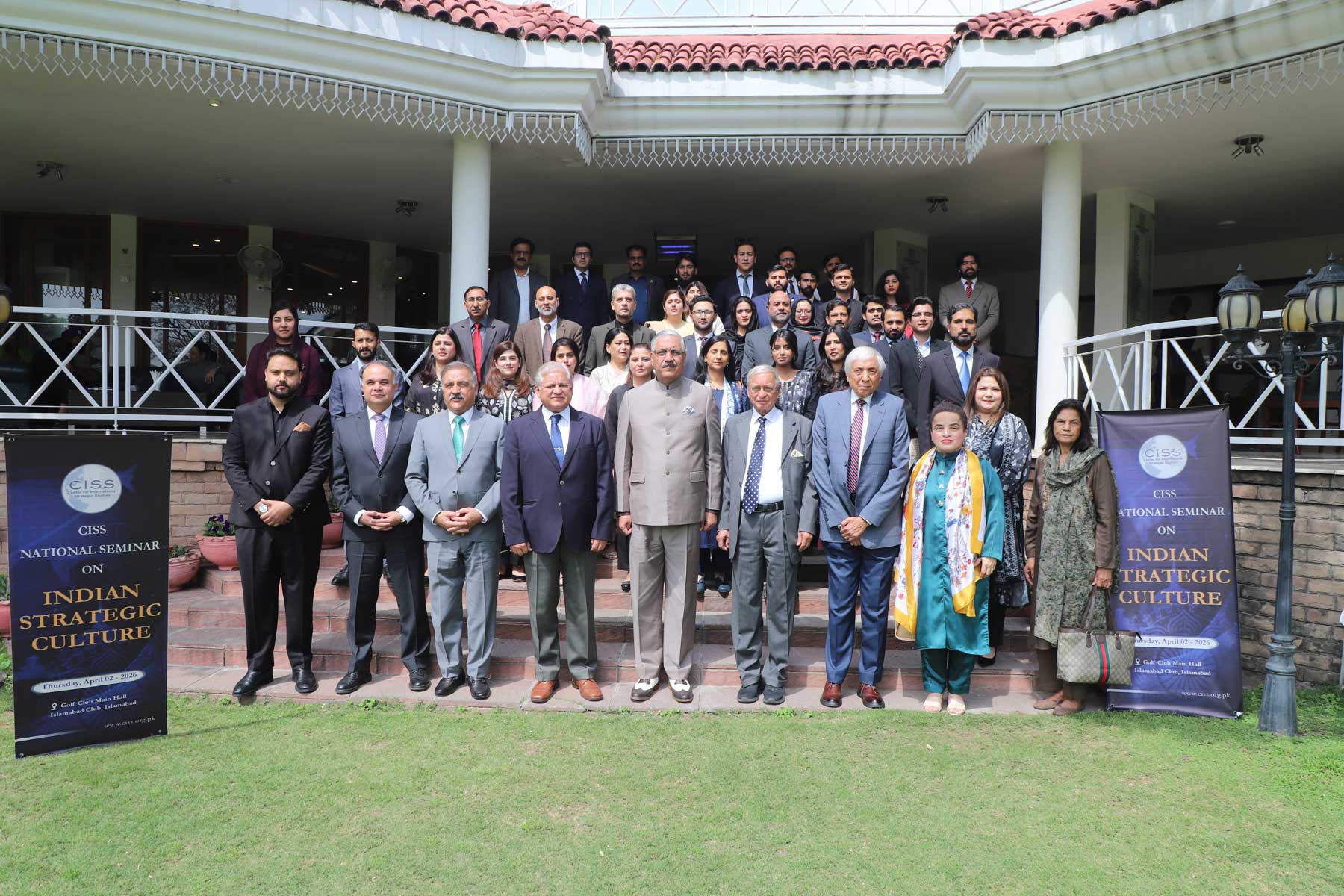
While delivering the keynote address at the National Seminar organised by the Center for International Strategic Studies (CISS), Islamabad, held at the Islamabad Club on April 2, 2026, Gen Zubair Mahmood Hayat, former Chairman Joint Chiefs of Staff Committee (CJCSC) stated that India suffers from significant strategic deficits. He observed that for decades, particularly in the post-Soviet era, the world has watched India with confusion – is it a friend, an enemy, or merely a civilisational drift? This deficit, he noted, was identified as far back as 1992 in a RAND Corporation study, which the Indian establishment long dismissed as Orientalist or misleading. But the author, John D. Denham, was not just right; rather, he was prophetic. The problem is not that India lacks the ingredients of strategic culture, including history, territory, and population, but that it has allowed its strategic culture to be consumed internally by Hindutva ideology.
The speakers of the seminar featured a distinguished group of scholars and practitioners, including Maj Gen Zahid Mehmood (Retd.), Principal NIPCONS, Islamabad; Dr. Mujeeb Afzal, Assistant Professor at the School of Politics and International Relations (SPIR), Quaid-i-Azam University; Dr Asma Shakir Khawaja, Executive Director of CISS, AJK; Dr Qamar Cheema, Executive Director of the Sanober Institute, Islamabad; Dr Bilal Zubair, Director Research at CISS, Islamabad; Dr Umair Pervez Khan, Lecturer at NDU, Islamabad; Dr Rahat Iqbal, Associate Director Research at CISS, Islamabad; and Mr. Syed Ali Abbas, Research Officer at CISS, Islamabad.
Ambassador Ali Sarwar Naqvi, Executive Director CISS Islamabad, in his opening remarks, said that Indian strategic culture has evolved through centuries of historical experience, including periods of imperial rule, colonial domination, and post-independence state-building. However, in recent decades, a significant transformation has taken place with the rise of Hindu nationalist ideology, commonly referred to as Hindutva. He noted that this ideology, associated with organizations such as the Rashtriya Swayamsevak Sangh (RSS) and politically represented by the Bharatiya Janata Party (BJP) under the leadership of Narendra Modi, has increasingly shaped India’s domestic and foreign policy outlook
In his remarks former CJCSC highlighted that, in its current incarnation, India has failed to cultivate a coherent strategic culture. India possesses deep roots in civilization, yet in modern times, it has no strategy for the 21st century. The space for rational, interest-based strategic thinking has been colonized by sentimentalism and dogma. He highlighted that the dominant strategic thought emanating from New Delhi today prioritizes Hindu Rashtra, not merely as a domestic political tool, but as the very lens through which the world is viewed and engaged. In this vacuum, dangerous influences have filled the void, including the adoption of an Israeli-style security mindset, replacing the soft power legacy of Gandhi with the hard power model of Sharon.
The absence of coherent strategic thought in India carries far-reaching consequences: it has left India a regional hegemon without allies which is hated by its neighbours and respected by none; it has created conditions where miscalculation is not a possibility but an inevitability; it has radicalised the neighbourhood by pushing Muslim-majority neighbours toward rival powers, accelerating India’s own encirclement; it has militarised foreign policy by reducing diplomacy to an afterthought and force as a first resort; and it has exposed the hollow ambition of Vishwaguru – an aspiration to global moral leadership that rings sounds delusional when India cannot secure peace in its own region.
Dr Asma argued that Hindu nationalism has become a key expression of Indian strategic culture, shaping policy, military doctrine, and regional ambitions, while driving visions such as Viksit Bharat 2047, Hindu Rashtra, and Akhand Bharat.
Maj Gen Zahid Mehmood highlighted that the regional dynamics in South Asia are changing. We are no longer confronting India of 1947; instead, the country is increasingly transitioning from a model of secular democracy toward one driven by civilizational revival and aspirations of imperial influence Dr Mujeeb Afzal highlighted that since 2014, the rise of Hindutva has shifted India toward ideological consolidation, reduced fragmentation, and an ambition to project power globally, blending civilizational continuity with economic, military, and identity-driven assertiveness.
Media Coverage
DAWN: https://www.dawn.com/news/amp/1988311
Pakistan Observer: https://pakobserver.net/gen-zubair-warns-rise-of-hindu-extremism-in-india-risks-regional-stability/