Recent conflicts have demonstrated that battlefield outcomes are increasingly shaped by precision, range, volume, and affordability rather than the use of conventional measures of military power. The ongoing US-Israel war on Iran has shown that long-range missiles and low-cost drones allow a technologically disadvantaged state to impose costs on a stronger adversary far exceeding the investment required to generate them. For Pakistan, facing a conventionally superior adversary, these developments are directly relevant to its security calculus. The May 2025 confrontation with India has already accelerated Islamabad’s recognition of this reality, and the US-Israel war on Iran has since validated it on a larger and more consequential scale. Acting on the lesson that range, precision, and volume are decisive in modern conflict, Pakistan has advanced its conventional missile programme and established a dedicated rocket force command. A credible strike capability, however, depends not only on the missiles but also on the depth of inventory and launchers available to sustain operational pressure under conflict. Similarly, drones, which form an integral part of any modern strike package by saturating air defences ahead of missile salvos, equally demand sustained investment in volume and production scale. Pakistan is moving in the right direction, but on both fronts, continued investment and expansion remain essential.
The US-Israel War on Iran: Asymmetric Cost Imposition in Practice
When the United States and Israel launched war against Iran in February 2026, Tehran retaliated without a conventional parity. Iran’s retaliation constituted ballistic and cruise missiles and large numbers of Shahed-series one-way attack drones. In sustained salvos, they targeted American and Israeli key operational nodes such as air defence systems, E-3 AWACS aircraft, and KC-135 aerial refuelling tankers.
However, an important impact was not only operational, but also economic. Iran fired more than 5,000 drones and missiles, pushing American and allied air defence systems to use interceptors at a rate that was unsustainably high. The cost of Shahed drone ranges from twenty to fifty thousand dollars while a Patriot PAC-3 interceptor is approximately four million dollars. The cost of each THAAD interceptor is about 12-15 million dollars. According to estimates, Bahrain exhausted as many as 87 per cent of its Patriot missiles, Israel used up 81 per cent of its Arrow missiles by the end of March and the UAE used up around 75 per cent of its air defence missiles. The United States had to shuffle interceptor stockpiles from other parts of the world to make up for the loss. Stockpiles which had been prepared over many years were depleted in a matter of weeks, which will take now years to replace them. The economic toll of the conflict has also been significant. Israeli economic losses are estimated at approximately three billion dollars per week, while United States military losses during the conflict is assessed at between 2.3 and 2.8 billion dollars.
Pakistan’s Strategic Calculus and May 2025
Consider Pakistan’s defence budget for FY 2025-26 is approximately 18 billion dollars, as compared to India’s defence budget of 75 billion dollars. India has definite strengths in terms of force structure, platform numbers, and military modernisation. It is continuing to evolve towards integrated theater commands, intended to provide increased precision strike capability and quicker joint-force mobilisation at operational depth. Pakistan cannot compete with India platform by platform, but it has the ability to make any Indian military action too costly and its missile programme has a pointed trajectory toward this end. The Fatah missile series is a testament of this capability in Pakistan.
The Fatah missile series, ranging from 140 kilometres with the Fatah-I to 750 kilometres with the Fatah-IV, places virtually all critical Indian military infrastructure within conventional strike range. The depth of a missile force makes Indian operational planning difficult, diverting resources away from the offensive to defence and dispersal. In tandem with Fatah missile series, large volume of low-cost drones can also overwhelm the air defence network and make the defence less deep, creating opportunities for missile attacks.
The conflict demonstrated that range and precision strike capability directly shape escalation dynamics and battlefield outcomes from the earliest phase of engagement. The formation of the Army Rocket Force Command demonstrated that Pakistan now views missile and drone capability as an integral part of its deterrence and warfighting capability. This strategic course has since been confirmed on a larger and more significant landscape by the war in the Middle East.
Building the Inventory Depth
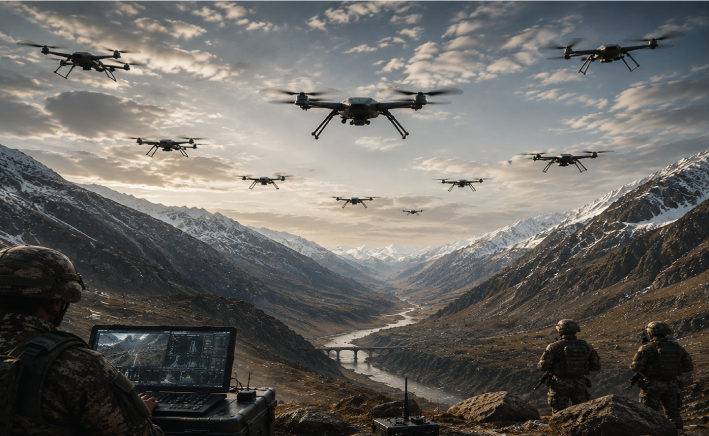
In the US/Israel-Iran war, the heavy volume and continuity of the campaign proved more important than technical sophistication. The sustained production of Iran’s attack campaign drove allies to use up their interceptor stocks. A continuous drone campaign, even if interception rate is high, affects targets and erodes adversary interceptors at the same time. It compounds effect of each salvo as it proceeds, continuously reducing defence capability. As launch volumes increase, air defence coverage degrades to the point where missiles can penetrate. To get that same operational impact, Pakistan programmes have not yet reached to the production scale of the missiles and especially drones.
Pakistan is in progress to develop more than six different designs of loitering munitions at various institutes including NESCOM, NASTP and private companies. The challenge is that it becomes a disjointed affair, with a few programmes generating operationally limited quantities, instead of resources being concentrated on one or two scalable designs. At the same time, Pakistan’s indigenous drone manufacturing is being rapidly pursued and is expected to increasingly fulfil national defence requirements. While advanced systems can be used as decoys and as radar emitters ahead of a missile salvo, they are not adapted to be the mass attrition layer needed for this strategy.
The right model should be simple airframe, small piston engine, commercially available guidance electronics, and conventional warhead. Pakistan’s existing industrial base, spanning its composites manufacturing sector for airframes, its automotive industry for engine components, and Pakistan Ordnance Factories for warheads and fuses, provide a credible foundation upon which this production capacity can be built. The requirement is to concentrate production resources on scalable, and simple designs rather than fragment them across a portfolio that produces technical variety at the cost of operational volume. Moreover, spreading assembly across multiple dispersed sites, rather than concentrating production in a handful of large facilities, ensures that drone manufacturing continues even under wartime conditions when centralised infrastructure becomes a target. Translating conflict experience into doctrine, production capacity, and operational readiness is a gradual process, and Pakistan is still working through it. The strategic direction is sound and the institutional foundations are in place. What remains is the harder industrial work, scaling missile inventory, expanding launcher numbers, and building drone production to the volume this strategy demands. The Iran war has confirmed that this approach is correct. The task now is to build it before the next conflict.
This article was published in another form at https://cscr.pk/explore/themes/defense-security/sustaining-strategic-volume-in-the-age-of-mass-drone-warfare/


Syed Ali Abbas is Research Officer & Comm Officer at the Center for International Strategic Studies (CISS) Islamabad. He is also an MPhil scholar in the Department of Strategic Studies at the National Defense University (NDU) Islamabad.