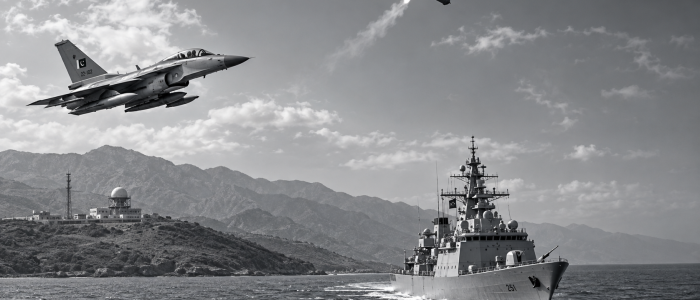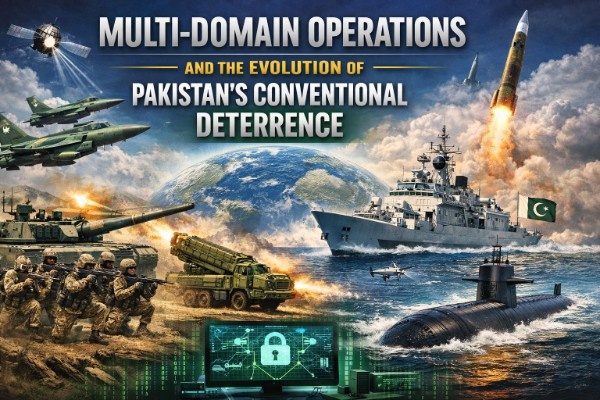
The South Asian security environment is undergoing a fundamental shift in how conventional military effectiveness is defined. Decision speed, cross-domain coordination, and technology-enabled command and control have emerged as primary determinants of operational success, a reality that the May 2025 conflict brought into sharp and irreversible focus. The recent Pakistan-India conflict in May 2025 have reinforced that these are now an active operational reality. Pakistan’s military defines multi-domain operations as the “synchronized application of air, land, cyber, electronic warfare and autonomous systems which converge into a single seamless design” — one where every sensor feeds to every shooter, every strike shapes the next maneuver, and every action pushes the adversary closer to operational collapse.
Pakistan’s articulation of multi-domain operations must be understood within this evolving environment. The important question is whether armed forces are translating multi-domain concepts into usable structures and routines, aligning force design, command arrangements, and training to a battlespace where integration and coordination increasingly decide outcomes. Pakistan’s trajectory reflects a measured, institution-driven evolution: an effort to align existing capabilities with a more networked and time-sensitive operational reality.
Crisis Dynamics and the Logic of Multi-Domain Integration
Crises in South Asia rarely unfold in a linear or predictable manner. They are marked by ambiguity, compressed political timelines, and limited tolerance for decision latency. Under such conditions, assumptions about the capacity for rapid and controlled conventional operations become central to strategic calculation. Confidence in speed and coherence can shape risk-taking behavior as much as formal force balances, and the consequences of mis-judgment become correspondingly severe.
Pakistan’s emerging emphasis on multi-domain integration can be read as a measured attempt to operate effectively within this compressed decision environment. Official formulations highlight synchronization across services and domains. The operational idea is to reduce decision latency, limit inter-service friction, and enable coordinated action under time pressure. Multi-domain operations are framed less as the pursuit of dominance in every domain and more as an effort to preserve operational coherence while disrupting an adversary’s coherence early, precisely when crises are most volatile and miscalculation most costly.
At the operational level, the focus is on shaping conditions prior to decisive maneuver. Intelligence, surveillance, and reconnaissance feed directly into targeting and fire-support processes. Air, land, cyber, and electronic effects are treated as mutually reinforcing. The premise is that operational coherence, once degraded, is difficult to restore within the political and temporal constraints that typically define South Asian crises. Maintaining that coherence under pressure, not merely demonstrating it in exercises, is the real test.
From Concept to Practice: Critical Enablers
Two developments illustrate how Pakistan is translating multi-domain integration from concept to practice. The first is the establishment of the Army Rocket Force Command (ARFC). Pakistan has long possessed long-range artillery and rocket systems, but their employment was not consistently embedded within joint planning structures. A dedicated rocket force represents a significant step toward centralizing the targeting, planning, and coordination of long-range conventional fires within a coherent command framework, and signals a deliberate move to strengthen the conventional response ladder.
The strategic significance of this development extends beyond organizational consolidation. By institutionally separating the management of conventional long-range fires from nuclear delivery systems, Pakistan signals an intent to maintain clear distinctions between rungs on the escalation ladder. This clarity serves deterrence: it reduces ambiguity about the nature of a response, lowers the risk of misinterpretation under time pressure, and preserves decision space for both sides during a crisis. Centralized command also improves the alignment of rocket forces with intelligence, surveillance, and electronic warfare assets, enabling earlier, more deliberate employment against command nodes, logistics hubs, and force concentrations across operational depth.
Institutional consolidation, however, demands discipline. Modern long-range fires are as much about precision and coordination as about range. Without integrated targeting systems and rigorous command processes, such capabilities risk operational inefficiency or, more seriously, unintended escalation. The credibility of the ARFC will ultimately depend on whether its doctrine, training, and command culture develop in step with its hardware. Recent exercises have demonstrated this integration in practice, armor and mechanized infantry advancing under digitized artillery targeting, with engineers maintaining tempo through mine-clearing operations and drone swarms embedded in fire concentration to compound the effects of conventional fires. Alongside centralized long-range fires, Pakistan has also expanded its use of loitering munitions and unmanned strike systems, reflecting a broader shift toward distributed precision engagement. Recent developments in indigenous and jointly produced systems indicate growing emphasis on stand-off targeting, persistence, and flexible employment across operational depth.
The second enabling layer is digital architecture, specifically, the indigenous Link-17 tactical data link. Multi-domain operations are fundamentally dependent on reliable command, control, and communications. Link-17 allows platforms across the air force and, increasingly, naval and ground-based platforms to share sensor data, targeting information, and situational awareness in near real time. This reduces reliance on voice communication, shortens engagement timelines, and lowers the risk of misidentification, advantages that matter most in joint air defense, maritime operations, and coordinated strike scenarios where the margin for error is narrow.
Sovereign control over network architecture carries strategic implications that go beyond technical interoperability. Ownership of source code and encryption keys allows Pakistan to integrate platforms of diverse origins and adapt its data link under contested conditions without dependence on external suppliers. In crisis environments where interoperability constraints can shape operational flexibility, and where adversaries actively seek to exploit communications vulnerabilities, such autonomy strengthens resilience and preserves control over how escalation dynamics are managed. The architecture is designed to be scalable, extending beyond the air domain to encompass naval platforms and ground-based air defense systems, with the longer-term objective of a common operational picture shared across all three services.
From Coordination to System-Level Operations
Taken together, the ARFC and Link-17 point to a gradual but deliberate shift away from service-centric coordination toward system-level employment of force. The emphasis is increasingly on how cross-domain effects are generated rather than which service performs a given task. Jointness, in this framing, becomes a structural property of the force rather than an episodic outcome of inter-service goodwill.
This trajectory is reinforced by efforts to strengthen tri-service coordination at senior leadership levels, including institutional mechanisms designed to improve joint planning and prioritization. Regular tri-service exercises and cross-service training exposure for officers contribute to reducing organizational friction and building a professional culture in which joint operations become routine rather than exceptional. The objective is to make integration a default condition, not a capability that must be assembled anew at the onset of each crisis.
A fourth and increasingly significant pillar is autonomous systems. Pakistan’s indigenously developed AI-enabled drones, operating in surveillance, strike, and swarm configurations, have been formally integrated into MDO exercises as force multipliers, embedding unmanned effects within artillery and armor operations to achieve effect-based destruction rather than attrition alone. The operational logic is precise: sensors detect, networks fuse, decisions accelerate, and the shooter grid executes. The goal is to paralyze adversary decision-making before it can translate intent into action.
Integration, however, demands discipline equal to its ambition. Reliance on digital networks heightens exposure to electronic warfare and cyber disruption. Long-range fires and unmanned systems raise the risk of misinterpretation, particularly in sensitive operational environments where adversary intent may be ambiguous. These constraints underscore that integration does not by itself guarantee stability. Effective multi-domain employment requires clear rules of engagement, robust escalation management mechanisms, and sustained civil-military coordination, especially in a region where decision timelines are short and the political stakes are high.
Conclusion
Pakistan’s adoption of multi-domain concepts is proceeding incrementally, with emphasis on institutional adjustment rather than declaratory transformation. The ARFC and Link-17 are architectural elements of a broader effort to make jointness routine, embedded in planning, doctrine, and command culture rather than confined to demonstrations and set-piece exercises. Whether that ambition is fully realized will determine the credibility of Pakistan’s conventional deterrence in a strategic environment that has grown measurably more demanding. The next crisis in South Asia will be decided less by order of battle than by which side’s systems hold together under pressure. As regional militaries place growing emphasis on decision speed and cross-domain coordination, deterrence will depend not only on capability but on control, the ability to act with precision, signal with clarity, and manage escalation with discipline. The strategic objective, as Pakistan’s military has publicly stated, is to paralyze the adversary, degrade its defenses, and enable advancing forces to achieve objectives with speed and minimal resistance. Whether that vision is matched by durable institutional capacity remains the central question for Pakistan’s conventional deterrence going forward.
This article was published in another form at https://defensetalks.com/multi-domain-operations-and-the-evolution-of-pakistans-conventional-deterrence/


Syed Ali Abbas is Research Officer & Comm Officer at the Center for International Strategic Studies (CISS) Islamabad. He is also an MPhil scholar in the Department of Strategic Studies at the National Defense University (NDU) Islamabad.