The Stockholm International Peace Research Institute (SIPRI) Yearbook 2026 marks more than an update of global military expenditures, armament and procurement. Along with other countries’ nuclear modernization, this year book highlights a significant shift in India’s nuclear trajectory. According to SIPRI, India’s nuclear weapons have grown from around 180 in January 2025 to approximately 190 in January 2026. India is pursuing the capability to deploy multiple warheads on ballistic missiles, while more warheads are in production for additional missiles. The Yearbook 2026 also mentions that, for the first time, India has deployed approximately 12 nuclear warheads during peacetime. This peacetime deployment argument is supported by the fact that India has canisterized nuclear tipped missile and is practicing sea-based deterrence patrolling. India is also on the list of countries, as per SIPRI Yearbook, that have deployed nuclear capable Hypersonic Cruise Missile (HCM) or Hypersonic Glide Vehicles (HGV). Along with the already three patrolling nuclear-powered ballistic missile submarines (SSBNs), the fourth SSBN, having nuclear tipped missiles, will also enter into service in 2027. Besides this, there are several other nuclear modernizations taking place in the related domains. Therefore, all these developments are certainly going to have serious implications for South Asia’s strategic stability.
New Delhi’s first dimension of nuclear expansionism is its sustainable vertical proliferation. With a substantial rise of 280%, India’s arsenal has increased from around 50 warheads in 2008 to around 190 warheads in 2026. This increasing stockpile is supported by the expansion of fissile material production. This exponential increase in fissile material stockpile is enabled by a special Nuclear Suppliers Group (NSG) waiver in 2008. According to the International Panel on Fissile Materials (IPFM), New Delhi possessed an estimated 6.1±2.4 tonnes of Highly Enriched Uranium (HEU), 0.73±0.17 tonnes of Weapon-Graded Plutonium, and approximately 11±6 tonnes of separate reactor grade plutonium. Moreover, the expected contribution of 500-MWe Prototype Fast Breeder Reactor (PFBR), at Kalpakkam, Tamil Nadu, will significantly boost India’s plutonium production capability. It serves the purpose of a sustainable option for qualitative modernization and quantitative expansion of India’s nuclear forces.
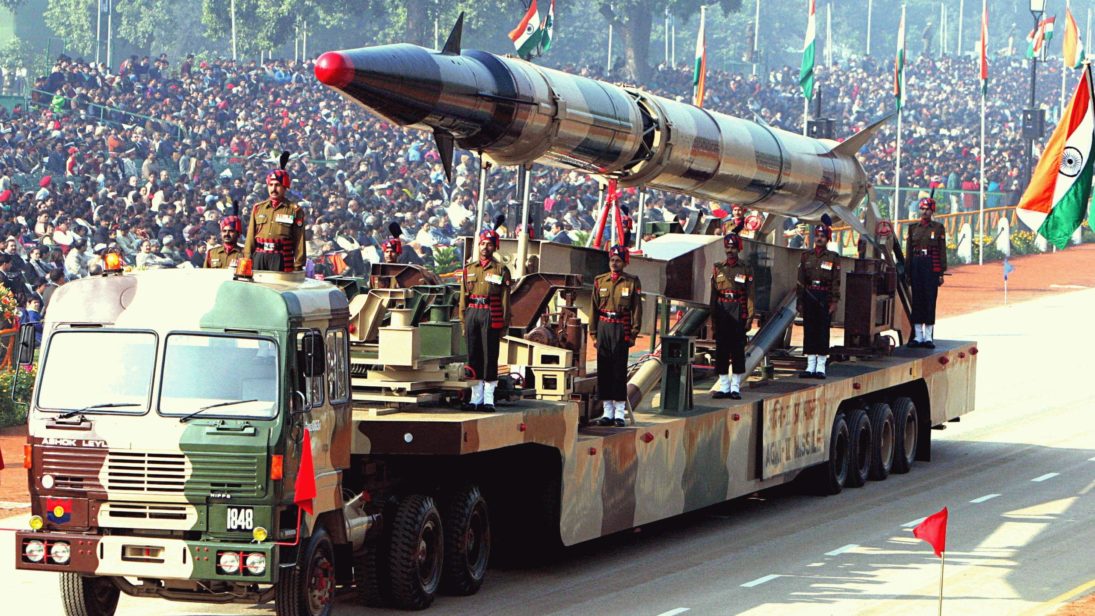
In addition to its quantitative expansion, India is also investing in expanding its delivery systems. In March 2024, India announced the successful test launch of Agni-V, an intercontinental ballistic missile (ICBM), a road-mobile canisterized missile with a range of about 5000-8000 km, equipped with Multiple Independently Targetable Re-entry Vehicle (MIRV) technology. India is also one of the countries that has a dual-capable Hypersonic Cruise Missile (HCM). Simultaneously, New Delhi is expanding the sea-based leg of its triad. According to SIPRI Yearbook 2026, right now India is operating three SSBNs, including INS Arihant, INS Arighaat and INS Aridhaman. Whereas the fourth, INS Arisudan will be operational in 2027. From its SSBNs, India can fire nuclear tipped K-4 and K-15 missiles and these missiles are under continuous upgradation. Moreover, India is also developing a next class SSBN, known as S5. The report has also predicted that at the end of the SSBN program, India would operate around eight SSBNs.
This quantitative and qualitative expansion is reshaping the dynamic of crisis stability in South Asia. Historically, India’s “recessed deterrent” posture, where warheads were kept separate from delivery platforms, provided the operational foundation for its declared No First Use (NFU) policy by ensuring deliberate rather than rapid nuclear employment. Now, the induction of solid-fueled, canisterized missile systems, including Agni-P and Agni-V, allows missiles to remain in a high state of readiness, potentially with pre-mated warheads, which reduces launch preparation time from hours to minutes. This trend is reinforced by SIPRI’s assessment that India has placed a limited number of its arsenal into an operationally deployed state at sea, signaling a shift towards a more readiness posture. This development further compresses decision making time during a crisis and increases the risk of conventional escalation. In such an environment, the deployment of a canisterized missile during a high intensity conflict may intensify the ‘use it or lose it’ dilemma, increasing the risk of miscalculation, and leading towards inadvertent escalation.
Beyond its implications for the crisis stability, India’s expanding nuclear capabilities are also eroding the arms race stability in South Asia. Arms race stability concerns whether states perceive their existing capabilities as sufficient for maintaining deterrence, thereby reducing the incentive for continuous force expansion. However, New Delhi’s ongoing quantitative and qualitative modernization raises concerns for arms race stability. A 36% increase in its nuclear stockpile during the last decade, the expansion of its Highly Enriched Uranium (HEU), weapon grade plutonium production base and expected contribution of the Kalpakkam PFBR collectively indicate the trajectory of force modernization beyond India’s security needs.
Although India portrays its nuclear modernization as a response to the challenges posed by China and Pakistan, in reality, it is a reflection of its hegemonic aspirations that fuels modernization. The SIPRI assessment represents more than an annual accounting of New Delhi’s nuclear arsenal; it signals a structural transformation of the strategic landscape of South Asia. New Delhi’s nuclear modernization is not just for the purpose of having more warheads. It represents a major transition characterized by evolving operational practices, quantitative increase, qualitative modernization, technological integration, and a transition from a recessed deterrent to the operational readiness posture. These developments mark a shift from restraint to readiness and preemption, making strategic stability more fragile. Collectively, these developments are changing the dynamics of strategic stability in South Asia by compressing decision-making time and raising the prospect of escalation between two nuclear-armed neighbours who have seen a series of military crises over the last ten years. The importance lies not merely in the increase from 180 to 190 warheads, but in the combination of sustained modernization, expanding fissile material production, and the transition to an operational readiness posture. These developments reinforce an action-reaction cycle, intensify arms race in South Asia, and incentivize the ‘use it or lose it’ dilemma, while undermining the crisis and strategic stability in the region.
This article was published by the Islamabad Policy Institute in another form at https://ipi.org.pk/indias-nuclear-modernization-and-strategic-stability-of-south-asia/


Mr Malik Muhammad Kashif is Research Assistant at the Center for International Strategic Studies (CISS), Islamabad.