Abstract

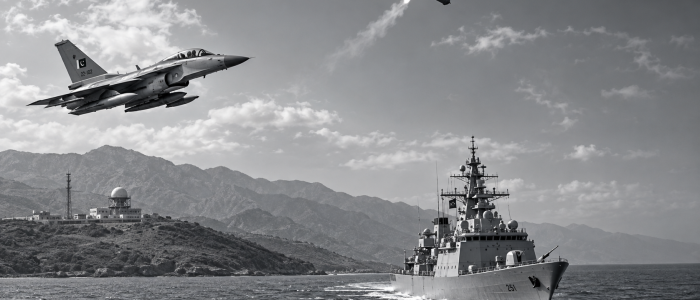
The security architecture of South Asia is fundamentally different from that of the Cold War era. During the Cold War, the two competing powers, the U.S. and the USSR, were geographically distant from each other. This lack of proximity between their strategic centers reduced the chances of crisis instability, miscalculation, and escalation crisis. In contrast, South Asia’s geographic contiguity, particularly between India and Pakistan, places their strategic centers in close proximity, significantly increasing the risk of crisis instability. India’s sea-based deterrent poses serious concerns for the region for two main reasons. First, the independent command and control system of SSBNs raises the issue of pre-delegation, especially if communication between the SSBNs and political leadership on land breaks down during a crisis. In such a scenario, it is unclear whether the SSBNs’ autonomous command and control system would be capable of accurately interpreting the situation. Second, India’s SSBNs, armed with sea-launched ballistic missiles (SLBMs) with intercontinental ranges, not only trigger an arms race within South Asia but may escalate strategic competition beyond the region. This research paper tries to critically discuss India’s sea-based deterrence under the shadow of its touted no-first-use policy. India’s doctrinal shift from countervalue second strike to counterforce stance, considering its SSBNs development. Moreover, the ranges and capability of India’s SLBMs will be discussed through the lens of India’s pursuit of prestige, and global strategic ambitions.

This resarcher paper was published by The Regional Tribune Vol. 5 No. 1 (2026) and can be read at https://submissions.regionaltribune.com/index.php/trt/article/view/214

Share.

Comments are closed.

Mr Syed Ali Abbas

Research Officer/ Comm Officer/ Managing Editor CISS Insight

Syed Ali Abbas is a Research Officer/Communication Officer at the Center for International Strategic Studies (CISS), Islamabad. Previously, he served as an associate editor at Indus News Network. His areas of interest include Middle East politics, military modernization, foreign policy, and nuclear politics. He has contributed to various platforms, including The National Interest, South Asian Voices, and others.

Dr Anum Riaz

Associate Director Research

Dr. Anum Riaz is the Associate Director Research at the Center for International Strategic Studies, Islamabad. She holds a Ph.D. in Political Science from the Department of Political Science at Bahauddin Zakariya University, Multan. She also possesses M.Phil. and M.Sc. degrees from the Department of Defence and Strategic Studies at Quaid-i-Azam University, Islamabad. Additionally, she has taught BS and Master’s students at the Department of Political Science at Bahauddin Zakariya University, Multan. Her areas of interest include strategic studies, international relations, international nuclear politics, the nuclear non-proliferation regime, arms control and disarmament, as well as traditional and non-traditional security issues.

Dr Bilal Zubair

Director Research

Dr. Bilal Zubair has worked as an Assistant Professor at the National Defence University Islamabad and Lecturer at the National University of Science and Technology. He holds a Ph.D. and M. Phil. in International Relations from Quaid-e-Azam University, Islamabad. Dr. Zubair is author of the book Chinese Soft Power and Public Diplomacy in the United States (Palgrave Macmillan, 2024) and contributed to several journal articles and book chapters focusing on soft power, diplomacy, and China’s role in international relations.

His research has been published in various academic journals, and he has presented at international conferences Dr. Zubair has also been an active reviewer and editorial board member. His professional interests include great power politics, and the role of communication in global diplomacy.

Mr Mobeen Jafar Mir

Research Officer

Mobeen Jafar Mir is a Research Officer at the Center for International Strategic Studies (CISS), Islamabad. His research focuses on U.S. foreign policy, particularly in the areas of strategy, technology, and arms control. He is currently pursuing an M.Phil. in International Relations at the School of Politics and International Relations, Quaid-i-Azam University, Islamabad. He can be found on Twitter @jafar_mobeen.
Exit mobile version