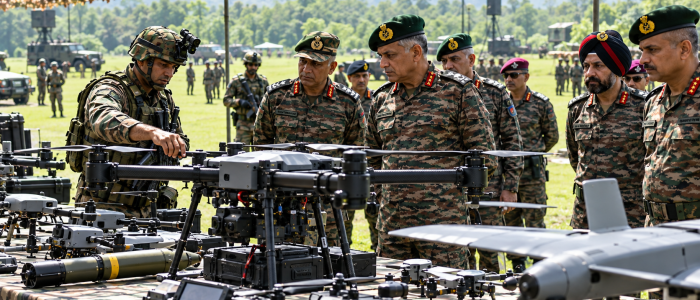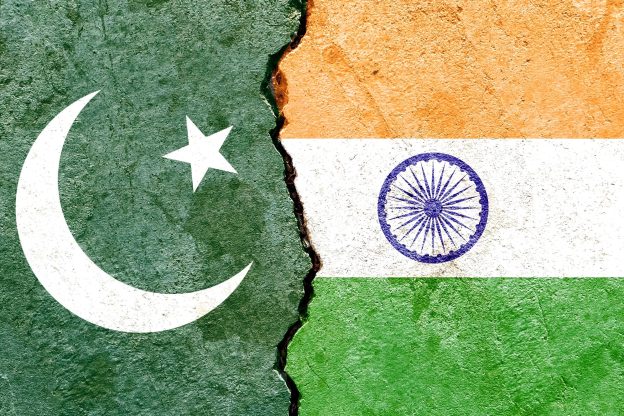
One year has passed since the four-day May 2025 crisis between India and Pakistan that ended in the aftermath of a U.S.-brokered ceasefire. The conflict, termed as “Marka-e-Haq” by Pakistan and “Operation Sindoor” by India has accelerated a structural transformation in the South Asian warfare. The crisis has demonstrated that future confrontations between the two nuclear armed countries is likely to be shaped by multi-domain non-contact warfare, with precision-strike standoff weapons, drone systems, loitering munitions, advanced missile capabilities and integrated missile forces taking the central space. Over the past year, both states have taken steps to strengthen their non-contact warfare capabilities. In a nuclearized environment, the speed, ambiguity, and compressed decision-making timelines associated with multi-domain non-contact warfare increase the risks of miscalculation, inadvertent escalation, and accidental nuclear use during future crises.
Currently, South Asia is in a condition of fluid instability, no war no peace situation. Although there are no immediate escalation pressures in the region and deterrence continues to function, the underlying root causes of conflict continue to exist, and in some cases are intensifying. In this situation, the probability of crisis is neither negligible nor imminent, rather persistently present. More-importantly, the post-May 2025 regional environment has been characterized by the absence of any bilateral communication between the two states. Instead, strategic signaling increasingly reflect coercive undertones and growing emphasis on the utility of force within statecraft. For example, Indian Prime Minister Narendra Modi said, “We have only paused Operation Sindoor,” and “Operation Sindoor is India’s new policy” reinforce perceptions that limited operations and standoff precision-strike capabilities are increasingly viewed as viable instruments of coercion during future crises.
India is accelerating the modernization of its precision-strike non-contact warfare capabilities, focusing on achieving escalation dominance through speed, precision, standoff systems and long-range conventional weapons. In December 2025, India test-launched a salvo of quasi-ballistic Paraly missiles, in a quick succession from same launcher. The missile having a range of 500 km, is capable of carrying multiple warhead configurations, including high explosive pre-formed fragmentation warheads, penetration-cum-blast warheads, and runway denial payloads. The missile having a circular error probability (CEP) of less than 10 meters, can be operationally utilized as a stand-off weapon for rapid precision strikes against Pakistan.
Moreover, India is planning to further expand its dual-capable BrahMos missile capability by extending the range to around 800km. This would further strengthen India’s precision standoff capability expanding the operational reach of the missile. Also, in May 2026, India announced further improvements in hypersonic propulsion technology during a recent test, achieving a run-time of 1200 seconds of its full scale scramjet combustor. The test highlights, New Delhi’s advancements towards the development of hypersonic cruise missiles.
At the strategic level, in May 2026, India has conducted a test of its Multiple Independent Reentry Vehicle (MIRV)-capable Agni V missile system, signaling its operational readiness. Similarly, Indian DRDO Chairman recently stated that they are technically prepared for the development of Agni-VI Intercontinental Ballistic Missile (ICBM), with a range of upto 12000 km, and are only waiting for a nod from the Government. Indian modernization of strategic missile arsenal suggests that New Delhi is increasingly extending beyond immediate regional deterrence requirements towards broader long-range strategic capability program. Taken together these developments in standoff non-contact warfare capabilities points towards a growing belief in New Delhi that they can carve out space for a limited conventional conflict under the nuclear overhang.
Pakistan, in response, is also enhancing its precision-strike standoff capabilities to strengthen its conventional deterrence posture. In August 2025, Pakistan formally institutionalized Army Rocket Force Command (ARFC) to integrate its conventional missile forces under a centralized command structure. In April 2026, Pakistan conducted test of Fatah-II missile system with a range of 400 km and having advanced avionic, maneuverability features, and navigational aids to improve its accuracy and survivability. Recently in May 2026, Pakistan conducted flight test of Fatah-IV Ground Launched Cruise Missile (GLCM), with a range of 750 km. The missile system, armed with conventional airburst warhead further increases standoff capability of Pakistan to strike at targets deeper inside India. Moreover, there are also reports suggesting that Pakistan is working on the development of a supersonic cruise missile in the form of Fateh-III.
Beyond land-based Fateh series, Pakistan has also strengthened its deterrence by denial capabilities in aerial and naval domains. The testing of Taimor Air Launched Cruise Missile (ALCM), and P282 SMASH Anti-ship ballistic missiles being some examples. The developments undertaken by Pakistan for non-contact warfare appear more closely tied to deterrence by denial, survivability, and technological offset against India’s conventional military advantages. Unlike Indian Dynamic Response Strategy (DRS), that has rapid punitive precision strikes at its core, Pakistan’s evolving non-contact warfare posture is designed to complicate conventional military operations and impose costs through stand-off response capability.
The accelerating movement towards multi-domain non-contact warfare capabilities without any strategic restraint, communication mechanisms and crisis stability mechanisms would erode crisis stability in South Asia. The dangers lies in the growing belief that standoff precision-strike weapons use can remain limited, controlled and insulated from broader escalation dynamics in a nuclearized environment where the margins of error remains extremely narrow.
The expansion of precision-strike hypersonic capabilities can significantly compress decision-making timelines in South Asia – where because of territorial congeniality there is already reduced decision-time. This can increase the risks of miscalculation during a crisis. Also, the use of dual-capable systems like BrahMos for conventional purposes can create payload ambiguity and increase the risks of inadvertent escalation.
Importantly, the rapid expansion of stand-off capabilities and increasing attack vectors challenges the assumption that limited conventional conflicts can remain controllable under the nuclear overhang. The growing Indian belief that precision-strike systems, loitering munitions, drones, and hypersonic missiles can provide space for calibrated and manageable military operations may itself prove destabilizing. In theory, standoff weapons might provide a flexible coercive option below the nuclear threshold. However, in practice, the speed, ambiguity, and retaliatory pressures associated with non-contact warfare can rapidly push crisis beyond intended political limits.
In nuclearized South Asia, there is a very little room for a prolonged or carefully managed conventional escalation. The geographical proximity of major military and strategic assets, combined with limited warning times and deeply adversarial threat perceptions, means that even limited-standoff exchanges can quickly generate pressures for retaliation and counter-retaliation. Precision-strike operations targeting airbases, command-and-control infrastructures, radar systems, missile sites and logistical networks can be interpreted as attempts to degrade strategic survivability. The lesson of May 2025 crisis therefore should not be interpreting it as validation of limited war under the nuclear overhang, but rather as a warning regarding increasing fragility of crisis stability in an era of multi-domain non-contact warfare.
This article was published in another form at https://thediplomat.com/2026/05/lesson-from-the-may-2025-india-pakistan-crisis-no-space-for-limited-war/


Abdul Moiz Khan is Research Officer at the Center for International Strategic Studies (CISS), Islamabad.

Dr. Summar Iqbal Babar is an assistant professor at the School of Politics and IR, Quaid-e-Azam University, Islamabad.