Executive Summary

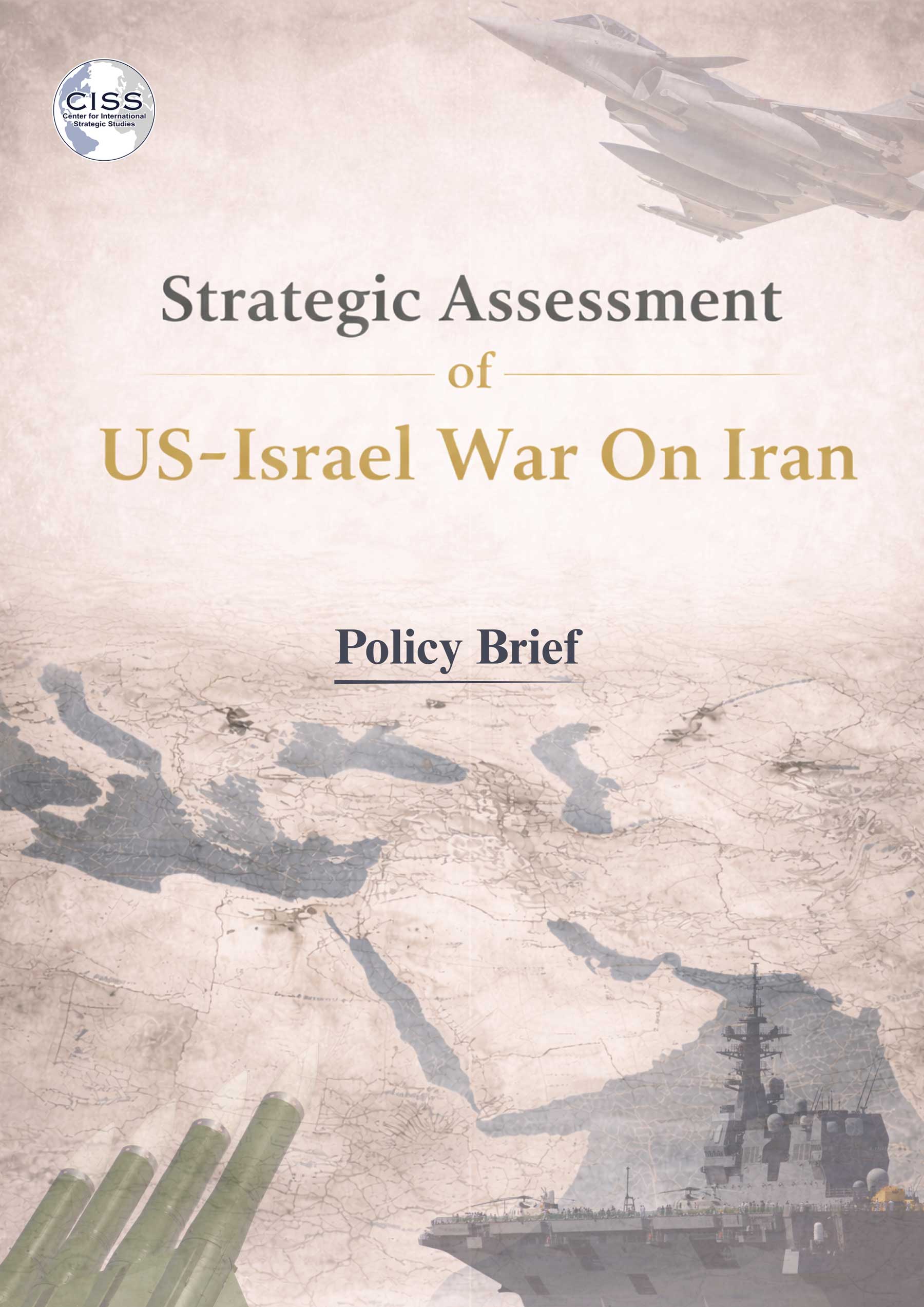
This policy brief analyzes the pre-war drivers, key strategic aspirations of the actors involved, and post-war trajectories of the 2026 U.S.-Israel-Iran war. The scope of the war has engulfed the entire region and would shape new regional realities after the end of hostilities. The complex nature of regional dynamics means the future order would be shaped by enduring structural drivers and a limited number of high-impact uncertainties. The future of Middle Eastern geostrategic order after the end of the war would not converge towards a single, strategic equilibrium.

The war was not triggered by a single incident but resulted from a convergence of several factors: collapse of nuclear diplomacy, intensifying regional rivalries, and the normalization of force as statecraft. The Strait of Hormuz emerged as a central economic and geopolitical flashpoint, while Israel’s regional military posture and Washington’s regime-change ambitions further escalated tensions. The issue of Iran’s nuclear programme underlay the U.S.-Iran tensions.

Post-war dynamics are defined by fundamentally incompatible objectives. The U.S. and Israel seek the dismantlement of Iran’s nuclear and missile capabilities, while Iran prioritize regime survival, strategic deterrence and sanctions relief. Gulf states demand stability and energy flows. In all this, Pakistan has emerged as a key mediator seeking peace and regional stability.

The future regional order will be driven by three structural variables: Iran’s nuclear decision (restraint vs. weaponization), the strategic status of the Strait of Hormuz, and evolving Middle East dynamics. These drivers produce multiple plausible scenarios ranging from managed stability to a fragmented arms race, with varying levels of cooperation or discord.

Overall, the region is entering a phase of “competitive fragmentation,” characterized by persistent instability, technological militarization, and weakened international norms. A durable settlement remains contingent on a negotiated nuclear framework, stabilization of maritime security in Hormuz, and sustained multilateral diplomacy – within which Pakistan’s mediatory role remains a critical enabling factor.

Share.

Comments are closed.

Mr Syed Ali Abbas

Research Officer/ Comm Officer/ Managing Editor CISS Insight

Syed Ali Abbas is a Research Officer/Communication Officer at the Center for International Strategic Studies (CISS), Islamabad. Previously, he served as an associate editor at Indus News Network. His areas of interest include Middle East politics, military modernization, foreign policy, and nuclear politics. He has contributed to various platforms, including The National Interest, South Asian Voices, and others.

Dr Anum Riaz

Associate Director Research

Dr. Anum Riaz is the Associate Director Research at the Center for International Strategic Studies, Islamabad. She holds a Ph.D. in Political Science from the Department of Political Science at Bahauddin Zakariya University, Multan. She also possesses M.Phil. and M.Sc. degrees from the Department of Defence and Strategic Studies at Quaid-i-Azam University, Islamabad. Additionally, she has taught BS and Master’s students at the Department of Political Science at Bahauddin Zakariya University, Multan. Her areas of interest include strategic studies, international relations, international nuclear politics, the nuclear non-proliferation regime, arms control and disarmament, as well as traditional and non-traditional security issues.

Dr Bilal Zubair

Director Research

Dr. Bilal Zubair has worked as an Assistant Professor at the National Defence University Islamabad and Lecturer at the National University of Science and Technology. He holds a Ph.D. and M. Phil. in International Relations from Quaid-e-Azam University, Islamabad. Dr. Zubair is author of the book Chinese Soft Power and Public Diplomacy in the United States (Palgrave Macmillan, 2024) and contributed to several journal articles and book chapters focusing on soft power, diplomacy, and China’s role in international relations.

His research has been published in various academic journals, and he has presented at international conferences Dr. Zubair has also been an active reviewer and editorial board member. His professional interests include great power politics, and the role of communication in global diplomacy.

Mr Mobeen Jafar Mir

Research Officer

Mobeen Jafar Mir is a Research Officer at the Center for International Strategic Studies (CISS), Islamabad. His research focuses on U.S. foreign policy, particularly in the areas of strategy, technology, and arms control. He is currently pursuing an M.Phil. in International Relations at the School of Politics and International Relations, Quaid-i-Azam University, Islamabad. He can be found on Twitter @jafar_mobeen.

Exit mobile version