Deterrence relies on military capability, but its effect is psychological. Nuclear weapons, missile defences, alliances and conventional forces shape how an adversary assesses the risks and costs of aggression. Bernard Brodie placed credible retaliation at the centre of nuclear deterrence, arguing that military power in the nuclear age should prevent war rather than win it. Thomas Schelling treated deterrence as an effort to shape an adversary’s choices by influencing expectations about costs and consequences. The logic remains: deterrence works when an adversary judges that the risks of action outweigh the gains. Its ultimate target is the decision-maker’s perception of strategic risk.
But what happens when that calculation is shaped by artificial intelligence? Militaries use AI to process military data, identify patterns, assess threats, estimate chances of success and support operational military decisions. These tools can make conflict appear more measurable and manageable. The danger is not that AI will remove uncertainty from war, but that decision-makers may believe it has been reduced. If AI-generated assessments increase confidence about losses, mission success, adversary responses or escalation, leaders may accept more military risk. AI could therefore weaken a psychological basis of deterrence by making war appear more calculable than it is.
From Data to Decisions
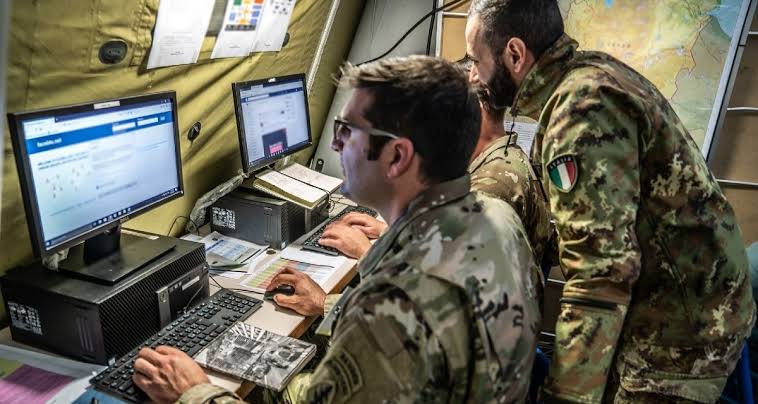
This shift is visible in military practice. NATO’s Next Generation Targeting programme seeks to use AI, shared data and automation to cut the time from information to military decision by more than 50 percent. Its Joint ISR Asset Planner can generate intelligence-collection plans in seconds instead of requiring staff to coordinate aircraft, drones and satellites manually. Ukraine’s DELTA command-and-control system is used by more than 200,000 defence personnel, while an AI model developed with NATO will analyse Russian military activity. Ukraine’s AI Defence Centre is developing a system to process information across a 1,200-kilometre front and provide recommendations from frontline units to strategic command. In Gaza, the IDF says its Habsora system fuses multiple intelligence datasets to direct analysts towards relevant targets. Investigative reporting on Lavender found that it had identified about 37,000 potential targets, while officers said some reviews took 20 seconds per target. During the 2026 U.S.-Iran war, the U.S. military used Palantir’s Maven Smart System, integrated with Anthropic’s Claude, to analyse satellite, surveillance and intelligence data, prioritize targets and assess strikes. U.S. forces hit around 1,000 targets in the first 24 hours. The CENTCOM commander Admiral Brad Cooper said AI reduced processes that once took “hours and sometimes even days” to seconds. AI is therefore compressing the process through which information becomes military judgement and action.
The Confidence-Uncertainty Paradox
The deeper problem is that AI can give uncertain information an appearance of certainty. War produces fragmented intelligence, contradictory signals and incomplete knowledge of an adversary. AI can compress that ambiguity into rankings, probabilities or recommended actions. This makes information easier to use, but can hide the uncertainty behind it. Human Rights Watch found that Israeli digital targeting tools in Gaza used incomplete data and inexact approximations to distinguish civilians from combatants, estimate civilian presence and identify potential targets, and warned that operators could place excessive trust in unreliable outputs. Ukraine’s defence AI chief has likewise warned that future systems could generate recommendations so quickly that humans may struggle to keep pace. The 2026 strike on the Shajareh Tayyebeh girls’ school in Minab showed a related limit of technological precision. A preliminary U.S. investigation pointed to outdated intelligence coordinates that identified the location as a military target, despite a functioning school there. More than 165 people, many children, were killed. There is no evidence that AI caused the strike, but the case shows that precise systems can produce catastrophic results when the underlying intelligence is outdated or wrong. SIPRI warns that opaque AI recommendations can bias decision-makers towards action while compressed timelines increase miscalculation. The result is a confidence-uncertainty paradox where the uncertainty of war remains, but technology can make decision-makers feel that more of it has been resolved. AI may increase confidence faster than predictability.
The Illusion of Controlled Escalation
This becomes more dangerous when greater calculability creates confidence that escalation can be controlled. A state may estimate the military effects of a strike precisely, but it cannot know with the same confidence how an adversary will respond. Escalation is interactive: every move changes the calculations, perceptions and political pressures facing the other side. Yet AI decision-support systems can present this fluid process through probabilities, rankings and recommended options, suggesting the path ahead can be mapped. Experimental evidence suggests otherwise. In simulated military crises, five leading language models developed arms-race dynamics and escalatory behaviour, with rare cases reaching nuclear use. In another wargame involving 214 national-security experts, LLM-generated responses were sometimes more aggressive than human teams and changed significantly when the scenario changed. A separate experiment using 640 military-intervention scenarios, each tested 100 times across models from OpenAI, Anthropic and Google, found that estimated probability of victory and domestic support were the strongest drivers of recommendations to intervene, carrying roughly twice the influence of civilian deaths, military casualties, economic costs and international condemnation. These simulations do not prove that AI will cause escalation. They show that algorithmic assessments of strategic risk are neither neutral nor stable: they vary with the model, assumptions and information provided. The danger is epistemic overconfidence: mistaking precision in calculating military options for an ability to predict the political consequences that follow. AI may help calculate the first move; it cannot calculate with equal certainty what the adversary will do next. AI can strengthen deterrence by improving surveillance, early warning, defence and decision support. The concern is not AI, but the confidence placed in what it can know. Deterrence still depends on human perceptions of risk, resolve and consequence, which cannot be reduced to data or probabilities. When better analysis creates confidence that conflict can be controlled, escalation bounded and adversary responses anticipated, the restraint produced by uncertainty may weaken. The challenge is to use AI responsibly without mistaking algorithmic confidence for strategic certainty. War may become more calculable; it will not become less human.
This article was published by the Global Defense Insight in another form at https://defensetalks.com/artificial-intelligence-deterrence-and-the-psychology-of-war/

Syed Ali Abbas is Research Officer & Comm Officer at the Center for International Strategic Studies (CISS) Islamabad. He is also an MPhil scholar in the Department of Strategic Studies at the National Defense University (NDU) Islamabad.