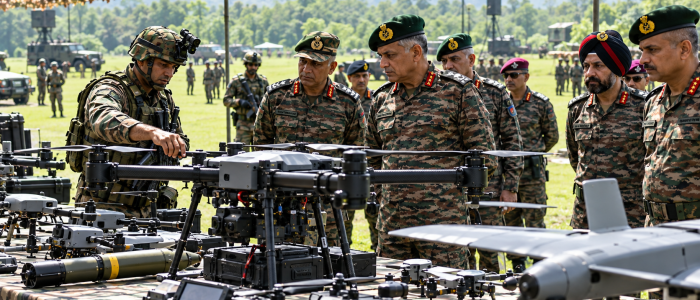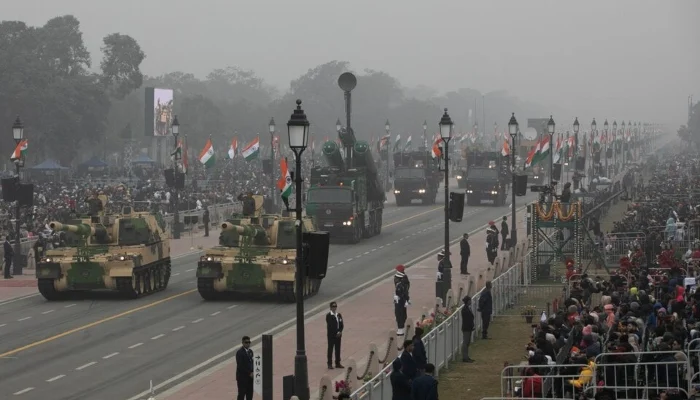
In 1961, President Eisenhower, in his farewell address, warned against the increasing influence of the US military industrial complex (MIC) beyond the country’s essential defense needs. President Eisenhower, who served as commander of Allied forces during World War-II stated, “In the councils of government, we must guard against the acquisition of unwarranted influence, whether sought or unsought, by the military-industrial complex. The potential for the disastrous rise of misplaced power exists and will persist.” The Then president’s warning about growing influence of the MIC acquires a new relevance in today’s India, where Modi government has recently opened the doors to private sector for missiles production. Indian government’s decision to involve private-sector for missile and other sensitive military hardware will add another layer of instability to a fragile regional security environment.
Last month, Indian Defense Minister Rajnath Singh approved the transfer of missile technologies developed under state-owned Defence Research and Development Organisation (DRDO) to the private sector. As per reports, the new policy covers a range of systems that includes land-attack cruise missiles, surface-to-air, anti-radiation, air-to-air missiles and anti-tank weapons. Indian Space Research Organisation (ISRO) under its initiative, Indian National Space Promotion and Authorisation Centre (IN-SPACe) which acts as an interface between government agency and private sector, has already started sharing its sensitive technologies with private sector.
Throughout the history, India maintained strict governmental control on the production of missile technologies and rockets systems. Now the course of action, particularly in missile manufacturing, has been changed. This marks a clear shift toward the US arms manufacturing model, one in which MIC drives weapons production, sustained demand, and expanding weapons exports. But US case is totally different from India’s. In the US context, this system complements its projection of global power and a vast network of alliances. In South Asian context, this logic of private-sector weapons production works under far more dangerous circumstances.
Commercial production of missiles and weapons systems create a structural problem that state-owned manufacturing units largely avoids. Once private companies such as Adani Defense and Aerospace India, invest heavily in manufacturing, supply chains and human resource dedicated to weapons production, these companies require an un-interrupted, high-volume orders to remain profitable. In South Asian context, that sustained demand for more missiles is most readily created by the climate of heightened crisis, massive stockpiles and real possibility of a conflict—because only a persistent conflict can reliably consume those weapons at the rate modern production systems are designed to supply. The result is quiet but a powerful incentive – the more missiles India will produce commercially, greater the pressure to keep regional security environment fragile enough to justify commercialization of defense sector. Subsequently, with a large stockpile of privately-manufactured missiles in Indian arsenal, the incentive for rapid escalation and a pre-emptive strike will only grow faster.
The greater danger lies in the very character of the MICs. Once private investment, production capacity and commercial interests embedded in the missiles and defense manufacturing, the system gets the momentum of its own. Such a scenario creates an enduring institutional bias towards higher output and continuous technological advancements. In South Asian context, where nuclear rivals India, and Pakistan share a history of animosity and mistrust, such a mechanism of commercial weapons production doesn’t simply meet prevailing security challenges; it fuels the security complexes. Each commercially-developed missile in Indian inventory will force its adversaries to respond, locking the entire South Asian region into an expensive arms race whose logic is driven by the commercial and industrial imperatives rather than by serious strategic calculation.
India’s decision to share sensitive missile technology with private sector won’t remain a purely domestic eco-system for weapons manufacturing. This initiative will carry dangerous implications for the region already marked by recurrent crisis, unresolved border disputes and presence of nuclear weapons. South Asian region can ill afford an arms race in which production capacity of sophisticated missiles systems expands faster than the framework available to manage their consequences. India, therefore, needs to assess the strategic consequences of its missile technology sharing with the private sector. The strategic environment, in which such an industrial shift in arms manufacturing is taking place, is not conducive. Besides, the lack of any meaningful arms-control framework between both nuclear rivals, and against the backdrop of a persistent trust deficit, the Indian decision to place production of missiles and weapon systems in commercial hands risks becoming a dangerous accelerator of the instability. What may seem as a step towards the self-reliance in defense sector could actually lock the entire region into a more faster, less controllable arms race. Therefore, New Delhi’s vision regarding the commercialization of its missile and space technologies may serve its military ambitions, but without corresponding mechanism of bilateral crisis management, this initiative risks commercializing instability in the crisis-ridden South Asia.
This article was published by The News in another form at https://www.thenews.pk/print/1440689-india-s-commercialised-defence


Mr Yasir Hussain is Associate Director Research at the Center for International Strategic Studies (CISS), Islamabad and is currently placed at CISS-KIU Research Center, Karakorum International University (KIU), Gilgit-Baltistan, Gilgit.