
Executive Summary
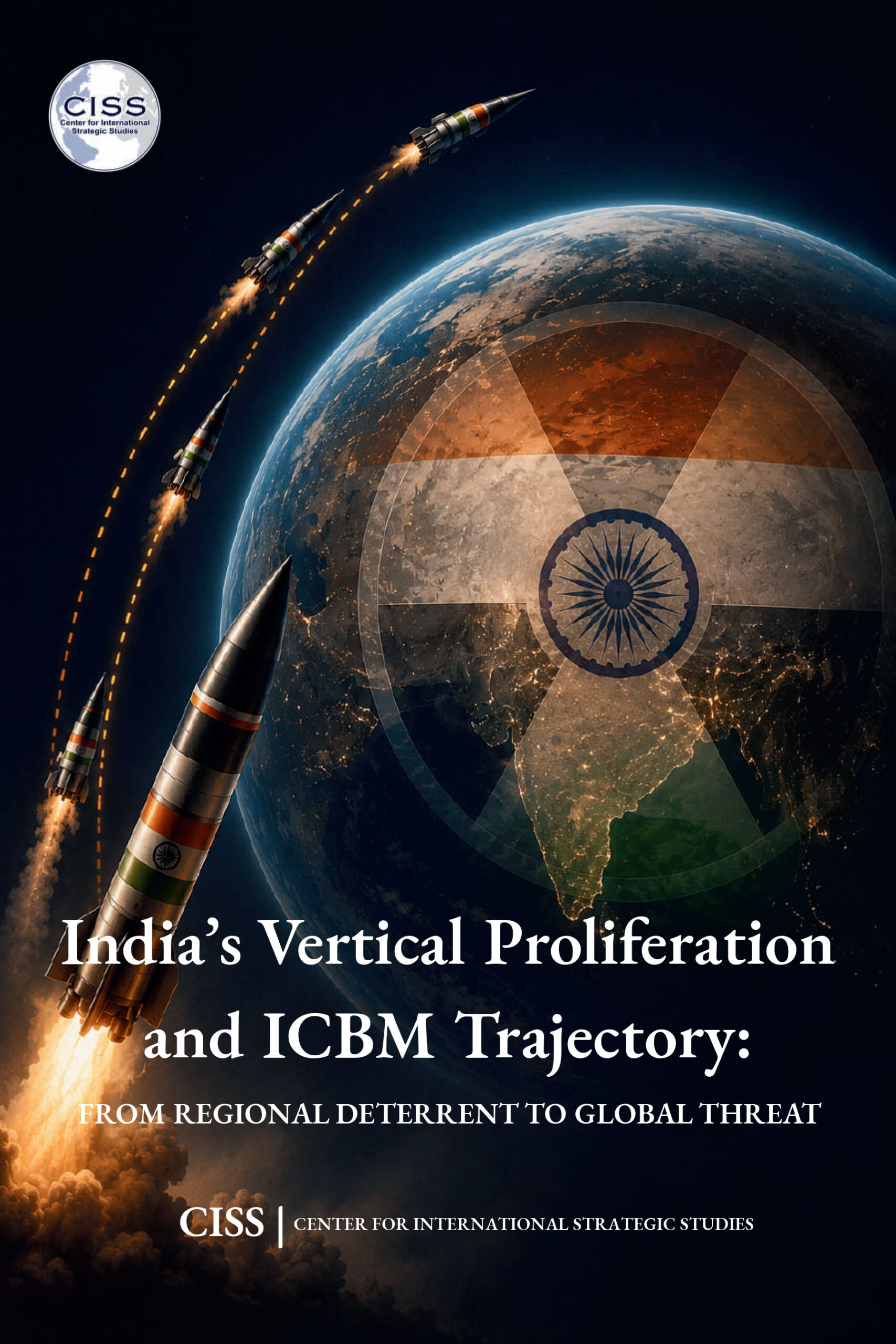
In mid-2026, two developments occurred to alter the terms on which India’s nuclear programme could be assessed. First, the Defence Research and Development Organisation (DRDO) announced technical readiness to begin full-scale development of the Agni-VI, a four stage,MIRV-capable intercontinental ballistic missile (ICBM) with a projected range of 10,000-12,000 kilometres. Second, the SIPRI Yearbook 2026 reported, for the first time in the history of India’s nuclear programme that a portion of its arsenal is operationally deployed with twelve warheads carried to sea aboard its ballistic missile submarine fleet. Also, the total stockpile rose from an estimated 180 warheads in 2025 to 190 warheads in 2026.
Together, these developments marked a departure from the framework under which India’s programme has been perceived for two decades i.e., a regionally bound deterrent, held in de-mated storage, against Pakistan and China. However, the two developments that occurred belied this perception. This assessment examines what that departure means for global security, credibility of the global non proliferation order, and Western security establishments that continue to read India’s arsenal through a purely regional lens India’s declared doctrine no longer explains its capability trajectory. India’s official posture rests on credible minimum deterrence (CMD), No First Use (NFU), and a two-adversary frame directed at Pakistan and China. By that doctrine’s own logic, the requirement was met when the MIRV-capable Agni-V with a 7,000-8,000 km range covering all of China and Pakistan, was tested and inducted. The Agni VI’s projected reach extends well beyond both adversaries, into Western Europe, North Africa, the Middle East, and the eastern seaboard of North America. No regional threat justified this step; and the extension is contrary to India’s own stated deterrence rationale.
Read the complete Strategic Assessment below in pdf format