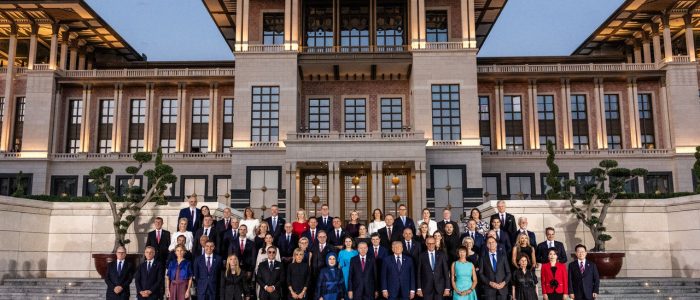
NATO’s biggest challenge may no longer be Russia’s military power, but uncertainty over the Alliance’s political cohesion. The 2026 Ankara Summit marked a transformation in NATO’s strategic trajectory: moving from pledging defence spending to producing the military capabilities required for deterrence. But the Alliance’s military consolidation is happening amid unprecedented questions about transatlantic political cohesion. NATO therefore faces a paradox of power: greater material strength accompanied by greater uncertainty over the political credibility of collective defence.
The 2026 Ankara Summit Declaration reaffirmed NATO’s ironclad commitment to the collective defence of its member states as enshrined under Article 5 of the alliance treaty, declaring an attack on one member state as an attack against all. However, political uncertainties within transatlantic relations continue to test alliance cohesion. Russia’s war in Ukraine compels NATO member states to move beyond defence spending commitments towards building credible military capabilities and expanding defence industrial capacity. Allies have affirmed to increase defence spending up to 5% of GDP by 2035, upholding the 2025 Hague defence investment pledge. The Ankara Summit has been viewed as a doctrinal reset, pushing NATO into a phase of militarisation, industrial mobilisation and European burden sharing within the alliance. Yet this strengthening of NATO’s material capabilities is accompanied by growing political uncertainty within the transatlantic relationship, particularly over the reliability of the US commitments, creating a paradox in which the Alliance is becoming militarily stronger but politically more complex.
NATO therefore faces a paradox of power: greater material strength accompanied by greater uncertainty over the political credibility of collective defence.
The summit took place against the backdrop of a highly polarised security environment, characterised by prolonged war in Eastern Europe, instability in the Middle East, and continuous doubts about the uncertainty of the US alliance commitments in Europe.
Despite these friction points, the summit’s most incredible achievement is the consolidation of NATO’s defence-industrial agenda. European allies announced more than € 50 billion in new procurement commitments, including the procurement of MQ-4C Triton uncrewed aircraft by states like Denmark, Finland, Germany and Norway and the selection of Saab Global Eye aircraft for NATO’s future airborne warning and control capability. These procurements highlight that the alliance’s future posture will be shaped by production capacity, supply-chain resilience, and public-private defence integration.
Additonally, the members reiterated the need to expand the defence industrial base, accelerate capability development, and enhance investment in emerging technologies. Apart from this, NATO allies have pledged unwavering support for Ukraine, allocating € 70 billion in military equipment for Kyiv for the 2026-2027 period. To defend its freedom and sovereignty, the US approved licensing arrangements for Ukraine to develop Patriot missile interceptors. The Trump administration showed disappointment with NATO members for not responding affirmatively to the President’s call for assistance in reopening the Strait of Hormuz. Moreover, a series of unilateral political stances from the Trump administration have irked European NATO allies, including the sanctions surrounding Nicolás Maduro, the rhetoric concerning Greenland, and remarks regarding Canada.
This spike in defence spending creates a security dilemma for Russia. NATO member states have emphasised unity, calling for closer cooperation among alliance members to respond to common threats, including terrorism. However, the transactional approach of the Trump administration creates credibility issues within the transatlantic alliance regarding US security commitments in Eastern Europe. Debates surrounding Greenland have overshadowed the narrative of security through unity. In 2026, the Trump administration termed the acquisition of Greenland a national security priority, sparking diplomatic friction over the Arctic landmass. The threat of unilateral action compelled Canadians and Europeans to consider a new security architecture rather than solely betting on the transatlantic alliance. Such an alternative security architecture was reiterated by German Chancellor Friedrich Merz and French President Emmanuel Macron in their speeches, emphasising Europe taking greater responsibility for its own defence while remaining committed to NATO’s collective defence.
President Emmanuel Macron had already expressed his disappointment with these policy directions, blaming the Trump administration for turning away from the NATO alliance, international rules, and NATO alliance commitments. He further described transactional foreign policies as a form of new strategic friction. Trump’s earlier remarks that the US should exert greater control over Denmark and that the US should incorporate Canada as the 51st state reiterated the political fragmentation within the transatlantic relationship, raising eyebrows over the future of transatlantic collective security. Therefore, it has become a challenge for NATO to maintain deterrence credibility while managing the political risks of a more transactional US approach. In the future, the NATO alliance will reorient toward maintaining deterrence against Moscow. Canada and European allies are expected to carry the burden of conventional defence, industrial expansion, and Ukraine assistance. To widen its strategic depth, NATO must deepen partnerships with industry, the EU, and Gulf partners. Such partnerships will create a more capable but complex alliance. Through the Ankara summit, NATO has sent a clear message, adapting to a harsher environment by converting burden-sharing into burden-shifting and rhetoric into production.
This article was published by the Centre for Strategic and Contemporary Research (CSCR)in another form at https://cscr.pk/explore/themes/defense-security/burden-shifting-in-the-post-ankara-era/

Ms Nawal Nawaz is Research Assistant at the Center for International Strategic Studies (CISS), Islamabad.