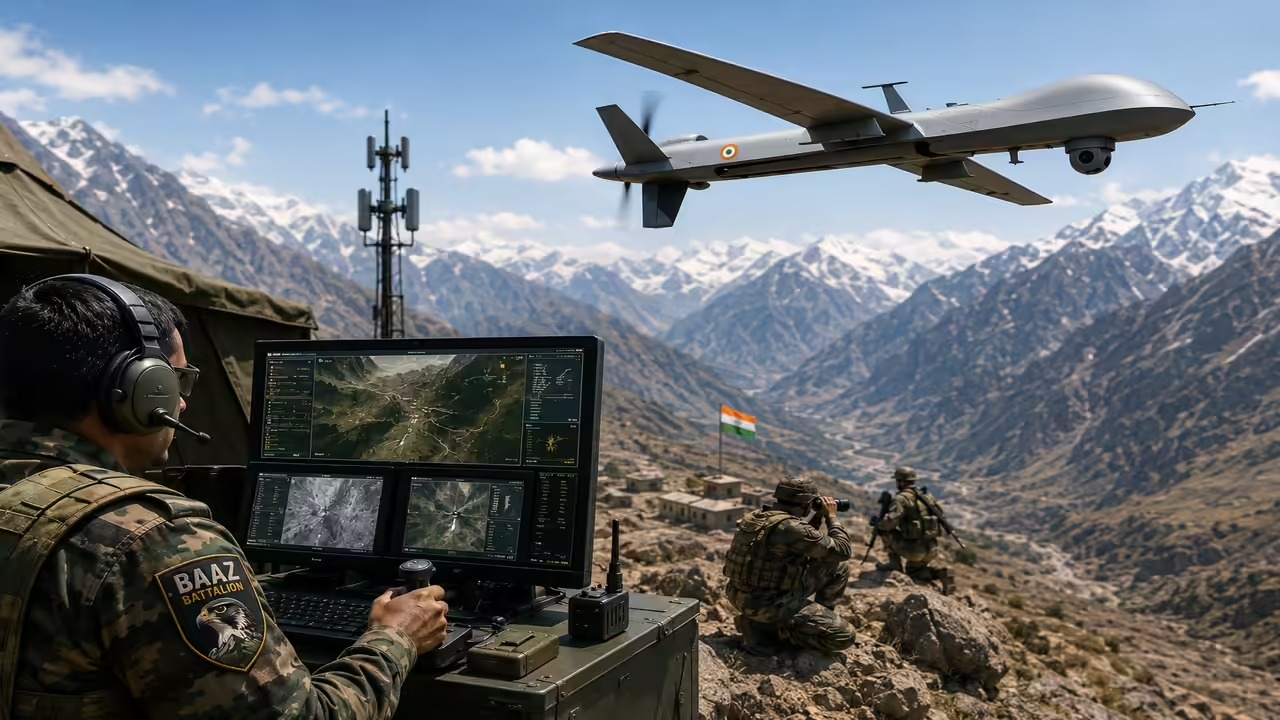
On 29 June 2026, outgoing Indian Army Chief General Upendra Dwivedi announced the raising of specialised Baaz battalions under the Army Aviation Corps. Most of India’s drone developments over the past two years have been about more units, more platforms, larger inventories. This new specialised battalion moves long-range unmanned ISR into a dedicated formation built to sustain persistent surveillance and compress the sensor-to-shooter cycle at the operational level. An announcement about it follows the Army’s April 2026 Technology Roadmap for unmanned systems, drafted in the aftermath of Pak-India May 2025 Conflict, where loitering munitions featured prominently in the opening exchanges of the conflict.
Indian post-May 2025 Conflict response has extended well beyond the Army. New Delhi allocated $234 million to a Drone Incentive Program covering platforms, components, and counter-drone technology, and cut GST on drone production from 18 percent to 5 percent to stabilise domestic manufacturing. The Border Security Force opened its own drone warfare school in June 2025, separate from the Army’s plan to establish nineteen drone training centres by early 2026. Baaz is one part of this wider institutional response to make drone warfare a standing feature of Indian force structure across services.
Understanding What Baaz is
Baaz battalions are specialised Army Aviation Corps UAVs formations built for long-range, sustained intelligence, surveillance, and reconnaissance, along with deep-area target acquisition. The formation will occupy a specific slot in a layered drone architecture the Indian Army has been assembling since 2024. At the tactical base sit the Ashini platoons, small teams attached to infantry battalions for close-range surveillance and short-range strike.
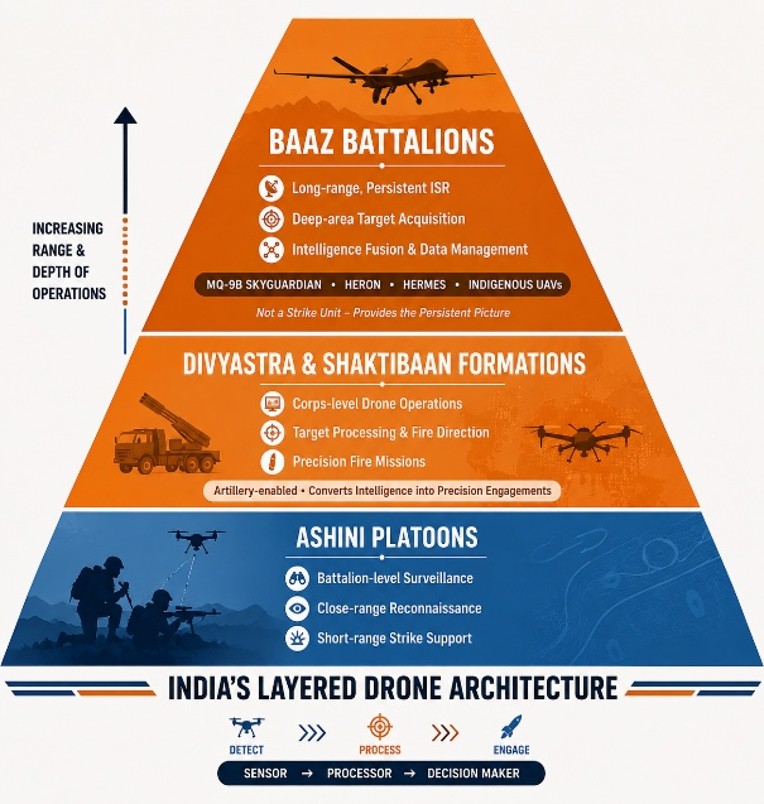
Above them sit the Divyastra and Shaktibaan formations under the Regiment of Artillery, which convert drone-derived data into fire missions at operational level. Baaz will sit above both, tasked with sustained ISR over depth areas, target acquisition, and managing the intelligence flow from a large and technologically mixed fleet. It is not conceived as a strike unit in the way Divyastra is. Its role will be to hold a persistent picture of the battlefield and route it to whoever needs to act on it.
The equipment reflects that intended role. Baaz units are set to fly the MQ-9B SkyGuardian, procured from General Atomics under the 2024 government-to-government deal worth roughly four billion dollars, alongside the Israeli Heron and Hermes families that have carried India’s long-range ISR for years, plus a growing share of indigenous platforms. Three different platform lineages, three different maintenance and software chains, will now sit under one formation responsible for making them work as a single system.
Where Integration Still Lags
Jointness has not kept pace with this expansion. The then India’s Chief of Defence Staff, General Anil Chauhan, noted in March 2025 that the armed forces had yet to settle on a common vocabulary for classifying unmanned and counter-unmanned systems, and called for a unified tri-service framework that remains unpublished. Assessments of India’s drone modernisation have drawn a similar conclusion, observing that fragmented command arrangements continue to constrain the interoperable operations that network-centric warfare requires. The tri-service “Cold Start” drone exercise held in October 2025 appears to have been one step toward addressing this, testing drone and counter-drone coordination across services.
Baaz will be raised into a space whose platforms will need to share airspace with other institutions such as the Indian Air Force and civil aviation, and its long-endurance drones will depend on satellite bandwidth India has not yet fully built for this purpose. Moreover, this will be managed in real time, under contested conditions remains unseen. A more fundamental question is about technical aspect; the MQ-9B, the Heron and Hermes families, and India’s indigenous platforms each generate sensor data in different formats, and combining that output into a single usable targeting picture depends on shared data standards that have not been demonstrated to exist. Settling which service controls the airspace is, in the end, a matter of negotiation. Getting three dissimilar sensor architectures to function as one in real time is an engineering task, and it is this second challenge, that suggests the Army’s institutional thinking on drone employment may be advancing ahead of the joint architecture needed to make full use of it.
Implications for Pakistan
The operationalisation of these plans will have serious implications for Pakistan. It needs to plan around a dedicated operational-level ISR and targeting formation that shortens the detection-to-strike timeline along the border. A formation built to sustain persistent watch over depth areas and hand targets to artillery and strike aircraft faster will reduce the warning time available to mobile assets and forward-deployed units. This effect depends on how well Baaz’s own mixed fleet fuses data internally and with other systems.
Pakistan’s more useful response should be to deny the sensor layer on which Baaz depends. Electronic warfare, spoofing, and decoy measures aimed at medium-altitude, long-endurance drones degrade the entire targeting chain rather than a single node within it. Continued investment in dispersal, hardening, and early warning for likely target sets also reduces the payoff India draws from persistent depth surveillance, even where detection itself cannot be prevented.
Three integration questions on the Indian side are important.
The Army and Air Force still need to settle shared control of contested airspace and space assets. Baaz’s own mixed fleet still needs to fuse dissimilar sensor data fast enough to matter under jamming. And across the wider force, the Army, Air Force, Navy, and Border Security Force are each building their own drone architecture on separate tracks, without a common standard tying them together. Baaz doesn’t break none of these gaps. But together, they suggest India’s drone capability may take longer to function as one integrated system than the pace of announcements implies. However, Baaz confirms a trajectory that India is institutionalising drone-centric ISR and strike as a standing part of its force structure, across the Army, Air Force, Navy, and paramilitary forces at the same time. Whether India closes the inter-service and intra-fleet integration gaps in time to make Baaz function as intended remains an open question.
This article was published by the Islamabad Policy Institute in another form at https://ipi.org.pk/indias-baaz-battalion-and-drone-warfare-in-south-asia/

Syed Ali Abbas is Research Officer & Comm Officer at the Center for International Strategic Studies (CISS) Islamabad. He is also an MPhil scholar in the Department of Strategic Studies at the National Defense University (NDU) Islamabad.