Fifteen months after the four-day war of May 2025, India is nearing implementation of a restructured military command built around a single organizing principle: integration. The Indian Chief of Defence Staff (CDS) has proposed three theatre commands, including a Western Theatre built explicitly around Pakistan and placed under Air Force leadership, with implementation expected to be completed soon. In June, the Defence Research and Development Organisation completed Phase 2 of India’s ballistic missile defence (BMD) programme, a fourth S-400 regiment arrived from Russia, and five further regiments were cleared for procurement. Together, these efforts try to fuse offensive strike, unified command, and layered air defence into one system built to operate against Pakistan and China simultaneously. Pakistan’s response to this consolidation is described as Cohesive Deterrence, a framework that gives shape to Pakistan’s already mature deterrence posture.
The concept rests on a nested structure. At the strategic level, Full Spectrum Deterrence capability is held within the ambit of Credible Minimum Deterrence, so that the extension of coverage from the sub-conventional level up through the strategic level remains governed entirely by CMD’s logic of sufficiency. Alongside this structure sits the conventional layer, supplied by Quid Pro Quo Plus, which gives Pakistan a proportionate response option at the conventional level without drawing on the strategic capabilities unless the situation demands it. India’s Cold Start doctrine was built on the assumption that a conventional strike could be calibrated to sit beneath the specific threshold that would otherwise have triggered a wider response. Cohesive Deterrence removes that assumption by tying the conventional layer and the strategic layer together into one response, so that a strike aimed at any point on the spectrum draws on the whole of it rather than on the single layer it was aimed at.
A second element sits alongside the doctrinal structure: national resolve treated as a material component of deterrence rather than as rhetoric. Thomas Schelling’s work on the threat that leaves something to chance, and the broader literature on manipulated risk, both treats demonstrated political will as a force multiplier independent of the raw balance of forces. A state whose resolve is visibly tied to an existential stake is harder to predict in a crisis, and that unpredictability raises the cost of miscalculation for an adversary weighing a limited strike. Pakistan’s emphasis on resolute national will, set against an increasingly assertive Indian strategic posture, reflects this standard deterrence logic.
Cohesive Deterrence has an institutional structure behind it. At the top sits the National Command Authority (NCA), the civil-military body that fuses political authority with military execution across all three services through its Employment Control Committee and Development Control Committee. Beneath it, the Strategic Plans Division (SPD) coordinates the nuclear structure, overseeing the Army Strategic Forces Command (ASFC), the Naval Strategic Force Command (NSFC), and the Air Force Strategic Command (AFSC), so that nuclear-capable delivery systems across the three services operate under one coordinated authority. Since August 2025, same logic has moved to the conventional layer, with the establishment of the Army Rocket Force Command (ARFC). It brings Pakistan’s conventional rocket and missile units, the Fatah series among them, under a dedicated three-star authority kept administratively distinct from Strategic Forces. Together, these institutions give Cohesive Deterrence its concrete form with a single civil-military authority above that keeps the entire system answerable to one chain of command.
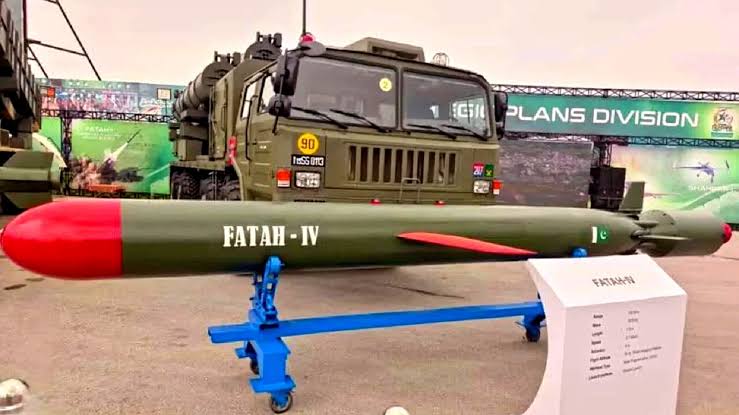
The fourth element is capability at each each rung of the structure. The Fatah series illustrates this: Fatah-1 and Fatah-2 established the initial guided-rocket capability at shorter range, Fatah-4 extended that reach to a demonstrated 750 kilometres as a ground-launched cruise missile, and Fatah-3, disclosed in May 2026, added a ramjet-powered profile capable of sustained speeds between Mach 2.2 and 3.5. This series gives QPQ+ a stand-off precision-strike option that earlier Paksitan lacked. J-10C deliveries, carrying the PL-15 long-range air-to-air missile, were substantially complete by early 2026. A maritime dimension followed with the commissioning of the first Hangor-class submarine in April 2026. Its significance lies in the addition of survivable, sea-based strike geography, which forces India’s anti-submarine planners to account for a far wider stretch of ocean. At the strategic level, Shaheen, Ababeel, and Nasr remain the declared backbone of CMD, spanning medium- and long-range ballistic strike, multiple-warhead capability, and low yield, short-range use respectively. Together, they give CMD the range and flexibility to cover every level of the spectrum, from battle use to the strategic level.
The fifth element is sufficiency rather than parity, consistent with the principle that has guided Pakistan’s deterrent since 1998. The near eighteen percent rise in Pakistan’s defence allocation this year, bringing the total to approximately Rs 3 trillion, reflects the cost of sustaining a mission that now spans sub-conventional, conventional, strategic, and maritime domains at once, not an attempt to match India system for system. Cohesive Deterrence rests on the same distinction: an integrated response achieved without an arms race is a self-imposed constraint on Pakistan’s programme.
The war of May 2025 remains the clearest demonstration of why this architecture matters. Over four days, India struck with artillery, loitering munitions, stand-off weapons, and cruise missiles used against Pakistan for the first time, hitting key military installations across Pakistani territory. Pakistan’s response followed within hours, extending across dozens of locations and combining drones, missiles, and air defence in a tempo that left India little opportunity to calibrate a controlled escalation. This is the outcome an integrated response system is designed to produce: an adversary unable to identify a limited, safely calibrated option on the escalation ladder. As India moves further toward offensive integration, adding new defence systems and consolidating its theatre commands, Pakistan needs to keep moving in the same direction, building on the resolve that has anchored its deterrence posture since 1998. The institutional, conventional, and strategic components of Cohesive Deterrence are already in place, and what remains is their continued consolidation. At the same time, a more stable region will require both states to invest in bilateral confidence-building measures and reliable communication mechanisms, so that neither side miscalculates the other’s intentions in a future crisis.
This article was published by Global Defense Insight in another form at https://defensetalks.com/pakistans-cohesive-deterrence-and-the-architecture-of-south-asian-stability/

Syed Ali Abbas is Research Officer & Comm Officer at the Center for International Strategic Studies (CISS) Islamabad. He is also an MPhil scholar in the Department of Strategic Studies at the National Defense University (NDU) Islamabad.