
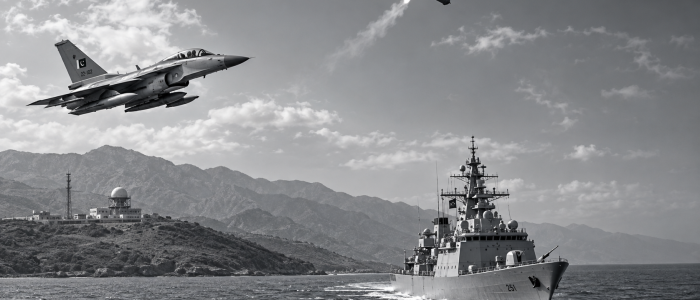
In evolving warfare, quantitative numbers do not provide an effective measurement of a country’s capabilities. The real metric is how well these capacities are linked and aligned across domains. India is slowly adapting to this reality, as its recent developments in defence are more focused on network-centric operations, such as surveillance, air defence, unmanned systems, electronic warfare and command-and-control architecture. Advanced platforms are essential, but they do not automatically translate into effective warfighting capabilities. They are effective only when they can operate interoperably, provide real-time situational awareness, and enable secure communication and coordinated action across domains.
Recent developments in India’s defence capabilities capture this shift. Defence Research and Development Organisation (DRDO) has started the project Quick Reaction Surface-to-Air Missile (QRSAM) for enhancement of range and ceiling of its QRSAM system, which is part of the attempts to boost layered air defence. For mobile anti-drone systems, India has ordered them for border security, mobile VVIP security and mobile urban policing. These systems are intended to identify, track, detect, and respond to any unauthorised drone, and are intended to be part of a larger ‘Sensor-to-Response’ system. These developments, combined, could be regarded as steps towards a more connected defence environment, but the extent to which they can be integrated into surveillance, communications and command-and-control networks will be key to their effectiveness.
This represents a move towards greater strategic depth rather than defence alone. However, these capabilities remain part of an evolving, broader warfighting model. They will require secure communications and effective command and control links to operate at their full potential; they will require reliable surveillance.
India’s attempt to modernise its existing platforms is another example of this. The Super Sukhoi programme is an attempt to modernise the Su-30MKI fleet with the latest avionics and radar. The significance of that modernisation in the operation of the aircraft, however, goes beyond the aircraft itself. It is now becoming more effective as a component of Intelligence Surveillance and Reconnaissance (ISR), secure data links, air-defence networks and precision-guided weaponry, thereby emphasising the multi-networked over platform-based approach to warfare.
Operation Sindoor has also helped to put issues like operational learning, jointness and military adaptation on the agenda for discussion in India. The experience shows ongoing work to improve the coordination of service and operational areas. But no one operation should be viewed as proof that India has a fully integrated warfighting system. Instead, it is part of a continuous transition in technology, organisation and doctrine to networked operations.
This is a structural issue facing India: how to integrate cutting-edge technology with an operational system that has to be reliable and resilient in the event of war. The integration will need to be meaningful and will not only require investment in technology but effective training and coordination between the services and the development of appropriate command structures and digital and communications networks that will be resilient. Even very sophisticated systems may not operate as intended if exposed to cyber disruption, electronic interference or degraded communications, especially when relying on interconnected sensors and communication networks for operation. These are, therefore, key issues that India must tackle as it transitions to a more integrated and networked War-Fighting Model.
Pakistan’s strategic concern should be India’s broader military modernisation rather than individual platforms. This is because India’s modernisation is gradually moving towards a more interconnected operational environment. For Pakistan, the challenge is not to replicate India’s platform acquisitions, but to maintain operational connectivity and ensure resilient decision-making. A platform-centric response could therefore prove costly and strategically counterproductive. Instead, Pakistan should prioritise capabilities that enhance its ability to detect, assess, communicate and respond effectively in an increasingly complex and evolving battlespace.
ISR should be the top priority of Pakistan. Deterrence, stability and crisis management in a South Asian Contingency with short warning time and high tempo of operations is at the core of the real-time Generation and Fusion of Situational Awareness (RSA).
Secondly, a reinforcement of Pakistan’s counter-drone capacities is needed. Unmanned systems are becoming more and more a part of the regional security landscape in the form of surveillance, target indicators, and/or potential disruption weapons. There is hence a need for Pakistan to develop a multi-layered counter-drone strategy, which involves detection, tracking, identification, electronic deception and, as needed, kinetic counter-drone measures, specifically in the vicinity of the border areas and sensitive urban nodes. These capabilities need to be combined with ISR and command & control networks to enable rapid detection, assessment and response to a potential drone threat. The counter-drone capability should not be a standalone system, but rather part of a larger sensor-to-decision-to-response architecture.
Thirdly, Pakistan needs to further pursue the electronic warfare (EW) path. The growing reliance of military systems on communications, navigation and interweaving sensor networks makes EW a potentially impactful capability that can interfere with or limit an opponent’s ability to communicate, navigate and be situationally aware. In parallel, Pakistan should boost defensive EW and electronic resilience to ensure the capability of its communication, sensors and command network to operate during interference and disruption. The goal should, then, be to create the capacity to perform and to operate in an active EW environment, but also to ensure reliable connectivity and decision making in an environment where electronic systems are stressed.
Fourth, Pakistan needs to develop command and control (C2) systems that are resilient and can function in a cyber stressed and electronically disturbed and communication-degraded environment. Fast-moving crises dictate that stability of decision-making structures is as critical as platforms’ speed.
These developments could have second-order effects on crisis stability in South Asia. For Pakistan, India’s growing sophistication and integration of conventional military capabilities may create new security challenges by reducing decision-making time, increasing the risk of miscalculation, and potentially undermining strategic stability during a crisis. The more that such systems are networked, the less time that is available for decision-making, and the more reliance is placed on automated or semi-automated functions and processes, the greater the risk of mistakes in interpretation. Even if not the intention, false positives in the sensor data or the misattribution of activity or disruption of electronic communication can create escalation pressure. Pakistan’s counter should thus aim at making operations resilient and ensuring credible deterrence without taking steps that would unwarrantedly increase the instability of the crisis. Modernisation of the Indian military should thus be seen as a gradual and dynamic process that is laying the groundwork for more networked warfighting, and not as a fully-fledged system in its own right. Platform-for-platform parity is not the right answer for Pakistan – it is to build the military architecture of Pakistan to be more connected, resilient and responsive. This means more integration of ISR, counter-drone, EW, and resilient command and control and maintaining crisis stability as the top priority in defence planning. There should be no attempt to match the numbers with India; the goal should be to have the capability to effectively deter and make decisions in an increasingly networked and contested battlespace.
This article was published by the Centre for Strategic and Contemporary Research (CSCR) in another form at https://cscr.pk/explore/themes/defense-security/reassessing-indias-modernisation-in-an-era-of-networked-warfighting/

Shahwana Binte Sohail is is Research Assistant at the Centre for International Strategic Studies Islamabad.