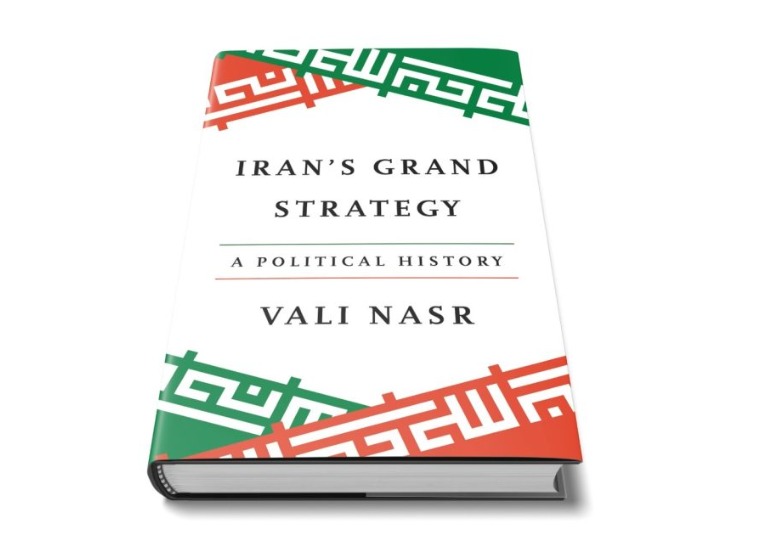
Iran’s Grand Strategy: A Political History
Vali Nasr, Princeton University Press, 2024-384 pp.
Iran’s Grand Strategy written by Professor Vali Nasr advances an important argument that Iranian foreign policy behaviour is driven by strategic calculation rooted in historical experience rather than by the ideological imperatives of the 1979 Islamic Revolution. He challenges the dominant Western analytical framework, which has consistently attributed Iranian decision-making to theological motivation and revolutionary ideology. Nasr contends that this framework has not merely been inadequate, it has actively produced misreadings of Iranian intent that have shaped policy outcomes across multiple US administrations. The book is an attempt to replace that framework with one grounded in observable behaviour, historical record, and strategic logic. The 2026 Iran-US/Israel war, still unfolding as this review is written, provides an important test of Nasr’s analytical framework.
Nasr is well positioned to make this argument. A former dean of the Johns Hopkins School of Advanced International Studies and a senior State Department advisor during the Obama administration, he brings to the subject both scholarly rigour and direct engagement with the policy processes the book examines. The text is extensively sourced, draws on Persian-language material, and situates Iranian behaviour within regional dynamics rather than treating Iran as a self-contained ideological project. This approach distinguishes this book, from a considerable body of Western literature on the subject.
The book’s most significant analytical contribution is its treatment of the Iran-Iraq War as the constitutive event of Iranian grand strategy. Nasr argues that the Islamic Republic as a functioning state is less the product of the 1979 Revolution than of the eight years of conflict that followed it. The war’s lessons were unambiguous for Iran as it stood in isolation. Meanwhile, Western powers and their allies backed Iraq. Chemical weapons were deployed against Iranian forces on a big scale, 54,000 chemical artillery shells, 27,000 short-range chemical rockets, 19,500 aerial gas bombs, that drew sustained international condemnation albeit selectively and belatedly. Iran concluded, with subsequent documentary confirmation, that the United States had directly assisted in developing Iraq’s chemical weapons capability. From this experience emerged the foundational conviction that shaped Iranian approach. It learned that Iran could not rely on the international order for its security, it had to build security through self-reliance and resistance to serve its interests. This is the base of what Nasr calls Iran’s grand strategy; a persuasive foundation derived from historical experiences.
The concept of resistance that emerged from the war is central to the book’s argument. Khamenei’s own formulation, that national security is ensured by resistance alone, is presented not as religious doctrine but as a security principle derived from direct wartime experience. This distinction reframes Iranian regional policy, including the development of allied militia networks and the forward defence strategy, as outputs of coherent strategic logic rather than expressions of ideological expansionism. The IRGC’s regional posture, articulated by General Rahim-Safavi as requiring a defensive perimeter extending to the Mediterranean and the Red Sea, and the Iranian intervention in Syria, framed by General Hamedani as a response to what Tehran read as an American project to fragment the region before turning on Iran, are presented through the words of the actors themselves. When Iran closed the Strait of Hormuz in the opening days of the 2026 conflict, Western commentary reached predictably for the language of desperation and recklessness. Nasr’s historical record suggests a more accurate reading. As early as 1983, Iran established the operational precedent that if it could not export oil, neither could its neighbours, retaliating against Iraqi naval pressure by attacking all tanker traffic in the Gulf. The Hormuz closure in 2026 was the activation of a documented, long-theorised strategic lever.
Nasr’s consideration of Khamenei’s structural distrust of American diplomatic engagement is analytically important and carries direct relevance to the events that preceded and followed the February 2026 strikes. He documents that this distrust is not theologically derived but politically formed, shaped by the perceived American role in the 1953 coup and reinforced by a sequence of specific interactions across multiple administrations. The 2003 Khatami diplomatic initiative, in which a comprehensive offer of negotiations was relayed to Washington through the Swiss embassy within weeks of American entry into Baghdad, was received and ignored by the Bush administration. Khamenei had advised Khatami against making the offer, predicting that Washington would read it as weakness. When that assessment proved correct, it reinforced a conviction institutionalised across the Iranian establishment: that American diplomatic engagement with Iran is consistently expedient rather than sincere.
In February 2026 the pattern was repeated. Iranian Foreign Minister Araghchi stated publicly on 25 February that a historic agreement was within reach ahead of renewed Geneva talks. US-Israeli strikes began a day later regardless, with the Omani Foreign Minister on record confirming that Iranian acceptance had been communicated through the backchannel. For the Iranian leadership, it was confirmation of an argument Khamenei had held and repeatedly argued for decades. That accumulated institutional validation of distrust explains Iran’s negotiating behaviour throughout the conflict: its rejection of a temporary ceasefire, its counter-demand for a permanent end to the war, sanctions relief, recognition of its right to enrich uranium etc. Iran does not accept partial arrangements that leave the structural pressure intact. Nasr’s book explains why that position is not intransigence. It is institutional memory, and the 2026 war has only deepened it.
The chapters on forward defence and the Axis of Resistance are among the book’s strongest and carry predictive weight that the 2026 conflict has validated. Nasr argues explicitly that Israel’s success in decimating Hamas and Hezbollah would not unravel Iran’s forward defence strategy but would instead lead Iran to seek enhanced military capabilities including missiles to better protect it. Following the ceasefire, the Iranian also made the inclusion of Lebanon, and by extension Hezbollah, a non-negotiable condition of any ceasefire arrangement. Nasr’s analytical logic runs directly through both decisions. Hezbollah is the centrepiece of Iran’s deterrence architecture, not a dispensable proxy. And the nuclear signal following the ceasefire is precisely the response Nasr predicts: military damage to the Axis of Resistance accelerates rather than reverses the Iranian nuclear incentive. The war, in Iranian strategic logic, has made the deterrent more necessary, not less.
The book’s primary limitation is one of perspective rather than analysis. Nasr is a Western-trained academic who has operated within American policy institutions. That background occasionally surfaces in how responsibility is distributed across the US-Iran relationship. The book documents American betrayals of Iranian diplomatic overtures with admirable honesty, the 2003 Khatami letter, the repeated pattern of engagement followed by pressure. But it does not pursue that pattern to its logical conclusion with the same force it applies to Iranian behaviour. Iran has initiated diplomacy repeatedly across different administrations and across different political configurations within its own system. Each time, the American response has either ignored the overture, reframed it as weakness, or used the diplomatic opening to extract concessions before abandoning the process. This is the consistent US behaviour that closed the door. What the 2026 conflict has also demonstrated is that Iran, whatever damage it absorbed, retains the institutional capacity to adapt. It fought, negotiated, and framed the outcome on its own terms. The experience of this war, the vulnerabilities it exposed, the leverage points it confirmed, the doctrinal adjustments it will inevitably produce, will layer onto the strategic culture Nasr so carefully documents. In that sense, Iran’s Grand Strategy is best understood as an essential foundation which gives the reader the historical logic, the institutional memory, and the doctrinal continuity from which Iranian decision-making flows. Understanding what Iran does next will require building on that foundation with the lessons this war has now added to it. For that purpose, this book remains the most appropriate starting point.
This book review was published in another form at https://new.ipi.org.pk/wp/2026/05/28/irans-grand-strategy-a-political-history/?amp=1

Syed Ali Abbas is Research Officer & Comm Officer at the Center for International Strategic Studies (CISS) Islamabad. He is also an MPhil scholar in the Department of Strategic Studies at the National Defense University (NDU) Islamabad.