
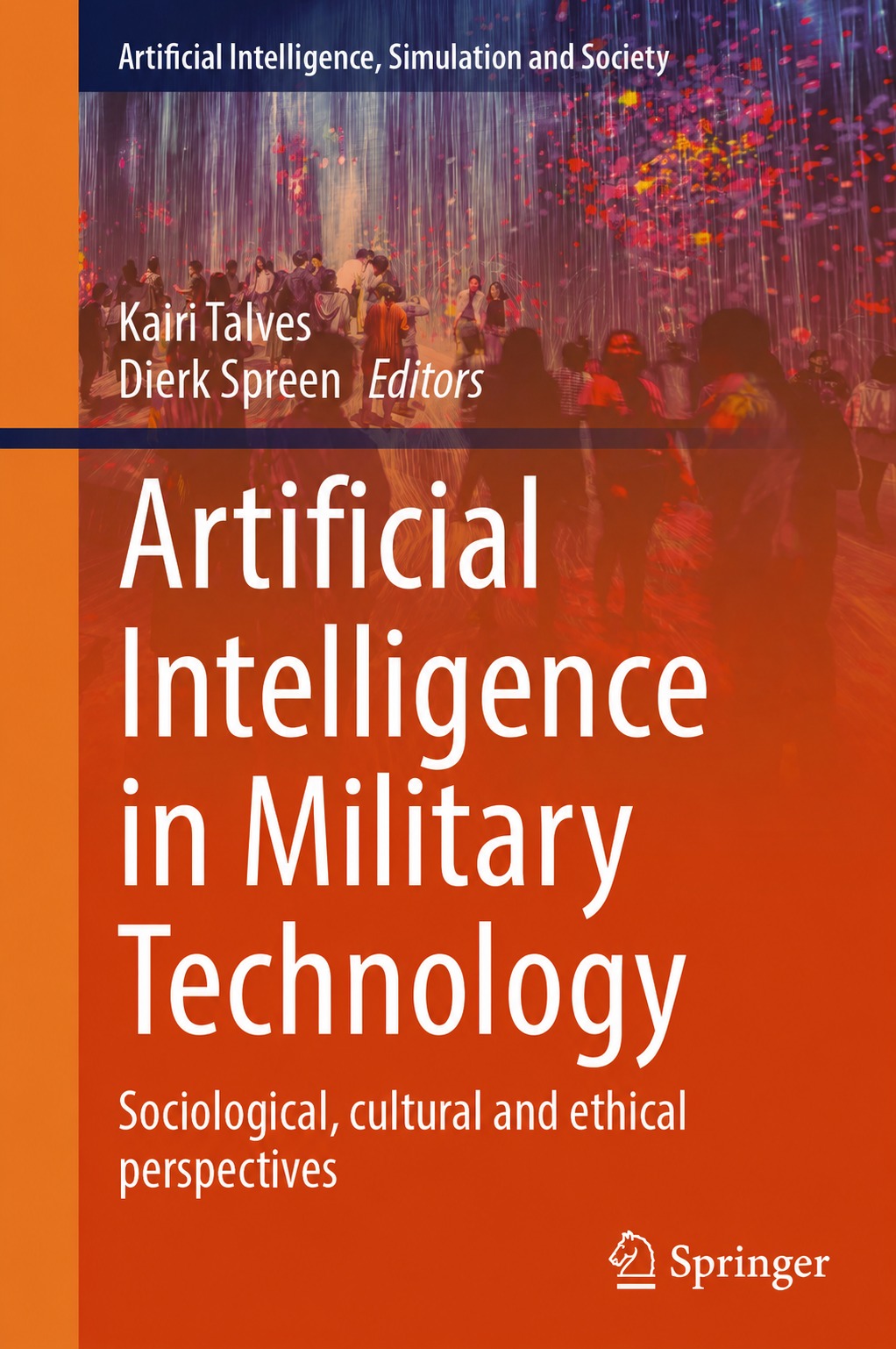
The book Artificial Intelligence in Military Technology: Sociological, Cultural and Ethical Perspectives, edited by Kairi Talves and Dierk Spreen, is an interdisciplinary volume on military Artificial Intelligence (AI). The book discusses AI from a sociological, ethical, legal, and organisational point of view. The volume contains contributions for scholars and practitioners of various fields with a background in military studies, sociology, law, communication, psychology, and human-computer interaction. The editors state that technology cannot be the only lens through which we have to view military AI. They stress that it needs to be understood in a wider social, ethical, legal and institutional framework, as these factors would affect both the evolution and use of AI in military operations.
The main thesis of the book is that AI is becoming an ever-growing part of the modern military, but it should be considered as a means of achieving defence capability under the effective and responsible control of humans with legal accountability. The editors adopt a balanced perspective on AI, viewing it as neither a panacea nor a threat. They reject both technological determinism and call for an absolute prohibition on military AI. Instead, they advocate the responsible governance of military AI through robust institutions, ethical guidelines, and adherence to international law. This balanced view sets the volume apart from many current debates that tend to be split between techno-optimism and techno-alarmism.
The book is divided into three interrelated sections. Each section contributes to developing the book’s central argument. The first part, Understanding AI, looks at the social and cultural aspects of Military AI. It discusses public perception, science fiction, ethical issues and technological acceptance. The contributors dispel some of the widely held myths about autonomous systems. They believe military uses of AI are as much about culture as anything, and attitudes to the technology are just as much cultural narratives.
Ethical enhancement, cyborg soldiers, AI and regulation, as well as public acceptance of AI in the Estonian Armed Forces, are also discussed in the first section. This combines conceptual with empirical evidence. The contributors demonstrate that technological innovation cannot be achieved without more than technical ability. The organisationalislture, public trust and political context are also very much part of the equation when it comes to the adoption of military AI.
The second part of the book looks at the strategic consequences of AI in war. It contends that, besides technological superiority, the effective integration of AI into doctrines, leadership and organisation is also essential for military success. The second part of the book looks at the strategic consequences of AI in war. It challenges the notion of technological determinism, the idea that technology alone drives military success and societal change. Instead, the contributors argue that technological superiority must be complemented by effective doctrine, leadership, and organisational integration. The contributors emphasise that, despite advances in AI, human judgment, responsibility, and accountability remain central to military decision-making. A key contribution of this section is its emphasis on responsible AI and meaningful human control.
The contributors argue that AI systems need to be kept in well-defined command structures. It is always the responsibility of human decision-makers, and they should be held accountable. One of the strongest arguments of the book is the difference between the computational power and moral responsibility of machines. The editors don’t claim that AI is replacing traditional military leadership, but rather that it is a decision support technology. They also look at autonomous weapons systems in the context of international humanitarian law. Technological developments do not make the principles of distinction, proportionality, necessity and accountability inapplicable, as argued by the authors, especially through a legal perspective. AI takes away no legal liability; instead, the authors argue that AI reinforces the importance of substantive human control in military activities.
The third section of the book, Challenges for Communication, delves into the significance of communication and trust in military AI. It is not a good idea to trust AI and not have any limits on its applications. Rather, it should be guided by transparency, explainability and the design of the system with the human user in mind. It’s not just about technical reliability. It also considers organisational communication, public communication, and cognitive warfare. The most significant contributions of the book relate to the importance of communication as part of responsible governance of AI. The contributors consider the conditions of institutional trust, effective communication, and public legitimacy crucial for the success of military AI.
An important contribution of the book is the balanced coverage of autonomous weapons by the editors. There are currently two sides to the discussion. One calls for the complete prohibition of autonomous weapons systems, while the other supports the continued development of military AI with minimal regulatory restrictions. The editors eschew both extremes. Rather, they call for responsible development, founded and based on ethics, law, real human control and institutional responsibility. This combination of perspectives benefits the volume, particularly for those who wish to include policymakers and policy guidance.
The volume is also commendable for dispelling the myths associated with AI. The contributors stress the point that present AI is not conscious, not intentional, doesn’t have emotions, and doesn’t have ethical sensibilities. By doing so, they separate the facts from popular myths about AI. This makes the book all the more valuable for policymakers and non-specialist readers who might be swayed by the media’s sensational stories. The discussion is particularly timely as there are often high expectations and fears that drive public and policy discourse on military AI.
The book has some limitations, including the lack of significant coverage of recent examples of real-world operation. Readers might hope to see more detail in the analysis of current wars in light of the fast-changing character of AI-supported warfare. Examples of this kind could have made the theory in the book more relevant.
Another limitation of the volume is related to geographical diversity and the background of the authors. The contributors acknowledged the debates on the international level, but the volume largely focuses on the European and NATO perspective of military AI. It would have been more comparative, as it would have made use of the views of others, especially from the Global South. The geographical representation of the emerging technologies could have been broader, thus enhancing the analytical scope of the book given the global nature of emerging technologies.
Additionally, like other edited volumes, there are repeated themes throughout the chapters. There is reference to ethical responsibility, meaningful human control, trust and accountability throughout the book. The editors have a main argument that is supported by these themes. But the discussion of these again is sometimes a hindrance to the analytical flow of the volume. Also, there is some unevenness across the chapters because of the differences in the writing style and level of analysis. But these are not flaws which mar the scholarly value of the book. The volume is a valuable addition to the literature on military AI. It highlights the need to go beyond the capabilities of military AI technologies to debate them. It should also have covered issues of governance, ethics, legal responsibility, organisational dynamics, as well as acceptance by society. One of the assets of this book is its interdisciplinary perspective. It indicates that the future of military AI is not just about tech and algorithms but also involves institutions, laws, ethics, and the individuals who will employ these technologies.
This book review was published by Islamabad Policy Institute in another form at https://ipi.org.pk/artificial-intelligence-in-military-technology-sociological-cultural-and-ethical-perspectives/

Shahwana Binte Sohail is is Research Assistant at the Centre for International Strategic Studies Islamabad.