Press Release
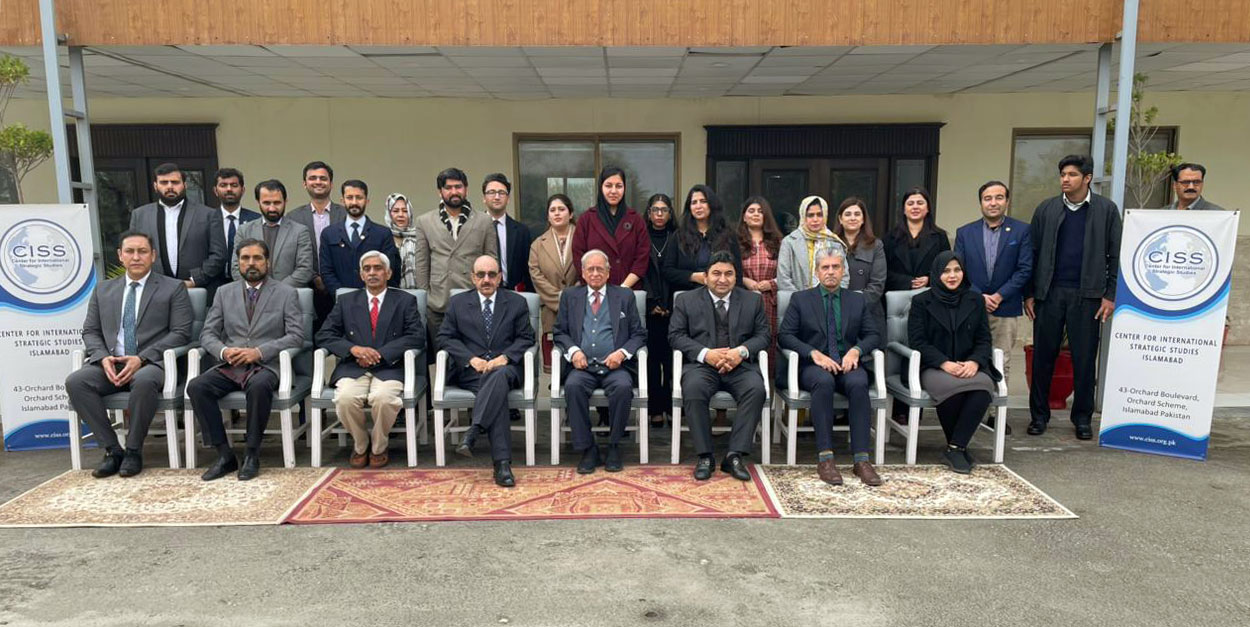
The Center for International Strategic Studies (CISS), Islamabad, organized a roundtable discussion on the National Security Strategy – 2025 of the United States of America, on Friday, 23 January 2026. The session brought together leading experts, including Ambassador (Retd) Masood Khan, Former Ambassador of Pakistan to the United States, Dr Nouman Sattar, Professor and former Acting Director of Area Study Center, Quaid-i-Azam University, Islamabad, and Dr Qamar Cheema, Executive Director of Sanober Institute, to assess the strategy’s key priorities and implications.
The roundtable focused on three key themes: the theoretical underpinnings of President Trump’s foreign policy and its orientation; the evolving geopolitical environment and the legacy of the “Peace President,” and the trajectory of Pakistan-US relations in the wake of the 2025 National Security Strategy. The discussions aimed to facilitate a deeper understanding of the Strategy as articulated and to assess its implications through a focused and informed dialogue.
In his welcome remarks, Ambassador Ali Sarwar Naqvi stated that, for Pakistan, the NSS 2025 has been issued against the backdrop of an already complex strategic environment marked by intensifying US-China competition, the militarization of the Asia-Pacific, and evolving alliance structures, which have direct implications for South Asian strategic stability, deterrence dynamics, and Pakistan’s foreign policy options. The emphasis on technological dominance, economic statecraft, and security partnerships further underscores the need for nuanced policy responses from middle powers including Pakistan to navigate an increasingly fragmented international order.
Deliberating on Pakistan-US relations within the framework of the US National Security Strategy 2025, Ambassador Masood Khan highlighted how US strategic priorities influence regional alignments. He noted that China does not view Pakistan as a strategic concern, reflecting the continuity of its all-weather partnership with Pakistan
Dr Nouman Sattar assessed the theoretical underpinnings of Trump’s foreign policy and stated that the US NSS 2025 reflects Trump’s worldview. One that seeks to roll back multilateralism and constrain the drift toward multipolarity in order to reassert US preeminence, which he believes eroded during the Biden years and under the post-Cold War period. He further stated that the strategy is rooted in a realist logic. The NSS 2025 does not just signal intent, it codifies objectives, prioritises national interest, and frames policy as competitive statecraft rather than values-led internationalism.
Dr Qamar Cheema analyzed the emerging geopolitical environment and noted that the US is in the process of reassessing its relations with India. The view in Washington is that India has not delivered enough over 20 years. Still, bipartisan support remains strong, so even a pause keeps India inside the US strategic calculations. India may feel sidelined in the near term, but its intrinsic utility for the United States remains significant. Even if Washington tactically downgrades aspects of the partnership or give greater emphasis on the Western Hemisphere, India and China will remain vital to US strategy.
While giving an overview of the NSS 2025, Mr Muhammad Ali Baig, Research Officer at CISS, underscored that the recent strategy starkly prioritizes regional areas. It reasserts a “Trump Corollary” to the Monroe Doctrine, demanding exclusive US primacy in the Western Hemisphere to exclude adversarial influence, protection of critical supply chains and the security of strategic assets. In his concluding remarks, Dr Bilal Zubair, Director Research at CISS, noted that President Trump is likely to seek the preservation of American preponderance in one form or another, as a significant strategic pullback appears unlikely. He highlighted that Trump’s approach to foreign policy is largely transactional, shaped by a business-oriented mindset, and prioritizes measurable returns.
Media Coverage
The News
https://www.thenews.pk/print/1395402-pakistan-needs-adaptive-policies-to-safeguard-its-interests
DAWN
https://www.dawn.com/news/1969215/round-table-seeks-calibrated-flexible-foreign-policy