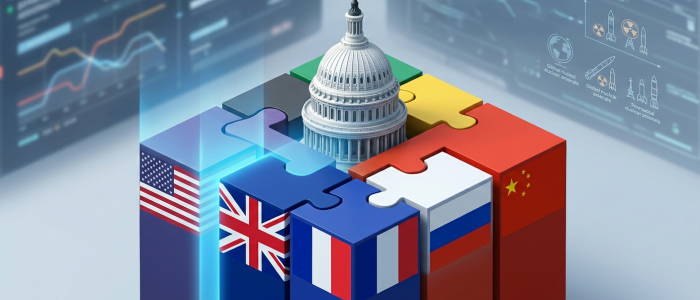
With the expiry of New START on February 5, 2026, the world has entered a new era in nuclear arms control, reflecting the evolving realities of the contemporary nuclear order. The United States believes that nuclear limits on warheads and launchers under the New START did not serve the broader purpose of the arms control framework, highlighting Washington’s lack of appetite for a renewed bilateral arrangement. Dr. Christopher Yeaw, the US Assistant Secretary of State for the Bureau of Arms Control and Non-Prolferation, shared the US perspective at the Conference on Disarmament (CD), shifting from exclusive US-Russia strategic constraints toward a more inclusive yet complex multilateral framework that could shape the future of global nuclear stability. This transition shows a broader shift in arms control policy of the United States, emphasizing the need for a new arms control arrangement that shows a transition from a bilateral framework to a multilateral forum, holding all five nuclear-weapon states under the Treaty on the Non-Proliferation of Nuclear Weapons (P-5) equally responsible for making serious efforts toward nuclear disarmament.
While addressing CD, the US Under Secretary for Arms Control and International Security used the shortcomings of the New START to advance a broader strategic argument rather than merely listing Russian violations. By emphasizing on Russia’s sizeable stockpile of non-strategic (theatre) nuclear weapons that are estimated to be around 2000 warheads and the production of novel systems like nuclear-armed Skyfall cruise missile and the nuclear powered Poseidon torpedo, Washington sought to highlight that New START has narrowly focused on deployed strategic warheads and altogether neglected the full spectrum of contemporary nuclear risks.
He further linked these loopholes with China’s emergence as a major nuclear actor, arguing that the New START bilateral structure left a structural gap by excluding Beijing at a time of unprecedented expansion in its nuclear arsenal. While projecting on China’s official defense white papers, he cautioned that Beijing could attain strategic parity in the next four to five years and may possess fissile material sufficient for more than 1000 warheads by 2030, which was roughly 200 at the time the treaty was signed in 2010. Additionally, he also highlighted concerns regarding Russian cooperation on China’s CFR-600 reactors, framing this collaboration as further complicating the US threat perceptions. Through these arguments, Washington justifies a shift from a bilateral arms control framework with Russia toward a multilateral platform that includes additional nuclear stakeholders, reflecting a recalibration of the US arms control policy in the contemporary multipolar nuclear landscape.
The United States believes that New START’s expiry arrived at the fortuitous time, urging all states, not just the nuclear weapon states, to strive for a better arms control framework. Under the new proposal, Washington aspires transition from a bilateral arms control agreement with Russia to a multilateral platform as a necessary next step in further discussions on arms control. Such a multilateral format can prevent an unmitigated nuclear arms race, restrain the build-up of nuclear arms and address issues surrounding non-NPT states with nuclear weapons. From a multilateral format, the Trump administration means all options are on the table while discussing the future of nuclear arms control in the current security environment. Washington wants to conduct negotiations on strategic stability and arms control in multiple avenues, including the P5 forum where NPT-recognised nuclear weapon states already meet to discuss issues of strategic importance. The Trump administration maintains that all five nuclear weapon states(P5) are under an obligation to negotiate on nuclear disarmament in good faith as per Article 6 of the Nuclear Non-Proliferation Treaty (NPT), and efforts for disarmament are not just related to those states that have the largest arsenals. Under this new proposal, the United States wants nuclear weapon states like Russia and China to participate in a multilateral process for effective debate on the elements of arms control arrangements.
In evolving multipolar nuclear order, bringing together all five nuclear weapon states to the NPT – Russia, China, France, United Kingdom and the United States- admits that today’s Strategic Stability extends beyond Russia-US dynamics. This forum could prove effective in preserving normative commitments under the Nuclear Non-Proliferation Treaty. However, asymmetries in nuclear capabilities and divergent threat perceptions limit the viability of such a multilateral forum. The United States and Russia still possess 80 percent of the global nuclear arsenal, while Beijing would resist numerical limits without prior reductions by the US and Russia. France would support such a multilateral dialogue with other P5 states, maintaining its independent nuclear deterrent. However, Paris would resist any binding multilateral commitments that could limit its relatively small arsenal. The United Kingdom (UK) will support the US initiative for expanding P5 engagement, However, the country would likely call for putting responsibility on the US, Russia and China, given their large scale of arsenals.
The imperative of arms control is encouraging, but given the evolving global nuclear order, where New START failed to achieve its objectives, it is difficult to see how the proposed multilateral, modernized approach might succeed in near future. In this scenario, the multilateral forum like P5 would remain a consultative platform rather than working as a substitute for enforcing arms control agreements. Conclusively, following New START’s expiry, the United States has shifted from bilateral arms control with Russia to a broader multilateral approach, urging all NPT nuclear-weapon states, through forums like the P5, to share responsibility for strategic stability, favouring flexible multilateral engagement over binding bilateral constraints in a changing security environment.
This article was published in another form at https://cscr.pk/explore/themes/defense-security/washingtons-push-for-strategic-stability-through-the-p5/

Ms Nawal Nawaz is Research Assistant at the Center for International Strategic Studies (CISS), Islamabad.