Introduction
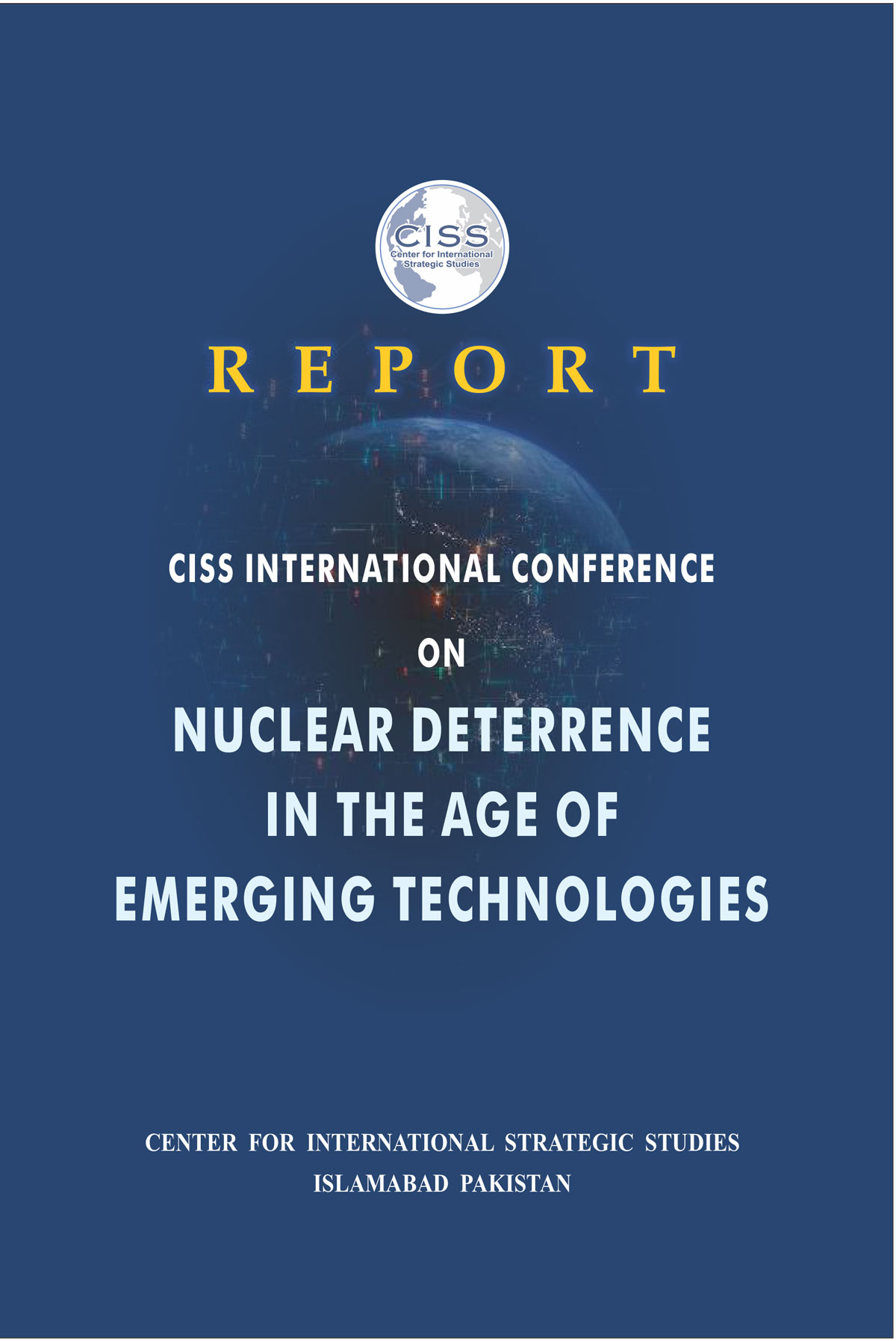
The Center for Strategic Studies (CISS), Islamabad, organized a two day International Conference, “Nuclear Deterrence in the Age of Emerging Technologies” on April 22-23, 2025, bringing together policy makers, practitioners, and eminent scholars from Pakistan and abroad. The conference highlighted Pakistan’s commitment to continued dialogue and collaboration in addressing the challenges posed by emerging technologies to international security and regional stability.
The event brought together esteemed speakers from Australia, Canada, China, Russia, Switzerland, Italy, Spain, Austria, Nigeria, the United Kingdom (UK) and the United States of America (USA) on a dialogue discussing emerging technologies. The event was also attended by scholars, notable statesmen, think tank professionals, academics, foreign policy experts, and diplomats.
The speakers for the first day included Dr Han Hua from Peking University (China), Dr Xia Liping, Center for Polar and Oceanic Studies (China), Dr Naeem Salik from Strategic Vision Institute (Islamabad), Mr Anton Khlopkov from Center for Energy and Security Studies (CENESS) (Russia), Dmitry Stefanovich from Institute of World Economy and International Relations of the Russian Academy of Sciences (IMEMO RAS), Dr Alexander Evans OBE from LSE School of Public Policy (the United Kingdom), Dr Petr Topychkanov from Lomonosov Moscow State University (Russia), Ms Alice Saltini from James Martin Center for Nonproliferation Studies and Institute for Security and Technology (Italy), Dr Jean-Marc Rickli from Geneva Center for Security Policy (Switzerland), Dr Zafar Khan from Baluchistan Think Tank Network (Quetta), Dr Robert B. Hayes from North Carolina State University, (USA) and Dr Tariq Rauf from Austria.
The speakers for the second day included Dr Laetitia Cesari from the United Nations Institute for Disarmament Research (UNIDIR) (online), Ms Almudena Azcárate Ortega from UNIDIR, Dr Christine M Leah from the National Institute for Deterrence Studies (Australia), Dr Olamide Samuel from Open Nuclear Network (Austria), Dr Jessica West from Project Ploughshare (Canada), Mr HE Miao from China Arms Control and Disarmament Association CACDA (China), Brigadier (R) Dr Zahir Kazmi, Advisor, Strategic Plans Division, Pakistan, Dr Rizwana Abbasi (Non-Resident Fellow, CISS Islamabad) based in Vienna, Austria, Prof. Dr Zafar Nawaz Jaspal from Quaid-e-Azam University (Islamabad), Prof. Dr Andrey Pavlov from Saint Petersburg State University (Russia), and Mr Vladislav Chernavskikh from Stockholm International Peace Research Institute (SIPRI).
The conference commenced with Welcome Remarks by Ambassador Ali Sarwar Naqvi, Executive Director of CISS, highlighting the impact of the unregulated development of emerging technologies (ETs) on the nuclear security architecture and crisis stability in South Asia. General Sahir Shamshad Mirza, NI (M), Chairman Joint Chiefs of Staff Committee (CJCSC), delivered the Keynote Address, contextualizing the global transformation toward a “fluid multipolarity” recognizing power contestation, technological innovation and the erosion of traditional deterrence architecture as driving forces behind the fluid multipolarity. He reinforced Pakistan’s commitment to Full-spectrum Deterrence (FSD) within Credible Minimum Deterrence (CMD), showcasing Pakistan’s responsible nuclear stewardship and its advocacy for a Strategic Restraint Regime in South Asia.
Air Commodore (R) Khalid Banuri moderated Session I, “Emerging Technologies and the Concept of Deterrence in the Contemporary World Order,” to explore the evolving dimensions of deterrence in the face of emerging and disruptive technologies (EDTs). Dr. Han Hua discussed trilateral nuclear dynamics among China, Russia and the US in her discussion on “Nuclear Deterrence, Emerging Technologies and Great Power Competition.” Dr. Xia Liping presented an analysis on Reshaping Strategic stability by Emerging and Disruptive Technologies, highlighting the impact of hypersonic weapons, AI and cyber warfare on conflict paradigms. He advocated global AI arms control and a No-First-Use pledge to maintain deterrence equilibrium. Dr Naeem Salik examined the influence of “Emerging and disruptive technologies on Nuclear deterrence,” explaining the risks of inadvertent escalation and miscalculation on the conventional-nuclear threshold due to hypersonic systems and dual-use technologies. Mr. Dmitry Stefanovich offered a perspective on “influence of Emerging Technologies on the Changing Character of War,” cautioning the world regarding erosion of the arms control regime due to space, cyber, and hypersonic capabilities. Dr. Alexander Evans provided insights into the human dimension of deterrence in his presentation on “Strategic Alliances in the Age of Emerging and Disruptive Technologies, stressing the need for maintaining transparency in managing technological surprises.”
Dr. Anum Riaz, chaired Session II, Impact of Militarization of Artificial Intelligence, discussing the impact of AI on strategic stability. Dr Petr Topychkanov cautioned about the integration of AI into the nuclear decision-making process. Ms. Alice Saltini discussed the vulnerabilities of automated nuclear command systems in her presentation on the Impact of AI on NC3. Dr. Jean- Marc Rickli stressed the moral hazards of lethal autonomous weapons in his discussion on Militarization of AI: Security, Legal and Ethical Perspectives. Dr. Zafar offered a perspective on South Asia’s Nuclear deterrence. Session II concluded by highlighting the importance of “human-in-the-loop” mechanisms for responsible use of AI in security domains.
Session III titled “Emerging Technologies and peaceful use of Nuclear Technology,” chaired by Dr Rahat, articulated the positive aspects of technology integration. Mr. Anton V. Khlopkov highlighted the role of emerging technologies in expanding the scope of peaceful nuclear application. Dr Robert B. Hayes linked technological innovation with clean energy. Dr Tariq Rauf stressed the importance of nuclear safety and security in the digital era.
A Special Session titled ‘A Conversation with General Zubair Mahmood Hayat’ was moderated by Dr Bilal Zubair, Director Research, CISS. The session featured Gen. Zubair Mahmood Hayat, Former CJCSC, who contextualized South Asia’s deterrence challenges within an increasingly volatile global environment shaped by the erosion of arms-control regimes, normalization of force, and the rise of multi-domain deterrence encompassing AI, space, and cyber domains. He cautioned that India’s unchecked military expansion and ideological trajectory risk destabilizing the region’s fragile strategic equilibrium. Session IV, on Quantum, Cyber Technologies, and Autonomous Weapon Systems, chaired by Ms. Anum A. Khan, explored the influence of quantum technologies on deterrence. Mr. Vladislav Chernavskikh, Dr. Jessica West, Dr. Laetitia Cesari, and Dr. Rizwana Abbasi unanimously agreed that quantum and cyber disruptions affect strategic opacity.
Session V, moderated by Dr. Adil Sultan, focused on the weaponization of Space and advancements in Missile Technology, discussing the militarization of outer space. Speakers, including Ms. Almudena Ortega, Ms. Anna Belolipetskaia, Dr Christine Leah, and Prof. Dr Zafar Nawaz Jaspal, characterized space as the “new battlefield”. Session highlighted the role of unchecked competition in outer space, transforming the modus operandi of warfare.
Session VI, moderated by Dr. Asma Khwaja, explored Emerging Technologies and Arms Control, examining the prospects of arms control in the era of technological disruption. Speakers, including Prof. Dr. Andrey Pavlov, Mr. He Miao, Brig. (R) Dr. Zahir Kazmi, and Dr. Olamide Samuel, unanimously advocated for a review of international law in the era of emerging and disruptive technologies.
Click here to download full report