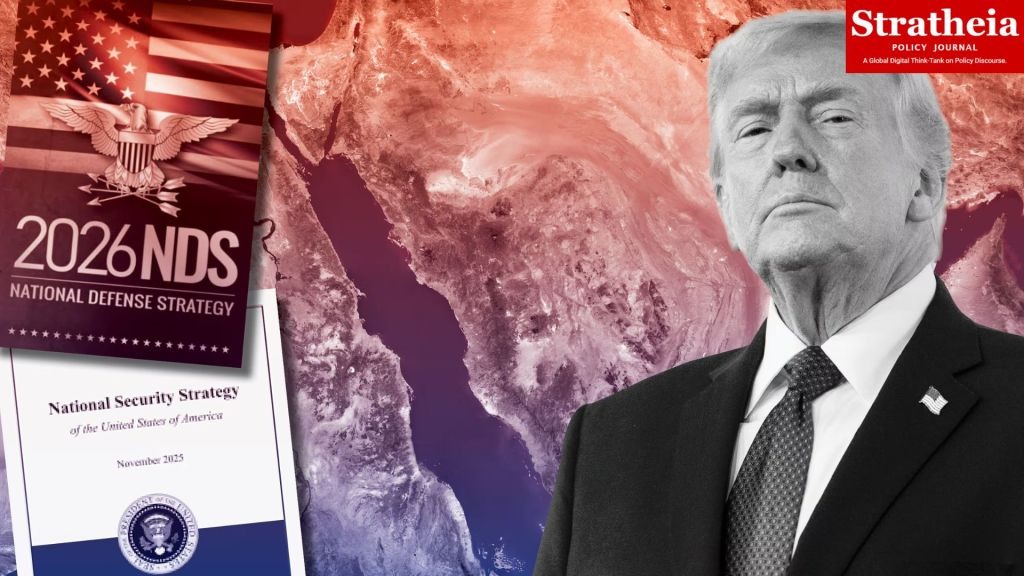
The National Security Strategy (NSS) 2025 of the United States of America signals a decisive shift towards a national interest-driven policy. In the Middle East, it favours restraint, deterrence, and shared responsibility over deep involvement. The strategy sees Middle Eastern security as a tool to protect U.S. interests, prevent regional crises, and check rivals, rather than committing to long-term involvement. In contrast, the 2026 National Defence Strategy (NDS) adopts a narrow, Iran-centric and militarised approach to Middle Eastern security. This analysis compares the 2026 NDS and 2025 NSS with the 2022 NSS of the Biden administration and the 2017 NSS of the Trump administration. The article evaluates whether the recent shift marks a transformation in US Middle East policy or maintains continuity in the strategic frameworks.
United States National Security Strategy 2025
The latest US NSS 2025, issued under President Trump’s administration, marks the Middle East as a region that no longer requires the same level of priority as before. The document explains that the two key factors of engagement for the US in the Middle East, energy dependence and superpower rivalry, have greatly decreased. Since the US is a net energy exporter and international competition is shifting to other regions, the strategy asserts that the Middle East is no longer the focus of American foreign policy. However, this realignment does not mean the US is withdrawing. The US and Israel see Iran as the region’s main source of instability. For the US, Israel security remains non-negotiable, and the extension of the Abraham Accords is presented as a main pillar of regional stability. The 2025 NSS favours pragmatic partnerships over promotion of democracy and nation-building, especially in the Gulf. This strategy prioritises pragmatic engagement with existing regimes. The region is framed as a space for technological cooperation, economic investment, and selective security engagement instead of crisis intervention.
United States National Security Strategy 2022
The US NSS 2022, issued under the Biden administration, differd in tone while maintaining continuity in its strategic priorities. The strategy criticised the past US dependence on military intervention and regime change, acknowledging that such approaches have produced instability and diverted attention from globally important strategic concerns. The Middle East was framed as a region in which stability must be managed through partnerships, long-term resilience, and gradual reform rather than enforcement alone. In response to these strategies, the Biden administration aimed to develop a framework centred on diplomacy, de-escalation, and regional integration, whilst sustaining deterrence through collaboration and a sustainable military structure. In that strategy, protecting navigational freedom in strategic chokepoints such as the Strait of Hormuz and the Bab al Mandab remained essential. It highlighted alliance coordination, integrated air and maritime defence, and diplomatic conflict management. In contrast to the 2025 NSS, the 2022 NSS places human rights, humanitarian support, and the commitment to the UN Charter at the centre of US engagement. It also insisted on a two-state solution for the Palestinian-Israeli conflict and followed a dual track strategy towards Iran. Through diplomatic engagement, it aimed to restrain nuclear proliferation, while retaining the option of military action if needed.
United States National Security Strategy 2017
The US NSS 2017, which was issued under President Trump’s administration, showed a far more threat-driven view of the Middle East. The region was represented as a centre of Iranian expansionism, jihadist terrorism, socio-economic stagnation and state collapse. Terrorist organisations such as al-Qaeda and ISIS dominated the security narrative of the region. At that moment, Iran is labelled as the world’s leading state that supports terrorism and exploits regional instability by missile development, proxies and cyber activities. The 2017 NSS rejected both disengagement and large-scale democracy promotion and emphasised a realistic approach that prioritize counter terrorism operations and power equilibrium. The argument reflects a broader change in how regional dynamics are understood, framing the Palestinian Israeli conflict as a main source of instability. It emphasises emerging alignments between Arab states and Israel in response to shared security threats, especially Iran and militant groups. Political stability and economic reform are strengthened as a primary tool to counter extremist recruitment, rather than to achieve normative goals.
US National Defence Strategy 2026
As regards the US National Defence Strategy 2026, it adopts a distinctly military-first approach to Middle Eastern security. It frames the region almost entirely through Iran as the primary threat. The strategy prioritises direct kinetic action, the degradation of Iran’s nuclear and proxy capabilities, and greater reliance on Israel and Gulf partners to carry the regional defence burden. Whereas the 2025 NSS integrates deterrence, diplomacy, and burden-sharing, the 2026 NDS Strategy focuses narrowly on Iran, with limited attention to regional political stabilization. While the 2022 Biden NSS focused on de-escalation and diplomacy with Iran, the 2026 NDS reflects a more force-driven and deterrence-oriented strategy. The 2026 NDS continues the 2017 Trump NSS threat assessment but applies it more aggressively. Overall, the 2026 NDS aligns with earlier NSS goals on Iran but shifts toward a more militarised and alliance-driven approach.
Old Wine in a New Bottle
These strategies show a clear pattern of strategic continuity beyond rhetorical change. Across all three NSS documents, the US efforts are to prevent a hostile regional hegemon and to guarantee Israel’s security. It also prioritises freedom of navigation in strategic waterways, countering terrorism and limiting Iran’s nuclear and regional influence. These objectives remain central to the Middle East security policy across different administrations. The change lies in the preferred methods and rationale used to pursue these objectives. The 2017 strategy prioritises military dominance and the containment of threats. The 2022 approach strikes a balance between deterrence, diplomacy, and humanitarian engagement. The 2025 NSS narrows US involvement through selective engagement, strategic retrenchment and economic pragmatism. The 2026 National Defence Strategy, by contrast, concentrates on Iran, emphasising direct military operations and strengthened alliances over regional stabilization. The US policy toward Middle East security reflects continuity in substance despite shifts in form. While these strategies differ in tone and emphasis, they maintain a continuity in U.S. priorities like protection of Israel, containment and providing direct action against the Iranian regime and protecting the sea lanes for the import of oil. NSS 2025, which shows a move to reduce the Middle East’s prominence in US foreign policy, yet they avoid completely withdrawing. Instead of withdrawing, Washington manages the region through deterrence, cooperation, and selective intervention while safeguarding enduring strategic interests. This approach does not signal a strategic transformation, but rather an adjustment in emphasis, with continuity remaining the defining feature of U.S. Middle East security policy. By contrast, the 2026 National Defence Strategy adopts a more operational and military-centric approach, focusing narrowly on Iran and emphasizing direct action and alliance enablement to manage regional threats.
This article was published in another form at https://stratheia.com/from-nss-to-nds-2026-middle-eastern-security/

Shahwana Binte Sohail is is Research Assistant at the Centre for International Strategic Studies Islamabad.