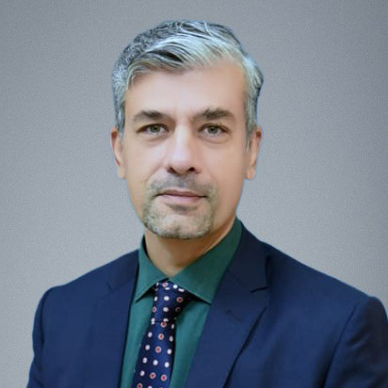
Arooj Fatima Kazmi holds an MPhil in Strategic Studies from NDU and serves as Visiting Faculty at the Department of Public Policy, NUST S3H.
Add A Comment
Get the latest creative news from FooBar about art, design and business.
Abstract
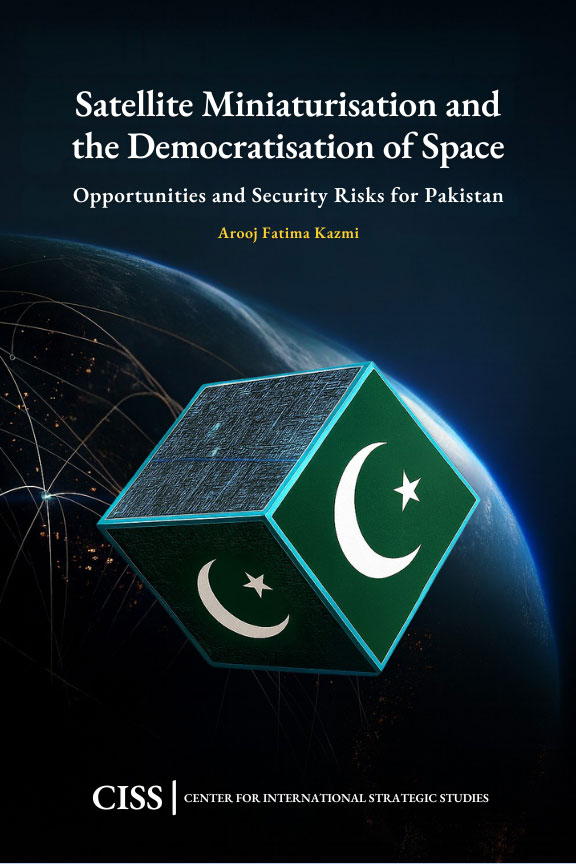
Where previously outer space was once accessible only to a handful of states, satellite miniaturisation has opened it to new actors, including developing countries, universities, and private companies. Small satellites, built on miniaturisation technology, have shorter development timelines and lower costs than traditional, large satellites. This paper examines how satellite miniaturisation intersects with the broader dynamics of NewSpace and the democratisation of space, highlighting both opportunities and risks for Pakistan. While small satellites support diverse applications in communication, Earth observation, and scientific research, they also raise challenges related to orbital debris, dual-use functions, and dependency on foreign suppliers. These trends are especially relevant to Pakistan as its space ecosystem enters a critical phase marked by clear goals set under the National Space Policy, closer cooperation with China, and research and innovation under the National Aerospace Science and Technology Park (NASTP). Through an exploratory approach, this study evaluates how small satellites can shape Pakistan’s trajectory, and proposes policy options to balance innovation, sovereignty, and security in the evolving global space environment.
Read the full report below
Arooj Fatima Kazmi holds an MPhil in Strategic Studies from NDU and serves as Visiting Faculty at the Department of Public Policy, NUST S3H.

Research Officer/ Comm Officer/ Managing Editor CISS Insight
Syed Ali Abbas is a Research Officer/Communication Officer at the Center for International Strategic Studies (CISS), Islamabad. Previously, he served as an associate editor at Indus News Network. His areas of interest include Middle East politics, military modernization, foreign policy, and nuclear politics. He has contributed to various platforms, including The National Interest, South Asian Voices, and others.

Associate Director Research
Dr. Anum Riaz is the Associate Director Research at the Center for International Strategic Studies, Islamabad. She holds a Ph.D. in Political Science from the Department of Political Science at Bahauddin Zakariya University, Multan. She also possesses M.Phil. and M.Sc. degrees from the Department of Defence and Strategic Studies at Quaid-i-Azam University, Islamabad. Additionally, she has taught BS and Master’s students at the Department of Political Science at Bahauddin Zakariya University, Multan. Her areas of interest include strategic studies, international relations, international nuclear politics, the nuclear non-proliferation regime, arms control and disarmament, as well as traditional and non-traditional security issues.
Dr. Bilal Zubair has worked as an Assistant Professor at the National Defence University Islamabad and Lecturer at the National University of Science and Technology. He holds a Ph.D. and M. Phil. in International Relations from Quaid-e-Azam University, Islamabad. Dr. Zubair is author of the book Chinese Soft Power and Public Diplomacy in the United States (Palgrave Macmillan, 2024) and contributed to several journal articles and book chapters focusing on soft power, diplomacy, and China’s role in international relations.
His research has been published in various academic journals, and he has presented at international conferences Dr. Zubair has also been an active reviewer and editorial board member. His professional interests include great power politics, and the role of communication in global diplomacy.
Mobeen Jafar Mir is a Research Officer at the Center for International Strategic Studies (CISS), Islamabad. His research focuses on U.S. foreign policy, particularly in the areas of strategy, technology, and arms control. He is currently pursuing an M.Phil. in International Relations at the School of Politics and International Relations, Quaid-i-Azam University, Islamabad. He can be found on Twitter @jafar_mobeen.