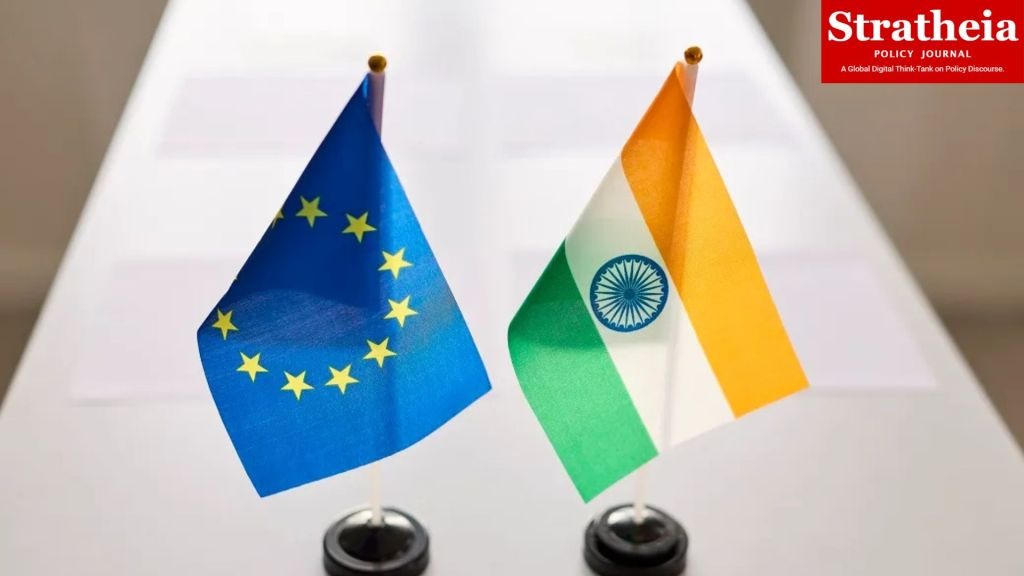
A Free Trade Agreement (FTA) between the European Union (EU) and India was concluded on January 27 this year. The agreement aims to bolster economic and political engagement between the two sides. On this occasion, European Commission President Ursulavon der Leyen stated:“The EU and India make history today, deepening the partnership between the world’s biggest democracies. We have created a free trade zone of 2 billion people, with both sides set to gain economically. We have sent a signal to the world that rules-based cooperation still delivers great outcomes. And, best of all, this is only the start – we will build on this success, and grow our relationship to be even stronger.” To facilitate trade flow, the agreement is expected to lower tariffs on a wide range of commodities, expand access to various services, and enhance regulatory cooperation between the EU and India. This trade deal demonstrates a decline in the United States (US) influence in European countries, which were once regarded as its most reliable allies and often followed similar policy patterns. Moreover, the agreement may simultaneously pose adverse economic implications for Pakistan.
The deal can be viewed as an outcome of the US’s tariff policies toward both the EU and India. According to a senior fellow for South Asia at the Atlantic Council, Michael Kugelman, “one could argue that the Trump factor provided a very strong impetus to the deal because both India and the EU are facing shock US tariffs that they never expected”. More recently, amid the United States’ stance regarding access to Greenland, Washington imposed tariffs on several allies that resisted this move. Moreover, tariffs reportedly exceeding 50% were imposed on India following the May 2025 crisis between India and Pakistan. In addition, a 25% tariff was levied in response to India’s continued purchase of crude oil from Russia.
India’s annual exports to the US are valued at approximately USD80-90 billion, whereas US exports to India amount to around USD40-50 billion. This trade balance is clearly tilted in India’s favor. Consequently, the increase in tariffs on Indian products appears to be a deliberate attempt to exert economic pressure on India. The underlying objective of this strategy was to compel India to reduce its imports of Russian hydrocarbons.
Following Russia’s invasion of Ukraine, the US and its Western allies imposed a series of sanctions, urging partners to curtail economic engagement with Moscow. Despite this pressure, India maintained its trade relations with Russia and continued purchasing Russian oil at discounted prices. As a result, the purchase of cheaper Russian oil has fueled India’s industrial sector by enabling the production of goods at lower costs.
Surprisingly, by concluding the trade deal, both the EU and India have turned the tables on US tariffs. The conclusion of multiple trade deals has the potential to surpass US intentions of pressuring countries through trade restrictions. The EU’s attempt to secure a trade deal with India has effectively undermined the US strategy of pressuring both states with high tariffs. Instead, it has created an opportunity for the EU and India to establish a strong foothold in each other’s markets, thereby sidelining the United States.
Notably, in the context of South Asia, this deal may pose certain challenges to Pakistan’s exports to the EU. Under the EU’s Generalized Scheme of Preferences (GSP), Pakistan is one of the most significant beneficiaries of trade concessions. At the same time, the EU remains Pakistan’s second-largest trading partner, accounting for 12.4% of its total trade in 2024. Moreover, Pakistan’s exports to the EU are heavily concentrated in textiles and clothing, which together account for approximately 75.8% of its total exports to the EU. Hence, the EU-India trade deal will directly affect Pakistan’s exports to EU countries.
EU textile imports from India amounted to around $9 billion, while imports from Pakistan stood at approximately $9.7 billion in 2024. As a result of the EU-India trade deal, European companies are likely to shift their focus increasingly towards India rather than Pakistan in order to benefit from reduced tariffs. Moreover, the EU and Pakistan have maintained trade linkages in the agricultural sector as well. Consequently, tariff concessions granted under the EU-India deal may erode Pakistan’s competitive edge in agricultural exports within the European market. Given the potential of the European market, Pakistan must strengthen its collaboration with existing companies in Europe and beyond to secure its presence in the market. Moreover, it needs to raise the standards and quality of its products to gain a competitive edge. Simultaneously, Islamabad should focus on maximizing production to meet the demands of European markets. Additionally, Pakistan should explore new markets for its products and invest in the production of substitute goods to diversify its export portfolio. Strategic mapping of the aforementioned opportunities can help the country reduce its reliance on traditional markets and assist in meeting global demand, eventually strengthening its position in the international trading systems.
This article was published in another form at https://stratheia.com/eu-india-trade-deal-a-politico-economic-quagmire/

Dr Rahat Iqbal is Associate Director Research at the Center for International Strategic Studies (CISS), Islamabad.